Sami Tamimi’s recipes for lamb and quince tagine with maftoul

These dishes were made to sit together. The lamb is slowly cooked with quince and saffron, bringing richness, warmth and a gentle sweetness, while the maftoul offers a lighter contrast with its lemon, currants and toasted almonds, and provides the perfect base for the fragrant meat juices. It’s a generous combination; simple enough for a family meal, but special enough to share with friends.
Lamb, quince and saffron tagine
Quince is one of those fruits that transforms completely when cooked, becoming soft, fragrant and gently sweet. Paired with tender lamb and the delicate perfume of saffron, it creates a dish that is rich without feeling heavy. The lamb is braised slowly until it almost falls apart, while the quince soaks up those savoury-sweet juices and spices. I serve this with maftoul, though couscous or rice will also work alongside. Either way, let everyone dig in and share.
Prep 15 min
Cook 2 hr 30 min+
Serves 4
4 lamb shanks (about 1.3kg)
Salt
3 tbsp sunflower oil
30g unsalted butter
1 large onion, peeled and roughly chopped (300g net)
1½ tbsp tomato puree
½ tbsp ground coriander
½ tbsp ground cumin
1 tsp ground cinnamon
½ tsp ground ginger
½ tsp ground turmeric
½ tsp ground black pepper
1 good pinch saffron
2 tbsp orange blossom water
500ml hot chicken stock
2 tsp grated lemon zest, plus 3 tbsp lemon juice
2 quince, peeled, cored and both cut into 8 chunks
5g mint leaves
Pat dry the lamb shanks with kitchen towel, then season all over with salt. Heat the oil in a large pan for which you have a lid, then sear the lamb on all sides for five minutes, until golden brown. Remove the meat from the pan.
Turn down the heat to medium, add the butter, onion and a quarter-teaspoon of salt, and cook, stirring often, for seven minutes, until golden and soft. Add the tomato puree and all the spices apart from the saffron, and cook, stirring, for a minute, until fragrant.
Meanwhile, crush the saffron in a small bowl, add the orange blossom water and steep for five minutes.
Stir in the hot stock, the saffron and its soaking liquid, the lemon zest and juice, and one and three-quarter teaspoons of salt, then return the lamb to the pan and nestle the quince pieces around it. Bring to a boil, then cover and cook on a low heat for two to two and a half hours, until the meat is almost falling off the bone. If you end up with a lot of sauce, turn up the heat to high, uncover the pan and cook for five to six minutes longer, until the sauce thickens.
Transfer the lamb and all the sauce to a deep platter, garnish with the mint and serve with the maftoul (below), rice or steamed couscous.
Maftoul with currants, lemon and almonds
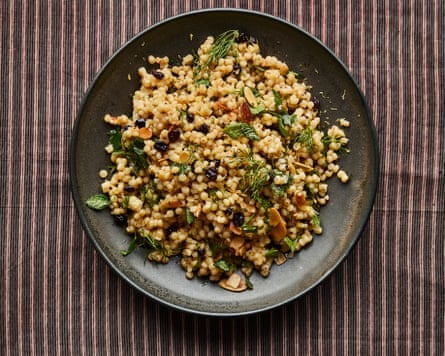
Maftoul is one of my favourite Palestinian ingredients, with its wonderfully nutty flavour and satisfying texture. Here, I’ve kept it simple, combining the grain with sweet currants, toasted almonds and plenty of lemon for freshness. The result is a dish that’s fragrant, bright and full of contrasting textures, making it a lovely accompaniment to richer dishes.
Prep 15 min
Cook 30 min
Serves 4
400g maftoul
600ml vegetable stock
Salt and black pepper
50g dried currants
2 tsp grated lemon zest, plus 3 tbsp lemon juice
3 tbsp olive oil
1 tsp cumin seeds
, toasted and slightly crushed
1 tsp coriander seeds, toasted and slightly crushed
30g flaked almonds, toasted
10g fresh coriander, roughly chopped
10g fresh mint, roughly chopped
10g fresh dill, roughly chopped
Wash and drain the maftoul, then put it in a medium saucepan with the vegetable stock and three-quarters of a teaspoon of salt. Bring to a boil, then cover, turn down the heat to low, and cook for 12 minutes, until the liquid is almost absorbed. Take off the heat, add the currants and leave to sit, covered, for 10 minutes.
Add the lemon zest and juice, olive oil and spices to the maftoul, and stir well. When ready to serve, add the almonds, herbs and a good grind of black pepper, mix again, then transfer to a serving plate or bowl and serve.
KioskNews shows a cleaned-up reading view extracted from the publisher’s page — the original always lives on their site, not ours.