EU nations balk at ‘associate member’ label for Canada ahead of summit: reports
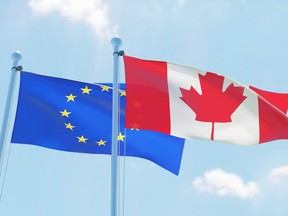
When a joint Canada-European Union statement is issued at their summit kicking off in Montreal on Thursday, there’ll be no mention of “associate membership,” according to reports.
Sign In or Create an Account
Instead, the statement will call for “ever closer associations” between Canada and the 27-member bloc, “short of full membership itself,” Politico reported Wednesday.
Germany, France and Greece, while broadly supporting closer ties with Ottawa, all objected to the use of “associate member” in draft versions, Euronews had earlier reported.
“The main concern is that this is unknown terminology, it might bring up legal uncertainty and expectations from other third countries,” an unnamed diplomat said.

Get a dash of perspective along with the trending news of the day in a very readable format.
By signing up you consent to receive the above newsletter from Postmedia Network Inc.
A welcome email is on its way. If you don't see it, please check your junk folder.
The next issue of NP Posted will soon be in your inbox.
We encountered an issue signing you up. Please try again
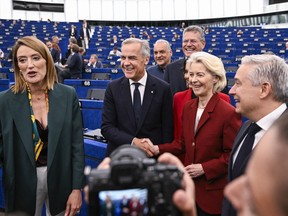
Last month, during a State of the Union address in Strasbourg, France, where Carney was the guest of honour, European Commission President Ursula von der Leyen proposed that Canada become an “associated member” of the EU, a term that doesn’t legally exist within the enclave. The idea was presented as a way to build a deeper partnership with a country that shares Europe’s democratic values and strategic concerns but has no intention of outright bloc membership.
Four European diplomats said von der Leyen put it forward without first consulting European capitals, Politico reported at the time.
Other EU diplomats warned that introducing a class of membership without a clear definition could create legal uncertainty, raise expectations among other countries seeking closer ties with Europe and complicate the EU’s existing arrangements with potential member nations.
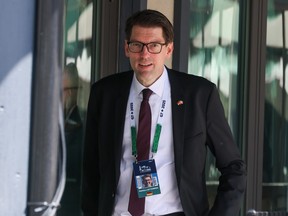
Matthias Lüttenberg, Germany’s ambassador to Canada, told CTV his country has used “associate membership” to describe the EU’s relationship with Ukraine and Moldova, two countries striving for full membership.
In May, German Chancellor Friedrich Merz proposed associate membership for Ukraine as an interim step to full membership that he said could help end the war with Russia, Reuters reported.
“What we have in front of us is something which is not clearly understood by all member states,” Lüttenberg said, suggesting all 27 member nations need “some time to reflect.”
“I think we have been a little surprised by the announcement, which doesn’t mean that we cannot agree on it.”
During a media briefing Tuesday, European officials said member nations are united in the ambition of Canada as an “associate member,” but admitted there is some division over the terminology, per Bloomberg.
Outside of “associate membership,” which is being explored only with Canada in mind, the officials also said talks could result in an “alliance of the future” — a broader framework the EU could extend to other countries that want closer ties without full membership.
The goal is to present a concept at next year’s summit.
Speaking to reporters on his way to the House of Commons on Tuesday, Carney said, “the good news is, it doesn’t matter about specific names or nomenclature.”
“What matters is the difference that it will make to the lives of Canadians, young Canadians, in terms of opportunities to study, work, and travel; our Canadian businesses in terms of new opportunities; Canadian researchers in terms of depth of opportunity; and Canada as a whole, becoming a more independent, more sovereign nation, so we can live our lives as we choose,” he said, as seen on CPAC.
The summit takes place on the 10th anniversary of the Canada-European Union Comprehensive Economic and Trade Agreement (CETA), a deal still not ratified by 10 of the bloc’s members, including France and Greece.
“The agenda of the summit will cover a wide range of topics, including trade, digital, critical raw materials, defence and security, cooperation in education, research and innovation, and youth,” the council wrote.
Meanwhile, a pair of recent surveys indicate Canadians remain open to increased partnership with the EU.
Nearly three-quarters of respondents to a Canada Pulse Insights national poll said Carney was “on the right track in seeking a closer economic and security alliance” with the EU.
“Current Conservative supporters stand apart: 58 per cent say wrong direction, while Canadians who report voting Conservative in April 2025 are almost evenly divided,” the pollster wrote.
An earlier Pollara Strategic Insights online survey found 76 per cent in favour of Canada partnering with the EU on trade and security.
On the question of full membership, initial support came in at 58 per cent, but fell to 50 per cent when presented with a list of things that could change.
The Canada Pulse Insights online poll of 1,532 adults was conducted Oct. 1-8. While a non-probability sample panel survey such as this doesn’t have a margin of error, a similar probability sample of that many respondents would have a margin of error of plus/minus 2.5 per cent, 19 times out of 20.
Pollara’s Sept. 10-18 online survey of 2,604 respondents. A probability sample of this size carries a margin of error of plus/minus 1.9 per cent, 19 times out of 20.
Our website is the place for the latest breaking news, exclusive scoops, longreads and provocative commentary. Please bookmark nationalpost.com and sign up for our newsletters here.
Join the Conversation
This website uses cookies to personalize your content (including ads), and allows us to analyze our traffic. Read more about cookies here. By continuing to use our site, you agree to our Terms of Use and Privacy Policy.
KioskNews shows a cleaned-up reading view extracted from the publisher’s page — the original always lives on their site, not ours.