Are Australians really overtaxed? It depends what you think government should do
When the federal government released its final budget figures for 2025–26 this week, it prompted a flurry of front-page articles in the conservative press arguing for lower taxes.
The budget figures showed tax revenue in 2025–26 was equivalent to 24.1% of the economy, above the May budget forecast of 23.6%.
Whether we pay too much tax is in essence a judgement about what we think government should do.
Our taxes pay for government services
Taxes pay for government services. The impact of government on our lives has grown steadily; tax has grown with it.
The Parliamentary Budget Office has estimated tax revenue only amounted to 5% of gross domestic product (GDP) at the time of federation in 1901. Taxes have grown steadily since — with ups and downs along the way — to their current level.
The final budget outcome for 2025–26, with tax revenue at 24.1%, is higher than in recent years, but marginally less than the 24.2% in 2004–05 and 2005–06 during the Howard-Costello government.
Often forgotten is that during what the conservative side of politics recall as the halcyon days of the Menzies government, many taxes were higher than they are now.
For example, the top rate of income tax was 75% in the early 1950s. This did not strangle economic growth. Indeed the economy grew faster in the 1950s and 1960s, and unemployment was lower, than has been the case this century.
How much a government spends represents the consensus in our democratic system on how much we want to spend on goods and services provided collectively — that is, by government — rather than individually.
A country’s willingness to fund some publicly provided goods and services goes up more than proportionately with income. This explains why tax-to-GDP ratios tend to be higher in rich countries than poor, and why they have risen over time in most countries.
Compared to our peers in OECD advanced economies, Australia is a low tax country.
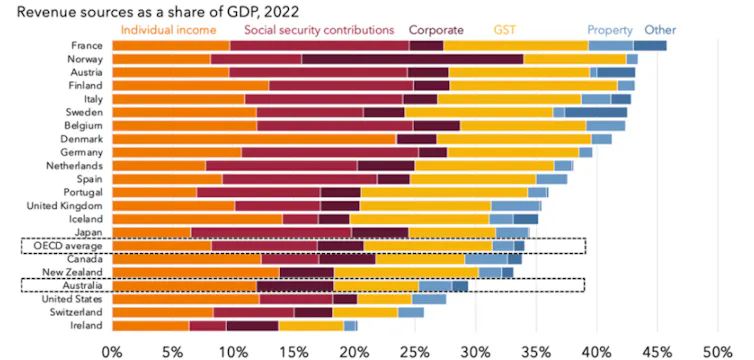
There is also no evidence that higher taxes necessarily make countries worse off. Indeed the countries with the highest tax-to-GDP ratios, mostly in Scandinavia, are among the happiest and most affluent.
Voters want good health services
The classic example is health. World Health Organization data show not only do high income countries spend more on health, but a higher percentage comes from government. That reflects voter demand for better health services in rich countries worldwide.
A key document in understanding the trends in spending is the recent Intergenerational Report, which outlines population growth and government spending over the next four decades.
It shows that the areas where spending is growing most have almost unanimous support. Aged care and health spending are rising due to an ageing population.
There is also broad but contested support for increased defence spending such as on AUKUS. Spending on interest payments on government debt is also rising, because bonds issued at very low interest rates during COVID need to be rolled over. No one is arguing we should default on our debt.
The lesson from the Intergenerational Report is that meeting these spending priorities without raising the tax-to-GDP ratio will imply running deficits, and therefore accumulating more debt, for decades.
The budget balance is the difference between revenue (mostly taxes) and spending. If spending is greater than revenue the result is a deficit, and therefore more debt.
The advocates of lower taxes need to explain how this can be achieved without cutting spending or increasing debt.
We could in theory cut government spending: cut Medicare and make people pay for their own hospital treatments; remove life-saving drugs (they tend to be the most expensive) from the Pharmaceutical Benefits Scheme; cancel planned AUKUS submarines; remove subsidies for aged care.
These are among the largest and fastest growing areas of government spending. Are low tax advocates really arguing for cuts like these? Blithely asserting “the government should cut spending” without saying what should be cut is misleading. There are no easy options.
There are revenue options
If we want to balance the budget, the debate could instead pivot to talking about the most efficient way to raise more revenue rather than tax cuts.
The efficiency of the tax system can be improved by taxing things we want to discourage, such as greenhouse gas emissions or unhealthy foods, more. Any tax cuts should be focused on things we want to encourage, such as work and innovation.
We should also rely more on taxes that do not distort decisions, such as on land (which would cause land to be used more efficiently) rather than stamp duty and on super-profits of resource companies. A super profits tax does not change how companies operate — they continue in business because they still make good profits.
Measures to improve productivity would expand the tax base and make the task easier.
Failing to raise government spending, and the taxes to pay for it, could condemn us to what the prominent 20th century economist John Kenneth Galbraith termed “private affluence, public squalor”.
An example would be consumers buying shiny new cars, but having to navigate roads riddled with potholes — much like the country roads in Victoria that have become a political issue ahead of the state election.
KioskNews shows a cleaned-up reading view extracted from the publisher’s page — the original always lives on their site, not ours.