Dune 3 Theory Rewrites The Entire Saga With An Unused Twist From George Lucas' Star Wars 9

Karlis has been obsessing over television and movie news since he first learned how to read. He has worked in tech, as a musician, and in journalism with a well-rounded knowledge base of pop-culture throughout the eras. He claims that he has memorized the entire Internet Movie Database, and to date no one has been able to refute this.
Holding a Bachelor's Degree in Religion and Culture from Wilfrid Laurier University, Karlis loves to examine the intersections of popular science-fiction and culture. His latest novel MASS. is available now on Amazon and examines a world where obesity has become a federal crime.
Dune: Part Three is set to conclude Denis Villeneuve's chapter of the science fiction saga, and a popular theory making the rounds online helps to reframe this story within the larger context of Frank Herbert's enormous universe. Telling some of the best sci-fi stories ever seen in movies, the Dune films have been celebrated for their scope and storytelling.
Still, it is notable that these films are only a small part of what Dune is. The franchise began with six books by the original author, but has been expanded upon with all kinds of ancillary material shepherded by Brian Herbert and Kevin J. Anderson. Since then, there have been countless Dune books, comics, and more throughout the years.
Dune has spawned several television shows, and this particular iteration has grown even bigger with the HBO success of Dune: Prophecy. That series has added some fantastic context to the universe of Villeneuve's films, and it seems likely that the Dune story will continue to be told even after Villeneuve leaves to direct the next James Bond movie.
With that in mind, there is an ending of sorts just ahead in Dune: Part Three. And if a new theory is to be believed, the ending that could come from the next film might do a much bigger job in tying together the whole story of Dune across thousands of years.
Leto II In Dune Explained

Leto II is a major figure in the Dune series. He, as well as his twin sister Ghanima, is Paul and Chani's child, born at the end of the novel Dune Messiah. One of the eponymous Children of Dune, Leto, named for his grandfather, takes on a major role in the third novel after Paul Atreides disappears into the desert.
However, things quickly become very strange for Leto II's journey. At the end of that book, Leto seizes control of the Golden Path, and he ventures into the desert to merge with a sandtrout, the larval form of Shai-Hulud. This bonding is a success, and Leto slowly becomes something other than human.
This story continues in the fourth Dune novel, the fan favorite God Emperor of Dune. That book takes place 3,500 years later and sees Leto having ascended to complete control, ruling the universe as a twisted but idealistic tyrant. The Landsraad has been eliminated and Arrakis has been terraformed into lush rivers and forests.
In this, Leto is the titular God Emperor, but has lost much of his humanity. He has access to ancestral memories, but no longer ages in a human way, thanks to his new body. He describes his changed physiology at the start of the novel, and it is twisted and unsettling:
At this writing, the whole could be considered rather gross. I am what could be called a pre-worm. My body is about seven meters long and somewhat more than two meters in diameter, ribbed for most of its length, with my Atreides face positioned man-height at one end, the arms and hands (still quite recognizable as human) just below. My legs and feet? Well, they are mostly atrophied. Just flippers, really, and they have wandered back along my body. The whole of me weighs approximately five old tons.
Has Leto II Been Narrating The Dune Movies?
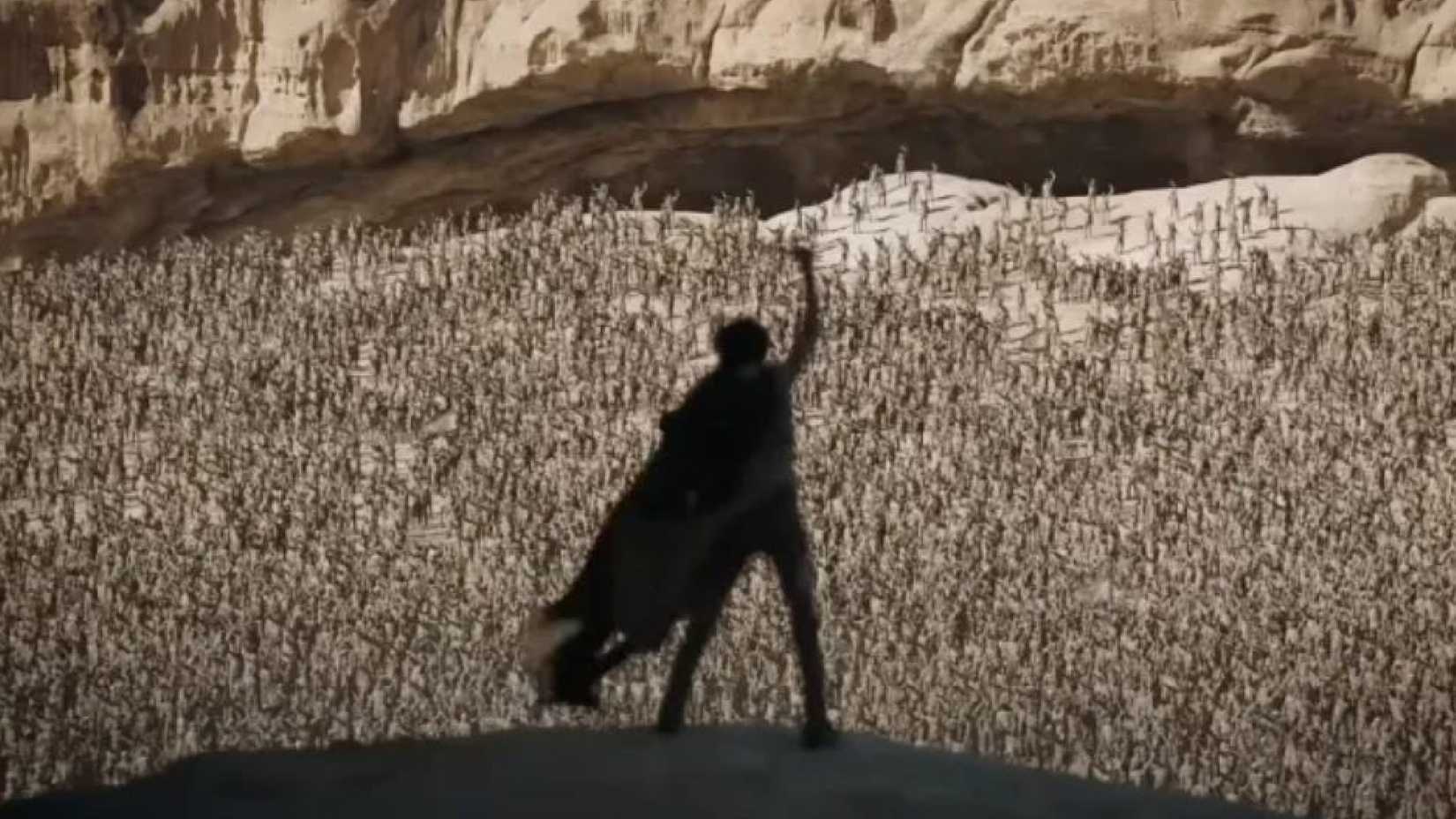
A popular fan theory is that the Dune films are actually memories told by Leto II from the distant future. This is strikingly similar to George Lucas' original plans for the ending of Star Wars: Episode IX, which intended to reframe the saga's events as a historical retelling by R2-D2 in the distant future.
The ending of the Dune books is clear, but how that ties into the movies remains to be seen, and there is a little bit of a basis for this theory: the throat singing from the beginning of each film is a unique sound that sounds quite alien.
The first film begins with "Dreams are messages from the deep," while the second opens with "Power over spice is power over all." This necessarily sets the stage for the story, but could reasonably be context coming from Leto's consciousness.
The future Leto exists with the memories of his line's past inside. Because of Chani's spice consumption during her pregnancy, Leto and his sister were "pre-born", which allows them to access the memories of their ancestors. This makes the possibility of Leto narrating the films from the distant future possible, although there are still some issues with the theory.
What This Theory Would Mean For Dune: Part Three

This theory is interesting because, if it is true, it means that the scope of Denis Villeneuve's Dune trilogy is much larger than many have expected. While Dune: Part Three was expected to adapt Dune Messiah, there are elements that suggest the film could go into the territory of Children of Dune as well.
The casting of the Atreides twins with Nakoa-Wolf Momoa and Ida Brooke is telling, because the performers are young adults, while these characters are only babies by the end of the second book.
However, if this theory is also true, it would mean that the upcoming film is adapting not just Dune Messiah and parts of Children of Dune, but even beyond that. Considering that Denis Villeneuve found it necessary to split the first Dune novel into two films, combining most of the next three books into one movie seems unlikely.
Still, the idea of framing the Dune story within a larger context is compelling. Leto II is a complex and wonderful character, and seeing his evolution would be wonderful. However, all of this is likely just a little too much for the upcoming sequel to handle on its own.
Why This Would Be Bad For Dune 3
There is much more to be told in the vast universe of Dune, and flashing forward to events of God Emperor of Dune would be too jarring for this to be an effective storytelling choice. Most importantly, however, the Dune movies promise enormous box office returns that Warner Bros. surely does not yet want to abandon.
Yes, Villeneuve will be leaving the franchise after Dune: Part Three, at least as director. However, it seems all but guaranteed that another filmmaker will be brought in to shepherd further stories in the series.
Especially with how beloved God Emperor of Dune is as a novel, it would make for an excellent additional film, featuring a ghola of Jason Momoa's Duncan Idaho as a co-lead.
In addition, suddenly moving 3,500 years into the future at the end of Dune: Part Three would simply be too much to ask from audiences. Viewers have grown used to this period and these characters, and reframing them through the lens of Paul's son, who will not even be introduced until Part Three, would have little impact.
As the subtitles for the first two films suggest, the speech at the beginning of the first two movies is likely just a thematic choice, rendered in Sardaukar voice for the sake of effective narration. It is likely not intended as a sandworm speaking, and reframing it as coming from Leto II would be unnecessarily convoluted and confusing.
It would not be awful if this choice was made, but it would be short-sighted for the franchise and would really only matter for a small subset of viewers. Either way, it will be interesting to see how the story wraps up when Dune: Part Three arrives in cinemas this December.
KioskNews shows a cleaned-up reading view extracted from the publisher’s page — the original always lives on their site, not ours.