Elephants removed for 15 years, dung beetles fell by 67%: study
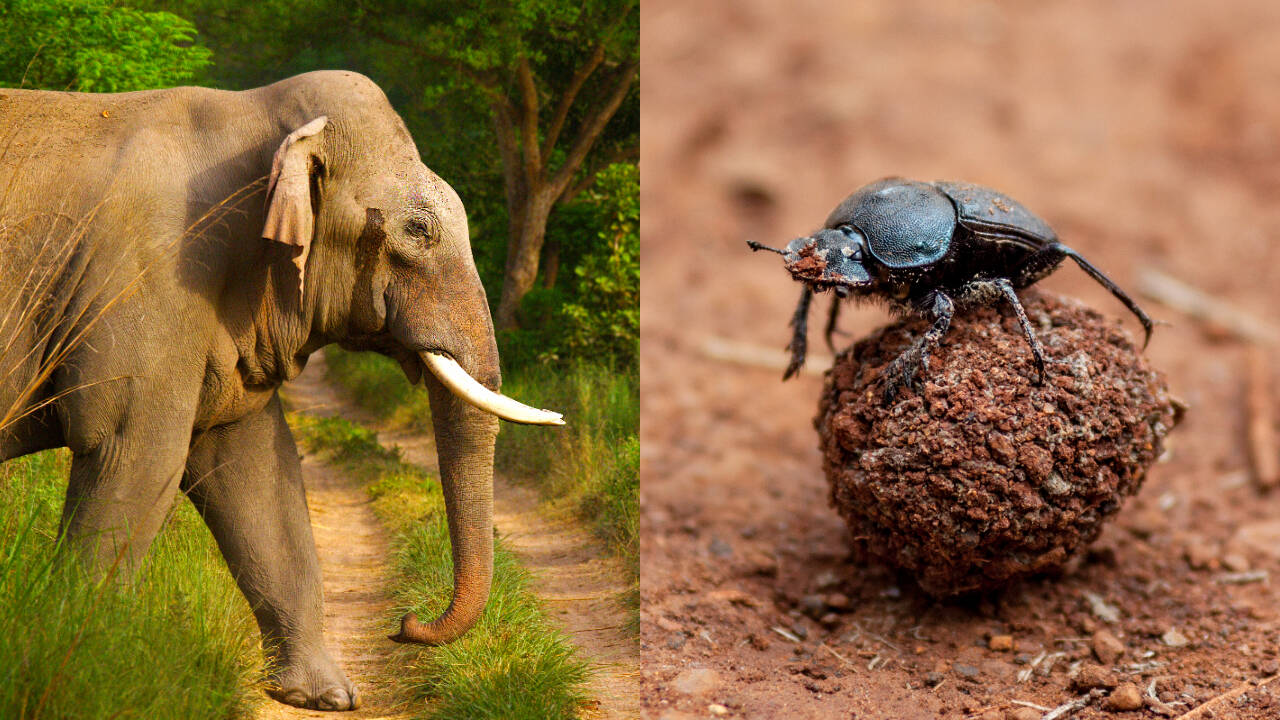
According to the research published by Science Adviser newsletter, dung beetles rarely attract the attention given to elephants, but their work is fundamental to healthy soils and functioning ecosystems.
On an African savanna, an elephant’s presence can be measured in ways that have little to do with the animal itself. Beneath the shade of acacia trees and across open grasslands, enormous quantities of dung become food, shelter and opportunity for insects.
Remove the elephants, and that hidden network begins to disappear. A 15-year ecological experiment in Kenya has now provided striking evidence of how closely one of the savanna’s largest mammals is connected to one of its smallest communities.Researchers of the study titled 'Importance of elephants for dung beetle biodiversity and ecosystem function' have found that excluding elephants from experimental plots caused major declines in dung beetle abundance, biomass and diversity, while also disrupting important ecological processes.
An ecosystem built around dung
According to the research published by Science Adviser newsletter, dung beetles rarely attract the attention given to elephants, but their work is fundamental to healthy soils and functioning ecosystems. By feeding on and burying dung, the insects help return nutrients to the ground, improve soil conditions, disperse seeds and reduce parasites associated with animal waste. The researchers first examined how beetles responded to dung from different mammals.Elephant dung attracted substantially greater numbers and a wider variety of beetles than dung from other animals, establishing just how important the giant herbivores were to the insect community.
That relationship makes sense on the scale of an elephant. The animals can spend up to 18 hours a day feeding, consuming roughly 300 pounds of food and producing as much as 200 pounds of dung. Across a landscape, that creates a steady and substantial resource for insects, states the research study.
Fifteen years without elephants
The researchers then turned to the long-running UHURU experiment at Kenya’s Mpala Research Center, established in 2008.
The project uses large fenced plots to selectively exclude mammals according to their body size.Some enclosures keep out the largest herbivores, including elephants and giraffes, while others exclude progressively smaller animals such as duikers and dik-diks. Open plots serve as controls, allowing researchers to compare ecosystems with different combinations of large mammals, adds the published research report.
The setup effectively allows scientists to examine what happens when species disappear from a landscape, particularly the large animals that are often among the most vulnerable to human pressures.
After 15 years, the differences were substantial. Plots without elephants had 67% fewer dung beetles, while total beetle biomass fell by 51%. The number of beetle species also declined by 23%, adds the report. The loss was strikingly specific to elephants.
Removing additional large herbivores on top of the elephants produced little further change in the beetle community, suggesting that elephants played a particularly important role in maintaining dung beetle diversity.
When the beetles disappear
The consequences extended beyond the insects themselves. Fewer dung beetles working through the soil meant dung decomposition slowed in plots without elephants. Seed dispersal also dropped, linking the beetles’ disappearance to larger changes in how the savanna operates.
The results provide a real world example of coextinction where the loss of one species has knock-on effects for other organisms that rely on it.
The study also links wildlife conservation to ecosystem services with a quantifiable economic component. Dung beetles help with nutrient cycling, soil improvement, parasite suppression and seed movement, with the value of similar services to the U.S. and U.K. cattle industry worth about $1.6 billion as of 2026.”
Why long-term experiments matter
The results also underline the importance of patience in ecological research. Many field studies run for only a few years, but the UHURU experiment has continued long enough for gradual changes to become visible. The 15-year record shows that elephants influence far more than vegetation and large-animal interactions. Their presence helps sustain a network of insects whose work continues long after an elephant has moved across the savanna.
In that sense, the experiment offers a different way of seeing extinction. Losing an elephant is not necessarily an isolated event. It can remove a resource, weaken an insect community and alter the ecological jobs that community performs, revealing how deeply connected the smallest and largest inhabitants of a landscape can be.Images Courtesy: istock
KioskNews shows a cleaned-up reading view extracted from the publisher’s page — the original always lives on their site, not ours.