Hull City’s rise from Championship strugglers to Premier League fliers

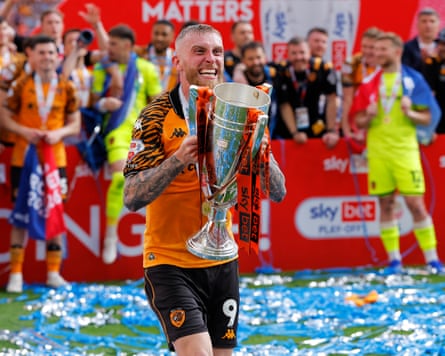
Sixteen months ago Hull City avoided relegation to League One on goal difference. Four months ago, they needed a last-minute goal from Oli McBurnie at Wembley to win the Championship playoff final. Three weeks ago, when the pre-season predictions were published, they were tipped to threaten Derby County’s record of the worst ever points tally in the Premier League. On Saturday night, they left Stamford Bridge third in the Premier League with eight points.
The 2-2 draw extended their unbeaten run to four games. They have beaten Manchester United and Coventry, and picked up draws against Aston Villa and Chelsea. We are in September and there are 34 more games to come. Hull will not be competing with Arsenal and Manchester City come the end of May. But their start has been remarkable. Almost everyone doubted whether the qualities that took them on an improbable run to the Premier League could keep them there.
The scepticism was not entirely unfounded. To understand where they have come from, it is worth going back to the final day of the 2024-25 season in the Championship. Hull were in the bottom three and their whole campaign would come down to 90 minutes against Portsmouth at Fratton Park. Win and Hull were safe; draw and they needed other results to go their way; lose and it was League One. A 1-1 draw, and Luton’s defeat to West Brom, preserved their status in the Championship, but only on goal difference.
Most sides look to rebuild after a campaign threatened by relegation, but a transfer embargo – imposed after the club had failed to pay Aston Villa £1m for Louie Barry’s loan fee – meant that the side that had scored the fewest goals in the league (just 44 in 46 matches) could not strengthen. To make matters worse, manager Rubén Sellés, hired just five months earlier, would soon be shown the door. It was hardly the sort of springboard from which to launch a promotion campaign.
And yet, 12 months later, Hull were celebrating promotion at Wembley. Sergej Jakirovic took over at the start of last season and led the club to a sixth-place finish and a place in the playoffs. They picked up 73 points, scoring just 70 goals in the process. To put that in some context, Coventry picked up 95 points while scoring 97 goals. The fact that Hull even made the playoffs defied the statistics. Had their matches been decided by expected goals, they would have finished second-bottom. They shipped 66 goals, giving them the fourth worst defensive record in the league. Given the speed and statistical improbability of their rise, you could hardly blame the naysayers for wondering whether Jakirovic and Hull would struggle in the Premier League.
The early evidence suggests their approach can work. Hull did not play like other promotion contenders last season in the Championship. They did not dominate the ball and drown out opponents – and that has been one of their biggest strengths so far in the Premier League. Speaking after their win against Manchester United on the opening weekend, their assistant manager, Dean Holden, said: “We are comfortable without the ball. It is not like we are coming up here having dominated the Championship and now we have to change.”
They averaged 45% possession in the Championship, the fifth-lowest in the division. In the Premier League, it has fallen to 29.4%, comfortably the lowest. Hull have not had to answer the question that faces other promoted sides: how do we adapt to not having the ball? They are simply playing a slightly more extreme version of a style they were already comfortable with.
Nor have changed what they do on the ball. They are using the same long, vertical, direct approach as last season. The first phase of the attack is often a long ball into McBurnie in the middle of the field; their midfielders then look to win the second ball and switch play to the wings, often targeting Ryan Giles at left wing-back where he delivers quick crosses or finds a target man in the box.
Hull attempted the second-most long passes in the Championship last season (3,057) and made the fewest passes per sequence (2.5). This season they have attempted the second most long passes (237) and are attempting the fewest passes per sequence in the Premier League (2.46). Giles ranked 10th for crosses in the Championship last season (207); he is third in the Premier League in that statistic this season with 28. Some managers change too much after promotion; Hull have benefited from continuity.
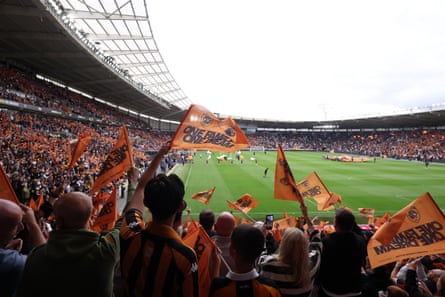
Having shipped the fourth-most goals in the Championship last season, Hull did not concede in their first three matches in the Premier League. Once again, Jakirovic has gone for continuity. The idea is the same one he used to shut out Millwall and Middlesbrough in the playoffs: a 5-4-1 formation in which his players sit in a mid-to-low block, close the gaps between lines, force the opponent wide, and win the next contact in the box.
Regan Slater and Matt Crooks screen in midfield, with John Egan and Semi Ajayi winning the ugly fights in front of the goalkeeper. Their summer arrivals, notably Nobel Mendy, have added to an already physical backline. Their 53.8% ground duel success rate is the sixth-highest in the Premier League and their 52.3% success rate in aerial duels also ranks sixth.
Perhaps the most valuable thing Hull took into the Premier League cannot be measured by statistics. They are a group that has been through plenty together and, in the process, forged a tight-knit unit. Yes, they spent £150m over the summer, but eight of the starting XI at Stamford Bridge were part of last season’s promotion-winning side. They have added Premier League quality and physicality, but have not attempted to replace the group that got them there. Speaking on the transfer embargo and the difficulties Hull faced last season, Jakirovic said: “Maybe it was the best that it happened like this. This group of players became even closer. They had to stick together and help each other.” They have perfected the art of being the underdogs.
Hull fans will not be getting carried away. There is still a lot of football to play and they know how things can deteriorate across a season. In 2008-09, they were third in the Premier League after nine games, but ended up surviving relegation by a single point. Perhaps they would take that this season, but for now they should enjoy being in the upper reaches of the league.
KioskNews shows a cleaned-up reading view extracted from the publisher’s page — the original always lives on their site, not ours.