Rocket Report: Starship set for historic test flight; a century of Electron
Welcome to Edition 9.19 of the Rocket Report! Will something historic happen this weekend? No orbital rocket has ever been fully recovered with the intent of reusing all of its components. But that’s just what SpaceX is going to try to do with a Starship launch on Friday, and an upper stage landing attempt 22.5 hours later on Saturday afternoon, local time. Ars will be on hand in Starbase, Texas, to provide coverage of it all.
As always, we welcome reader submissions, and if you don’t want to miss an issue, please subscribe using the box below (the form will not appear on AMP-enabled versions of the site). Each report will include information on small-, medium-, and heavy-lift rockets as well as a quick look ahead at the next three launches on the calendar.

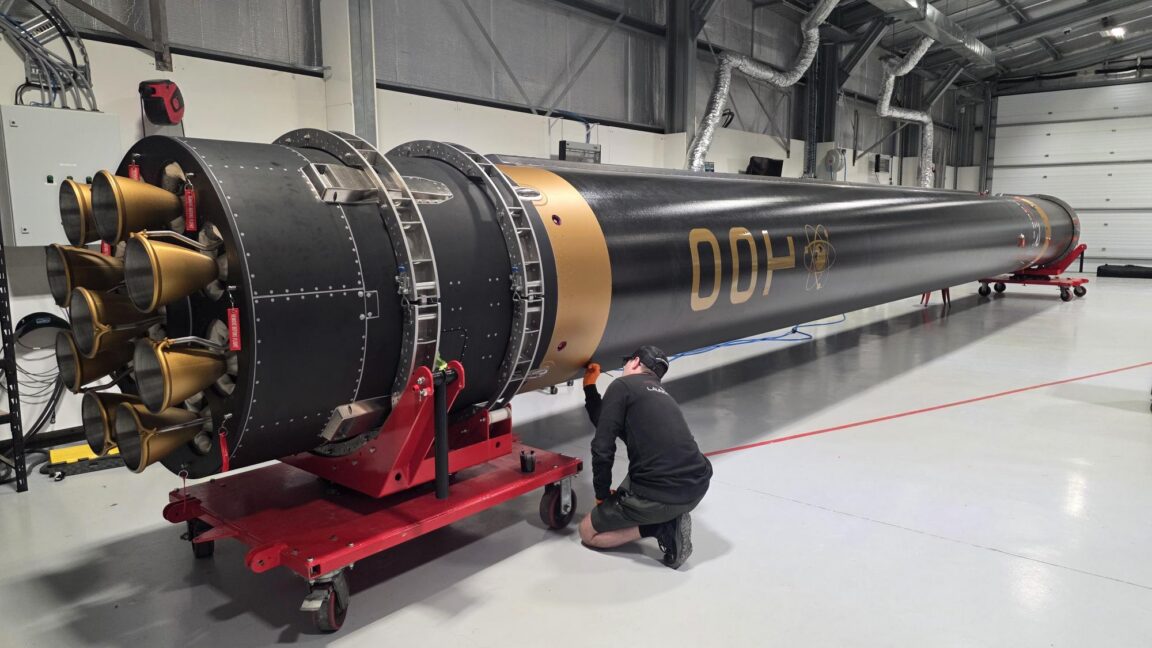
Electron set for milestone launch. The next launch of Rocket Lab’s Electron vehicle is due to lift off from the Mahia Peninsula in New Zealand on November 14 at 5:30 UTC. This mission will serve as Electron’s 100th overall mission—a notable milestone for the small rocket that first flew in 2017, NASASpaceflight.com reports.
A true commercial success … This flight of Electron, named “The Mountain God Rises,” will deliver another iQPS satellite into LEO for iQPS’s synthetic aperture radar constellation. The anniversary rocket features a special gold-and-black livery which looks fantastic. Rocket Lab truly does deserve recognition as the world’s second purely commercial launch business to make a successful go at it. We are all celebrating with them.
Is the Vega rocket a dead end? Last month, Italian rocket builder Avio presented a market update that outlined the additional investment required to increase the annual launch cadence of its Vega C rocket to six and eventually nine flights per year, European Spaceflight reports. The need for this additional funding raises an interesting question about the future of Italy’s Vega launch vehicle family. Is investing in the infrastructure needed to secure just three more Vega C flights per year by the end of the decade the best use of resources, particularly when several emerging European launch companies appear poised to offer comparable capacity?
Boosters may be better used by Ariane 6 … Vega C isn’t going anywhere. But it’s an inescapable reality that a single Ariane 64 launch requires the equivalent of an entire year’s worth of solid rocket boosters for Vega C at its baseline annual launch cadence of four flights. Does it make sense to continue investing in expanding Vega C’s launch cadence and later introducing Vega E when the future of both vehicles depends on production capacity that is increasingly demanded by Ariane 6?
Keep up with the latest in space exploration and rocket launches.
Synspective inks 10 Alpha rockets. Firefly Aerospace announced on Tuesday a multi-launch agreement with Synspective, a Japanese synthetic aperture radar satellite data and solutions provider, for up to 10 launches on Firefly’s Alpha rocket through 2030. With the ability to launch 1,000 kg to low Earth orbit, Alpha will deliver two of Synspective’s SAR satellites to orbit per mission, deploying up to 20 total satellites.
Getting it done with one ton … Under the agreement, Firefly will launch Synspective’s SAR satellites from both Pad-0A at Wallops Flight Facility in Virginia and Space Launch Complex 2 at Vandenberg Space Force Base in California. “This landmark agreement reflects growing customer confidence in our Alpha Block II vehicle,” said Jason Kim, CEO of Firefly Aerospace. “With 1-ton payload capacity and responsive launch capabilities, Alpha is a natural fit for customers like Synspective seeking direct access to orbit to get their operations up and running sooner.”
Stoke and Planet sign multi-launch agreement. Stoke Space on Monday announced a multi-launch agreement with Planet Labs PBC. The companies did not announce the terms of the agreement, including the total number of launches under contract, nor the cost of the launches. “We need launch partners who move as quickly as we do,” said Will Marshall, Co-Founder & CEO of Planet.
An open-ended agreement? … The announcement suggests this could be an open-ended agreement, however. “Planet builds and operates the largest fleet of Earth-imaging satellites in orbit and captures imagery of Earth’s landmass every day,” a related release says. “Operators like Planet launch on a regular basis to expand and replenish their fleets, and that steady demand is what our Nova fleet is designed to serve.”

The launch crunch comes to national security. The US military is taking a new approach to prop up commercial launch companies as SpaceX looks to wind down its Falcon rocket program, suggesting defense officials see the workhorse rocket’s retirement as a potential national security risk, Ars reports. The Pentagon’s Office of Strategic Capital has twice in the last two weeks announced it was sending cash to two of SpaceX’s competitors in the launch business.
More pads and rockets … First, on October 26, the office announced a $150 million conditional loan commitment to Stoke Space. Military officials revealed a second $150 million Pentagon loan Tuesday for Rocket Lab. Stoke Space’s loan is tailored to support the buildout of the company’s second launch pad at Cape Canaveral Space Force Station, Florida. The loan to Rocket Lab will support the company’s efforts to increase the flight rate of its partially reusable Neutron rocket.
Rocket Lab raises Neutron price. Citing strong customer demand and a constrained market for launch, Rocket Lab announced this week it had increased the cost of a dedicated Neutron rocket from $55 million to $70 million, Payload reports. In recent months, the coming shortage of launch capacity in the US—mainly due to SpaceX sunsetting its Transporter rideshare program—has sparked a flurry of interest in new medium-lift rocket entrants.
Positive on Neutron … “Neutron is rapidly establishing itself as the backbone of next-generation constellation deployment and government missions in the medium-lift launch class,” CEO Peter Beck said in a statement. “Strong international demand and a growing launch manifest, at a new price point, is proof that Neutron is the launch vehicle the market has been waiting for.” The price hike for Neutron isn’t keeping customers away as new bookings continue, the company said. Customers’ next options to fly on Neutron are now in the 2030s and beyond.
Rockets are not hard? During an hour-long event on Thursday, Abel Avellan, the founder and chief executive of the telecommunications company AST SpaceMobile, laid out his vision for developing a large rocket to launch his Bluebird satellites into orbit, Ars reports. Avellan emphasized, over and over again, that AST plans to build a “simple” rocket. He paraphrased SpaceX founder Elon Musk several times, saying, “the best part is no part.”
This sounds a little naive … “Of course rocket engineers are going to get mad with me, but you can simplify it as a big tank feeding engines,” he said of the rocket. “So big tanks—we know how to do them. We know how to do them. We know how to do them in composite.” The Blacklift rocket will be “simple,” he said, because it will be solely tailored to lift five Bluebird satellites into low-Earth orbit at a time. It will have 20 metric tons of lift capacity, a reusable first stage, and launch twice a month from a pad at Wallops Flight Facility in Virginia that formerly served the Antares rocket. (submitted by thegooglemonster)
When will the Eclipse rocket be ready? During an earnings call this week (see transcript), Firefly CEO Kim spoke about the company’s ongoing work to develop the Eclipse rocket. “We’re heads down on Eclipse,” he said. “We’re laser-focused on delivering the first stage to our co-developer Northrop Grumman. And we’re over 175 hot fires on Miranda, counting the one from today. And we’re looking at all the data, verifying the capability. It’s a very mature engine, and we’re very confident in its capabilities.”
Probably not launching soon … However, when an analyst pressed on Firefly getting a launch in 2027, Kim did not offer a direct answer. “Everything is just laser-focused on all the milestones in terms of qualifying Miranda and qualifying our composite tanks and fluid systems as well,” he said. “So we’re really, really just excited about the future of Eclipse, especially with this injection of capital that will help accelerate our production line.” Bottom line: Don’t expect to see Eclipse on a launch pad any time soon.

Starship set for 15th test flight on Friday. Flight 15 of Starship is preparing to launch as soon as Friday, November 13, pending regulatory approval, SpaceX said. The 75-minute launch window will open at 4:45 p.m. CT (22:45 UTC). The upcoming flight is planned to be the first to return both Starship and Super Heavy to the launch site for catch. If successful, this will mark the first full recovery of an orbital launch system.
All eyes on the ship … Starship’s initial return-to-launch-site mission is expected to orbit the Earth at an altitude of about 275 km and complete approximately 14 orbits around the planet over the course of a more than 22-hour flight. Starship’s primary mission will be to deliver 26 Starlink V3 satellites to orbit. But really, this mission is all about the landings, first of the booster and then, more dramatically, of the upper stage Starship on Saturday.
SpaceX is now an ‘infrastructure’ company. For a long time, SpaceX has been synonymous with developing newer, larger, and ever-more-reusable rockets, Ars reports. But that began to change over the last decade with the introduction of Starlink, and the change has accelerated during the last 18 months as the company has pivoted to data and artificial intelligence. At last week’s UP.Summit conference in Florida, SpaceX’s vice president of launch, Kiko Dontchev, offered some of the most revealing comments to date about the company’s changing focus.
From AI to Mars? … “In the last couple years, when I talk about SpaceX, yes, we are a rocket company, but fundamentally we are an infrastructure company at this point,” Dontchev said. “We’re building infrastructure on the ground and low Earth orbit, soon on the Moon, and obviously eventually Mars.” However, Dontchev insisted that human settlement and Mars remain part of the core of SpaceX’s aspirations. “We have come to understand that this tool is critical to us accelerating our pace of innovation,” he said of artificial intelligence. “Without AI, I think we still would have gotten to the Moon. I think we still get to Mars with SI. We’re going to get there so much faster.”
Next three launches
Nov. 13: Vulcan | Amazon Leo LV-01 | Cape Canaveral Space Force Station, Florida | 17:54 UTC
Nov. 13: Starship | Flight 15 | Starbase, Texas | 22:45 UTC
Nov. 14: Soyuz 2.1b | MKA Kinosputnik, others | Vostochny Cosmodrome, Russia | 00:50 UTC


Eric Berger is the senior space editor at Ars Technica, covering everything from astronomy to private space to NASA policy, and author of two books: Liftoff, about the rise of SpaceX; and Reentry, on the development of the Falcon 9 rocket and Dragon. A certified meteorologist, Eric lives in Houston.
KioskNews shows a cleaned-up reading view extracted from the publisher’s page — the original always lives on their site, not ours.