At G20 foreign ministers’ meet: Jaishankar raises energy crisis, flags sanctions, attacks
Expressing concern over the increasing “distortions of energy markets through obstacles, sanctions and chokepoints”, External Affairs Minister S Jaishankar has said that the “deliberate attacks” on energy infrastructure and trade are a “calculated strategy” to hold prices hostage.
Speaking at the second plenary session of the G20 Foreign Ministers’ meeting in Atlanta, US, on Friday, Jaishankar said there appears to be “little regard” for the predicament of low-income countries.
His remarks come amid the US’s sanctions on the sale of Iranian oil and its recent decision to waive Russia-linked sanctions. There have been attacks on energy infrastructure and ships carrying oil and gas in both the ongoing wars in West Asia and Russia-Ukraine.
“Spoke at the 2nd Plenary of @g20org #Atlanta. Underlined that the world today stares at an energy crisis, not of production, but of unpredictability & disruption, unaffordable costs, and challenges of access,” Jaishankar said in a post on X.
“Highlighted that deliberate attacks on energy trade & energy infrastructure are a calculated strategy to hold energy prices hostage,” he said.
Jaishankar said he emphasised that “continuous distortions of energy markets through obstacles, sanctions & chokepoints are happening with increasing frequency, greater complexity & wider impact.” adding that “there appears little regard for the predicament of low-income countries”.
“Stressed that convenient distinctions are being drawn between oil and gas. Selective carveouts speak for themselves. Reiterated that the knock-on effects & mutual dependence in a globalised market should not be underestimated,” he said in his post.
Story continues below this ad
Reaffirming that India needs “reliable and predictable LPG supplies for its clean cooking needs”, Jaishankar said he reiterated that India’s national mission on critical minerals spans from exploration to recycling. India has also proposed a G20 Critical Minerals Circularity Initiative, he said.
“The G20 must display both understanding and leadership to keep energy markets open & predictable. It must widen access to finance and advance storage, small modular reactors, green hydrogen and bio fuels,” he said.
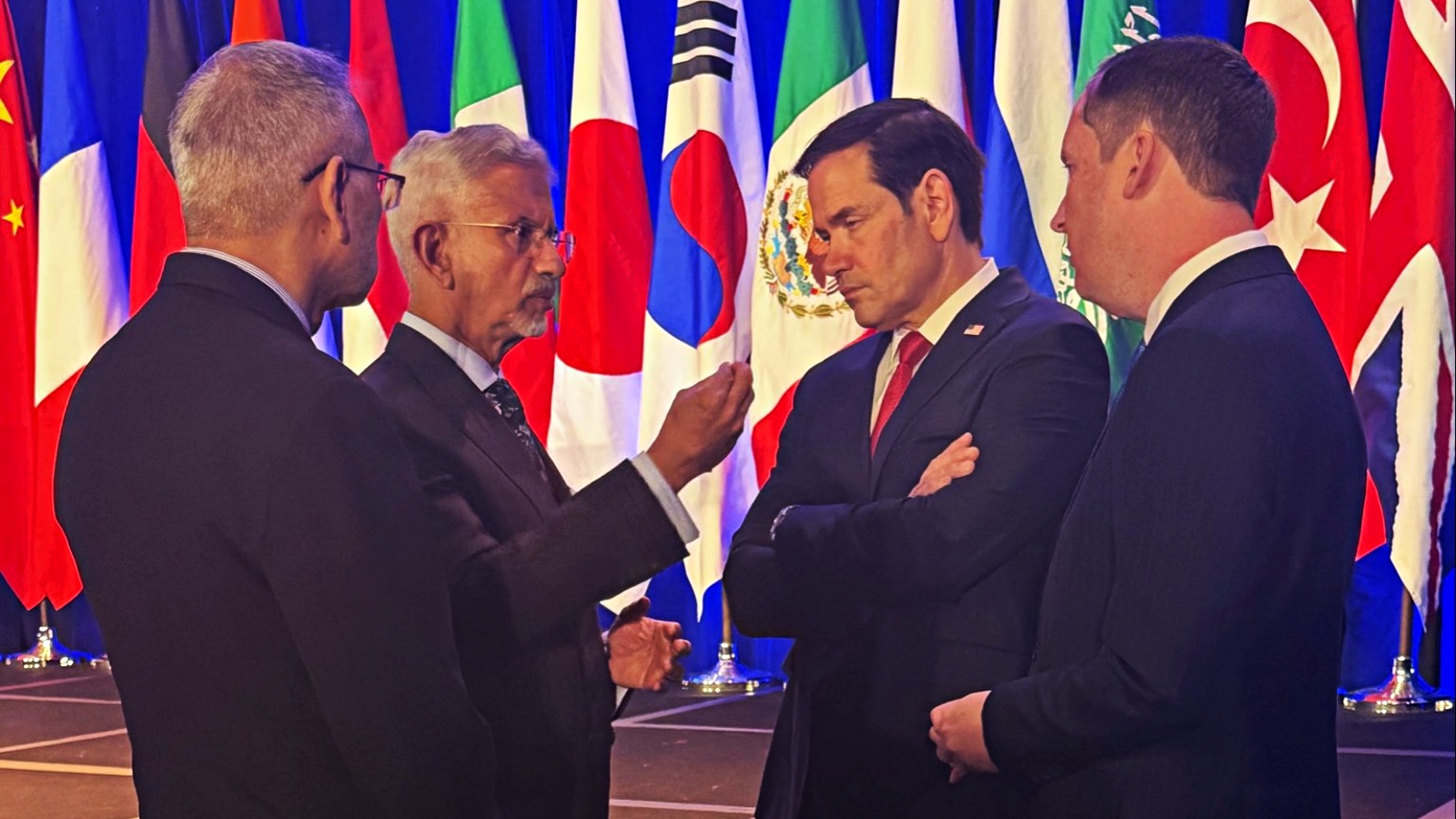
After the session, Jaishankar also met US Secretary of State Marco Rubio. “Appreciated @SecRubio’s hospitality in Atlanta for the @g20org FMM. Took stock of our bilateral cooperation,” Jaishankar posted on X, along with a picture of him with Rubio, Indian Ambassador to the US Vinay Mohan Kwatra and US Ambassador to India Sergio Gor.
Jaishankar’s participation at the G20 Foreign Ministers’ meeting comes just days after Rubio visited India on October 20-22. His visit is also being seen as laying the groundwork for Prime Minister Narendra Modi’s possible visit to the US for the G20 leaders’ summit in mid-December.
Story continues below this ad
Jaishankar also met his counterparts from Canada, Australia, Germany, Brazil, Mexico, Argentina and Poland among others.
In his meeting with his Canadian counterpart Anita Anand, the two sides assessed the “steady growth” in India-Canada cooperation and agreed that Modi’s visit to Canada in December will be another “building block” in their “ambitious relationship”.
From Atlanta, Jaishankar will travel to Antigua & Barbuda to attend the CHOGM (Commonwealth Heads of Government Meeting) from November 1 to 4. His visits are part of Delhi’s engagement with multilateral groupings, with an opportunity to have bilateral engagements.
KioskNews shows a cleaned-up reading view extracted from the publisher’s page — the original always lives on their site, not ours.