Institute touts milk test to monitor health of cows
By Yang Yuan-ting and Esme Yeh / Staff reporters


The Taiwan Livestock Research Institute has developed a technique for dairy farm management evaluation that can help stabilize milk production by identifying nutritional problems up to two weeks earlier than conventional indicators.
Total milk fat percentage and milk yield used to be key indicators for monitoring the health of dairy cattle, but those indicators can lag ill health by days, the institute said on Tuesday.
Wang Ssu-han (王思涵), an associate researcher at the institute, said that it analyzed 2,073 bulk tank milk samples and found that milk fat composition is highly subject to summer heat, which can cause heat stress in cows, reducing feed intake and changing the composition of their milk.
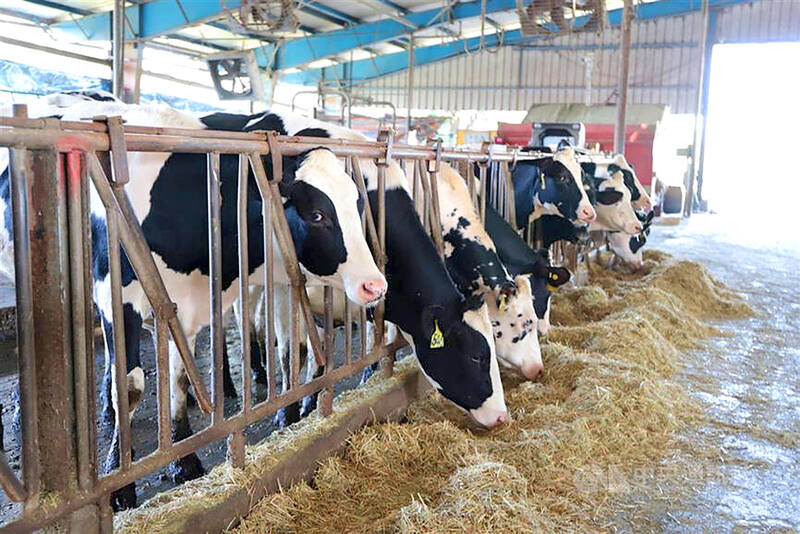
Cows are pictured at a farm in an undated photograph.
Photo: CNA
The institute used the analysis to develop an evaluation technique that dairy farmers use to detect health issues in cattle a week or two weeks earlier than before, Wang said.
The technique can categorize milk fatty acids into two types: “newly synthesized” and “preformed,” she said.
Newly synthesized fatty acids are derived from the process of dairy cows digesting feed and their mammary glands synthesizing fatty acids, while preformed fatty acids come directly from diet or body fat, she said.
Analyzing the fatty acid profiles reveals health issues earlier, she said.
For example, levels of newly synthesized fatty acids in milk can indicate how well cows’ rumens are functioning and the quality of their feed, she said.
Preformed fatty acids help detect issues such as insufficient food intake, she added.
With health issues spotted earlier, farmers can more promptly adjust starch, fiber and concentrate in feed and increase the milk fat percentage, Wang said, citing one farm application in which adjusting the feed helped restore milk fat content to 3.75 percent from 3.5 percent.
With that percentage gain, revenue loss of about NT$0.92 per kilogram of raw milk would be prevented, she said.
For a mid-sized dairy farm with daily milk production of 2,000kg, that would avoid monthly revenue loss of up to NT$55,000, she added.
Dairy farmers are advised to monitor long-term data trends instead of using a single figure for decisionmaking when they apply the technique, the institute said.
Milk fatty acids data are warning signals for dairy farm management, it said.
Farmers who observe a sustained negative trend in the milk fatty acid composition of their cows should check the physical condition of their animals, as well as improve potential issues such as moldy feed or poor cowshed ventilation, it said.
KioskNews shows a cleaned-up reading view extracted from the publisher’s page — the original always lives on their site, not ours.