Should seniors be hopping and stomping? Why explosive exercises may help prevent fractures and falls
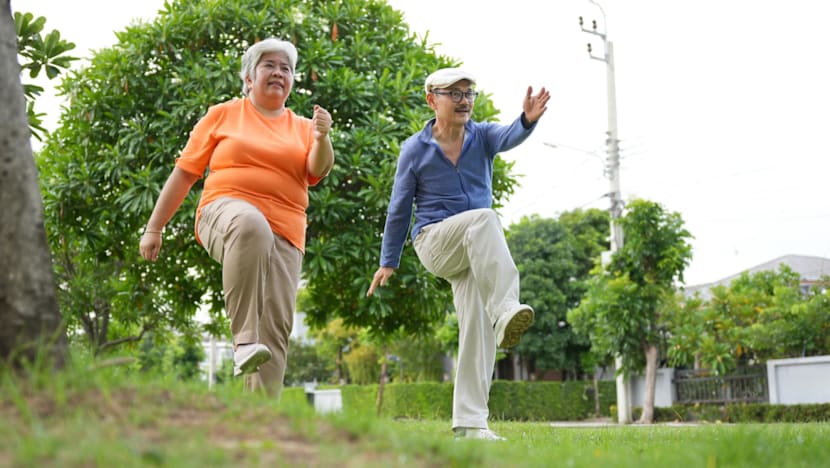
Plyometric exercises aren’t just box jumps and pogo hops. Experts explain how gentler versions can help older adults train their balance, reaction time, speed and bone strength – and how to get started safely.
New: You can now listen to articles.

This audio is generated by an AI tool.

27 Sep 2026 08:13AM
You may be onboard when it comes to strength or resistance training for your 65-year-old (or maybe even older) parents. If you’re not, have a look at this article. But getting them to jump or hop? They're already starting to look frail and their movements can be unsteady at times. What if they fell and broke something?
Besides, you haven’t had much success getting your parents to do more than go to the market for groceries. For many seniors, “exercise” is just that – and maybe walking the grandchildren home from school. You might be able to convince them (if you’re lucky) to join a morning exercise group. And if you’re very, very convincing, they might agree to pick up a fitness band to try some stretching exercises.
But getting seniors to perform quick, explosive movements – or what is known as plyometric exercises – are essential to build agility, balance and speed, said Dr Chiam Tut Fu, a visiting sports medicine physician at Ascensus Health Specialist Centre. “There is a decline in speed, reaction time and body balance with age, and so plyometrics can help to improve these areas.”
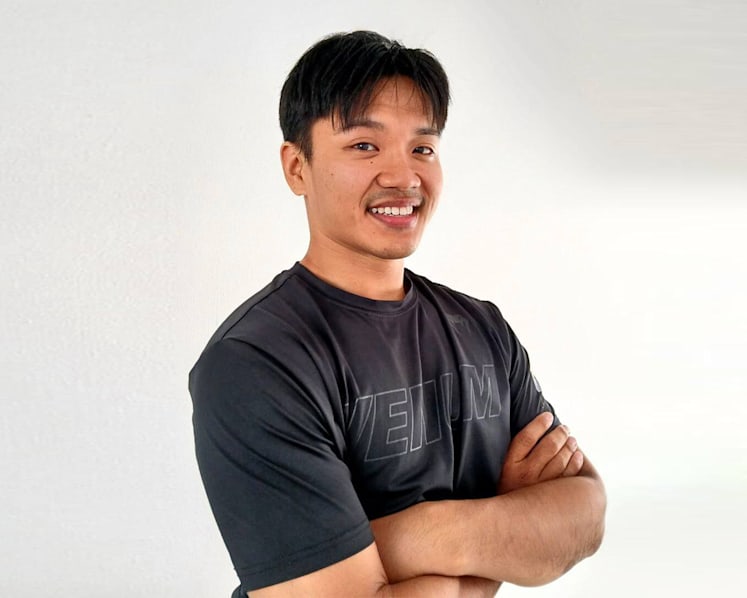
Joshua Tan, 31, an independent personal trainer who has been in the fitness industry for 16 years, agreed. “Plyometrics trains your body to move and react faster, so when you start to fall, you have a real chance of catching yourself or pushing back up off the floor.”
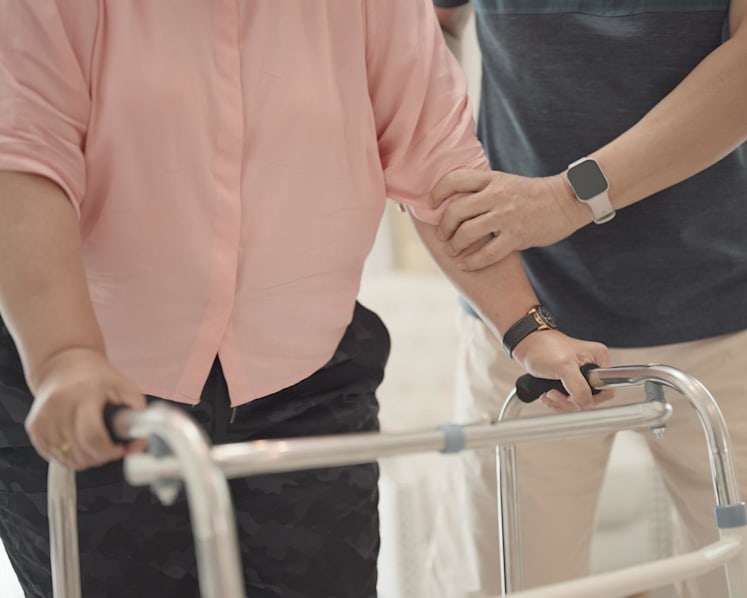
While strength training lets you carry your own weight, Tan is of the opinion that explosive actions are essential for balance, coordination and speed. “If you don’t train your joints and muscles to handle higher-intensity movements, they'll never be prepared for the moments when life demands it, like catching yourself from a fall.”
He added that the impact from plyometric exercises directly helps to build bone density when he noticed that many of his senior clients, especially the female ones, had osteoporosis. “I needed a way to help build their bone strength more directly, and the impact from plyometric movements does exactly that.”
And the research corroborates. A systematic review on the benefits of plyometrics in seniors found that explosive movements like jumping and hopping create forces that activate cells known as osteoblasts (bone-building cells) and osteocytes (cells that maintain the health of bone tissue) to form new bone tissue.
WHAT DO PLYOMETRIC EXERCISES LOOK LIKE FOR SENIORS?
Remember the standing broad jumps you did back in PE class? That’s an example of a plyometric exercise. Other exercises can include box jumps, where you jump from the ground onto a box. Or pogo hops, where you bounce rapidly on the balls of your feet. For the upper body, there are medicine ball slams, where you lift a medicine ball overhead and slam it down hard onto the floor.
Of course, plyometric exercises for seniors wouldn’t look like that – at least not initially. “There won’t be anything scary like a big jump,” said Tan. “It can be as simple as holding onto a rail and doing small hops or skips forward, backward or side to side.” At times, a thick, stretching mat can double as a small step, and the individual can repeatedly step up and down on it, he said.
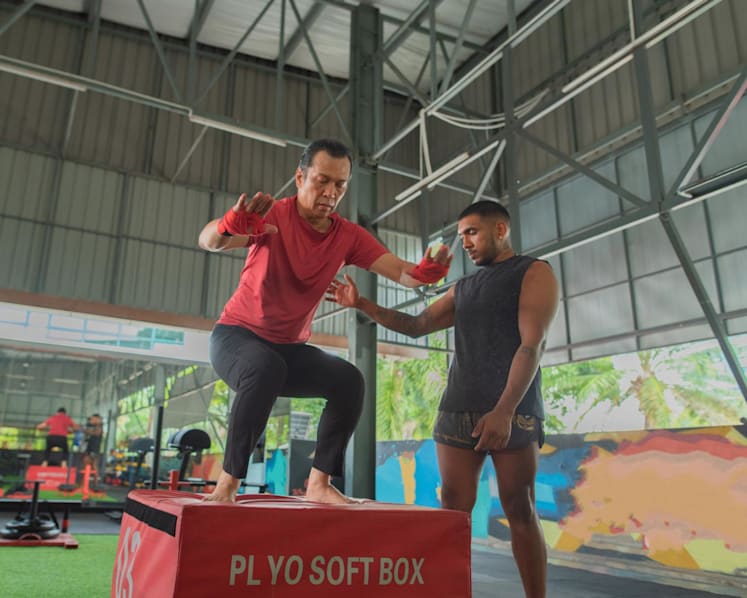
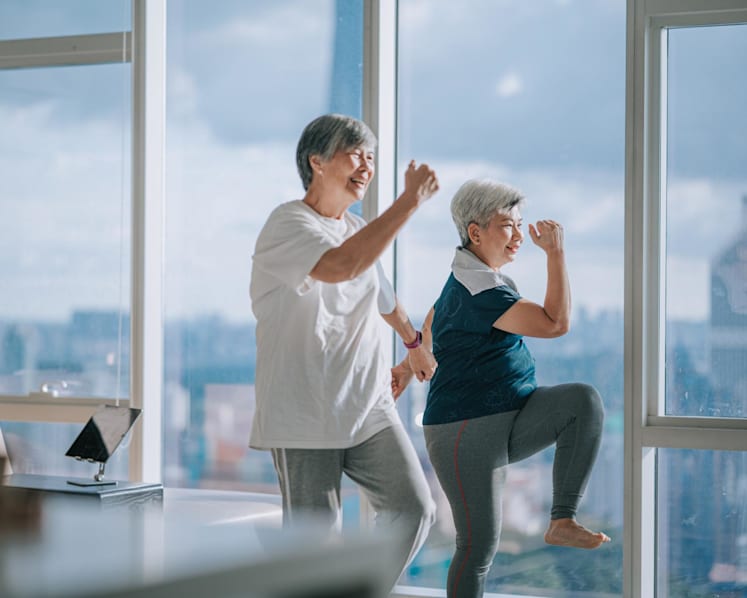
To add variation and increase intensity, the hopping can be performed on one leg, or while holding light weights. It can even just be stomping your feet hard on the ground before standing up. “It doesn't have to be a jump; any quick, explosive movement counts,” said Tan.
WHAT SHOULD SENIORS TAKE NOTE OF?
The exercises need to be carefully designed and executed for seniors, and there should be a gradual step-up in intensity, said Dr Chiam. “Plyometrics for seniors will be similar to those for the younger population but done with less speed, impact and with reduction in joint range of motion, especially at the start of the programme.”
Acknowledging the fear of pain as a big hurdle for seniors, Dr Chiam added that “they can still do plyometrics within the pain-free range of motion” and “depending on their specific joint conditions, suitable exercises and movements can be curated for them”.
Tan is also cognizant of the challenges that older individuals face in his ongoing work with seniors in their 60s and 70s. “Physically, they may have osteoporosis, sarcopenia, knee/back/hip/elbow pain, frozen shoulders, and/or difficulty getting up off the floor,” he observed. “The big non-physical fear is the fear of falling.”
To stay injury-free, engage a trainer who is conversant and trained to manage older people, advised Dr Chiam. “Seniors should also listen to their bodies for aches and pains from the exercise and inform the trainer.”
The good news is, “plyometrics can be done by people with no prior exercise experience”, said Dr Chiam. “As long as they are medically screened appropriately for participation in exercise, they can participate in a plyometrics programme.” Even better news, seniors can see improvements in their body balance, reaction time, speed and even muscle strength from as early as one month with twice-weekly training sessions, he added.
GETTING STARTED
The majority of Tan’s clients is aged 50 and above. Many are “working adults who have neglected their health for years, and they want to get back on track”. “Knowing that they can still jump and move explosively gives them more options in how they use their bodies in their day-to-day activities,” he said.
Tan listed the following lower-body exercises to help seniors build explosive strength, and train their muscles and limbs to move fast when needed. “The impact also signals to your bones and joints that they need to get stronger to handle that kind of load.”
Demonstrating the exercises is Tan’s mother and retired academic, Choo Bee Khim, 63. She found out she has osteopenia – a condition of reduced bone mineral density that is less severe than osteoporosis – when she broke her ankle while cycling two years ago. “I’d just put my foot down from the bicycle pedal and that was it,” she said. Choo used to swim thrice weekly but did not strength train.
Choo’s ankle has since healed but a persistent weakness has caused her steps to be wobbly. Three months ago, at her son’s insistence, she started doing plyometric exercises three times a week. “I feel more confident and have more energy now,” she said.
Tan’s recommendations may sound like a lot: perform each of the following six exercises for three to five sets. “Work up to 50 to 100 reps in total per exercise as your strength builds – very achievable since each rep is quick," he said.
“There's always a normal level of discomfort with exercise,” Tan continued. “I want people working just past ‘comfortable’ to where they start to sweat, but not to the point of panting hard, dizziness or sharp pain. Sharp, sudden pain is always a stop signal. Dull, lingering muscle aches or delayed onset muscle soreness (DOMS) that fades over a day or two is normal and okay.”
For Exercises 1 to 5, position the bar or any form of support about arm's length away from your body in front of you. Hold with one or two hands, whichever you prefer. Keep your elbows slightly bent, and tucked in against the sides of your body. When hopping, push off through the toes or balls of your feet.
For each session, spend about 10 minutes. Aim to do three sessions a week as consistency is key. "Training at least three or four times a week, most people will notice a difference within about two weeks," said Tan. "At two or three times a week, it can take closer to a month."
1. Hopping on the spot
Make sure to hop straight up and down in place.
Hopping on the spot. (Video: CNA/Khoo Bee Khim and Chern Ling; model: Choo Bee Khim)
2. Hopping forward and back
Cue: A line of tape or towel placed horizontally on the floor can give you a visual cue to jump over.
Hopping forward and back. (Video: CNA/Khoo Bee Khim and Chern Ling; model: Choo Bee Khim)
3. Hopping side to side
Cue: A line of tape placed vertically on the floor gives you a visual cue to jump to the left and right.
Hopping side to side. (Video: CNA/Khoo Bee Khim and Chern Ling; model: Choo Bee Khim)
4. Jump squats
Squat your hips down as low as you can stay in control. Explode upwards, letting your feet leave the ground. Then, land with both feet firmly on the ground before repeating. Remove the support once you can do it unassisted.
Jump squats. (Video: CNA/Khoo Bee Khim and Chern Ling; model: Choo Bee Khim)
5. Marching stomps
Raise your knee high, at least up to waist height. Then, stomp your lifted leg down hard enough to make a sound on landing.
Cue: Imagine stomping on a bug. It’s not a soft foot placement, which would turn the stomping into marching instead.
Marching stomps. (Video: CNA/Khoo Bee Khim and Chern Ling; model: Choo Bee Khim)
6. Stomp squats
Start seated. Stomp your feet as hard as you can, using that force to stand upright.
Cue: Let the stomp power your stand; it should not be a separate motion before it.
Stomp squats. (Video: CNA/Khoo Bee Khim and Chern Ling; model: Choo Bee Khim)
The exercises shown may not be suitable for everyone. Older adults should seek medical clearance before starting plyometric training and, where possible, learn the exercises under the supervision of a qualified trainer.
KioskNews shows a cleaned-up reading view extracted from the publisher’s page — the original always lives on their site, not ours.