Diversifying energy sources and fuel suppliers critical for S’pore’s energy security: Tan See Leng
SINGAPORE - Diversification – in both energy sources and suppliers of fuel – is how Singapore plans to safeguard its energy security, even as it aims towards achieving self-sufficiency in the long-run, said Minister for Energy, Trade and Industry (Energy and Industry) Tan See Leng.
This strategy includes ensuring Singapore can tap multiple sources of energy in its fuel mix. This means expanding beyond its current dominant fuel of natural gas to include solar power, energy imports and exploring emerging technologies such as geothermal and nuclear energy.
At the same time, the country will also ensure that it has a range of suppliers for all imported energy sources, Tan said in an interview with local media on Nov 13.
“What we’re trying to do is ensure that with (the diversification and investments into research) that future generations of Singaporeans will always find Singapore energy self-sufficient, secure, reliable, at the same time affordable,” the minister added.
Tan, whose ministry was in October renamed to reflect the growing importance of the energy sector for Singapore, was laying out the plans that the country is embarking on to safeguard the security of this resource.
During the hour-long interview, the minister also spoke about Singapore’s future energy mix, the ASEAN Power Grid and electricity imports, and nuclear energy.
The vulnerability of Singapore’s energy sector to global shocks had recently been highlighted by a spate of geopolitical events.
The closure of the Strait of Hormuz due to the war waged by the US and Israel on Iran is causing oil and gas prices to rise globally, affecting electricity tariffs in Singapore, with implications for households and businesses.
In October, Indonesia also reduced supplies of piped natural gas to the Republic. An official there has also hinted that Jakarta may block renewable electricity exports to Singapore.
“There are neighbors that are finding it challenging to keep up with their own domestic needs, which are rising significantly as well,” Tan said.
“This has reached a particular point, in terms of all of our international relations versus balancing it against growth requirements, and I think that is causing a fair bit of interest (and) a fair bit of tension.”
But he noted that Singapore’s diversification strategy will continue to support the country.
Currently, less than half of Singapore’s natural gas needs are served by piped gas - primarily from Indonesia and Malaysia. In the early 2000s, Singapore relied mainly on imported piped natural gas from Indonesia and Malaysia for power generation.
Indonesia’s existing gas supply contracts with Singapore run until the end of 2028. Tan noted that the Government has taken a long-view of this and has moved on various fronts to ensure that the Republic continues to get access to gas.
For instance, when Singapore’s second LNG terminal at Jurong Port begins operating by 2030, its reliance on piped natural gas would drop further, added the minister.
With the Middle East conflict disrupting LNG shipments from Qatar, Singapore secured replacement fuel from Australia, Africa and the US. Singapore is reaching out further, potentially to Latin America as well, said Tan.
Besides natural gas, Singapore’s power plants must also be able to run on diesel, which the Republic can refine from oil reserves. New power plants too have to be designed to run on a blend of natural gas and a portion of hydrogen, a future fuel.
These multiple layers of fuel safeguards ensures that “you don’t have anything that slips through the cracks”, said Tan.
Natural gas expected to anchor 2050 energy mix
Tan said Singapore’s energy mix around 2050 may still be underpinned by natural gas - comprising 50% or less of the fuel mix - even as the country explores cleaner power sources.
Natural gas is a fossil fuel, and 2050 is the year Singapore has pledged to achieve net-zero carbon emissions.
If 40 to 50% of Singapore’s electricity could come from renewable and cleaner sources, “I think we will be able to decarbonise,” said Tan. “No country in the world can go 100% green,” he added.
This is because natural gas fulfils the 24-hour baseload - providing for the minimum, continuous level of electricity demand required for a power grid - unlike wind, solar and other renewables that are intermittent.
Another cleaner, emissions-free baseload option that Singapore is studying is nuclear power.
While Singapore has not made a decision on nuclear energy, it has beefed up its capacity to study the energy source, and has announced its plan to undergo a readiness assessment by the UN atomic watchdog in 2027.
“And that’s what makes nuclear energy so exciting, because nuclear energy can substitute gas. It is a very dense fuel,” Tan said.
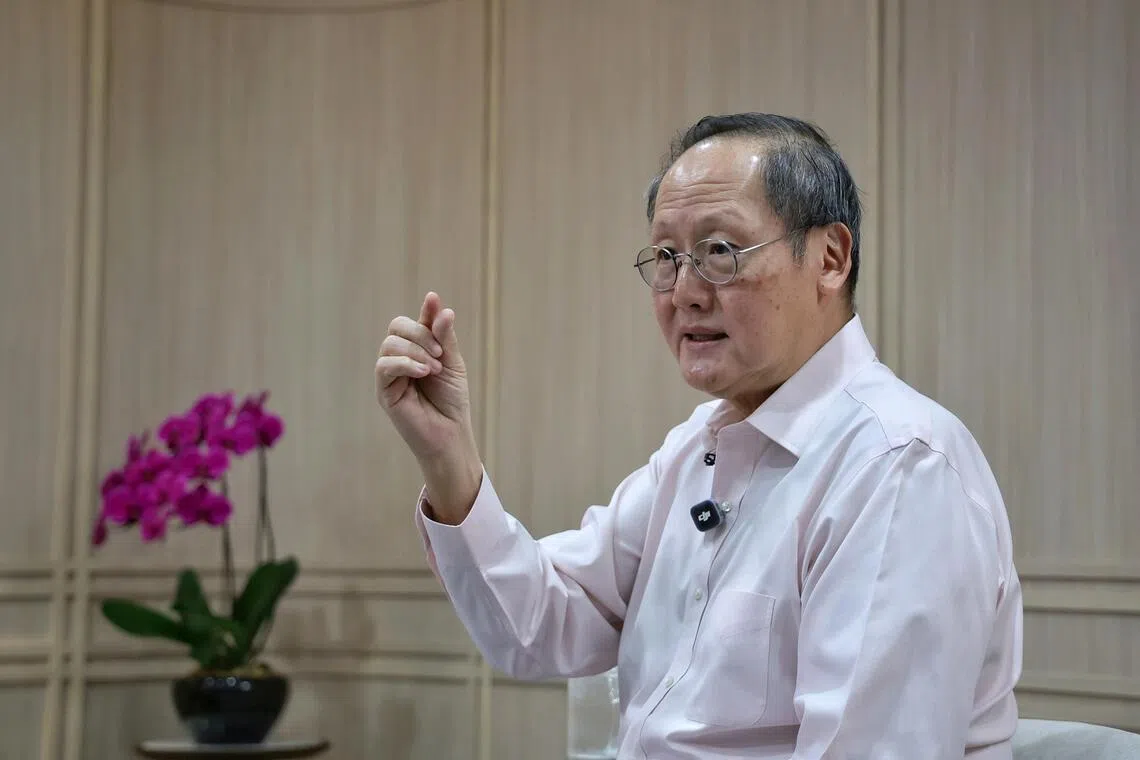
Minister for Energy, Trade and Industry (Energy and Industry) Tan See Leng gestures the size of a uranium pellet with his thumb.
ST PHOTO: KEVIN LIM
Singapore is closely studying advanced nuclear technologies such as small modular reactors (SMR) that have been deemed more suitable for Singapore than conventional, large plants. Promising enhanced safety features, SMRs are compact reactors that can be factory-assembled and installed closer to urban areas.
“If you can do it at scale, and it’s commercially viable, then (nuclear) would really help move the needle in bringing down the natural gas needs,” he said.
In the meantime, the plan closer to 2050 is to have imported electricity form around 25 to 30% of the energy mix.
The “very aggressive ramp up” of domestic solar could meet around 10% of Singapore’s electricity needs then.
The rest of the mix could include green hydrogen - which does not produce any planet-warming carbon dioxide when burned - and green ammonia. If Singapore decides to go nuclear, SMRs may contribute to “some percentage” of the mix, said Tan.
At that time, Singapore would also have a clearer picture of its geothermal potential, he added.
Balancing cost against energy security and going green
The minister was also asked about how the Government will balance safeguarding energy security and its decarbonisation drive against higher electricity prices.
“We are very focused on ensuring that we don’t price ourselves out the market,” Tan said.
Singapore does not subsidise electricity tariffs because “you are inevitably subsidising those people who consume a lot”, he added.
Instead, tiered U-Save rebates are given to households to offset their utility bills.
As for businesses that invest in Singapore, Tan noted that they are aware of the premiums that they are paying in exchange for stability and a disruption-free environment, where firms have the confidence to make long-term business projections.
On how Singapore will attain its climate targets if natural gas continues to be part of its energy mix, Tan noted that carbon capture technology could hold some promise.
This technology entails sucking planet-warming CO2 from polluting sources and locking it away either in rock formations deep underground or under the seabed.
While Singapore has entered into a few carbon capture and storage agreements with a few countries, until the technology can reach a certain scale, today the cost is “very prohibitive”, said Tan.
“If the cost is very low, ideally I would like to capture all of it,” said Tan.
Moreover, capturing carbon from the burning of natural gas is tricker than doing so for more pollutive fuels like coal, because the carbon content in a gas-fired power plant’s exhaust is more diluted.
Tan said: “While I want to ensure we have that energy security, that diversification, and decarbonisation, I’ve also got to ensure that it’s affordable for all of you.
“And to me, we will decarbonise, but we will never decarbonise at all costs.”
KioskNews shows a cleaned-up reading view extracted from the publisher’s page — the original always lives on their site, not ours.