Insects on these sub-Antarctic islands are bouncing back after invasive rats and mice were eradicated
Island species typically evolve in isolation – and often without many predators. As a result, islands are home to high numbers of unique species.
Unfortunately, these species are highly vulnerable. When introduced species arrive, they often prey on or out-compete island species, driving them to extinction. Around 75% of all documented extinctions since European colonisation have taken place on islands.
Rats and mice have followed humans around the globe. Rodents often stow away on boats and make their way to rodent-free islands. Once ashore, their populations surge at the expense of birds, lizards, plants, invertebrates and other creatures. Seabird chicks in nests are eaten alive by rats and even by mice. Dramatic falls in populations often follow.
Black rats wiped out the endemic Lord Howe Island stick-insect within a few decades of arriving. The large, striking insect only survived on a remote, rodent-free rock stack offshore.
In response, land managers have worked to eradicate rats and mice from remote islands around the world. It’s well documented that seabird populations recover with rodents gone. But what about other creatures? In our new research, we tracked how unique island invertebrates fared. We found recovery can be slower than expected – but it is happening.
Rodent removal is a big job
Rats and mice are small, clever and resilient. Removing them from large islands isn’t easy. If even one breeding pair is missed, they can repopulate rapidly.
The good news: our removal methods have advanced considerably in recent years.
Currently managers rely mainly on poison baits for eradication. Aerial baiting by helicopter – and even drones – means baits can be spread everywhere, with GPS used to ensure accurate delivery. Baiting methods are adapted for the size of the island and other species present.
These methods have made it possible to successfully eradicate all rats and mice from islands previously considered too large or geographically complex. Macquarie and Antipodes Islands are two of these.
After aerial baiting with helicopters and follow up with detection dogs, Macquarie Island was declared free of rats, mice and rabbits in 2014. Antipodes Island has been mice-free since 2018.
When rodents are gone
What happens on these islands after the last rats and mice die?
Seabirds bounce back well, though full recovery can take decades. Threatened seabird species are relatively well studied, as they are easy to locate and count.
We know much less about unique invertebrates, as they are smaller, harder to find and less charismatic than albatross, penguins and seals and therefore receive less attention and funding. But they are crucial for healthy, functioning ecosystems, working to break down organic matter and drive nutrient turnover and decomposition.

To understand whether invertebrates were recovering, we compared two sub-Antarctic islands: Antipodes Island, which had a single invasive rodent (mice) and Macquarie Island, which had rats, mice and rabbits. There are no native land mammal, reptile or amphibian species on either island.
Despite being separated by almost 1,500km of ocean, long-distance dispersal via wind and birds has meant the two islands share 18 invertebrate species. They also have their own unique species, including an endemic snail on Macquarie and an undescribed cave weta (flightless ground cricket) on Antipodes Island, which is likely extinct due to mice.
Antipodes Island has over 80 known native species of insects and 16 species of spiders, while Macquarie Island has only 19 known native species of insects and 3 species of spiders. Both islands have many more species of other types of invertebrates such as worms, ticks, springtails, mites, molluscs and many more.
With no permanent towns, agriculture, bushfires or land clearing, these islands represent ideal natural laboratories.
We visited both islands over several years to catch surface-crawling invertebrates in traps. Both islands are very windy, which means they have only a few flying insects.
We sampled a range of sites on both islands, and resampled the same sites over time. It then took hundreds of hours of microscope time by an expert to identify all the specimens.
We compared our results to data collected before rodents were removed. This involved a lengthy search for historical records and datasets, culminating in 30 years of data for Macquarie Island, and eight years for Antipodes. Long-term monitoring provided us with essential background and baseline data.
Recovery is real
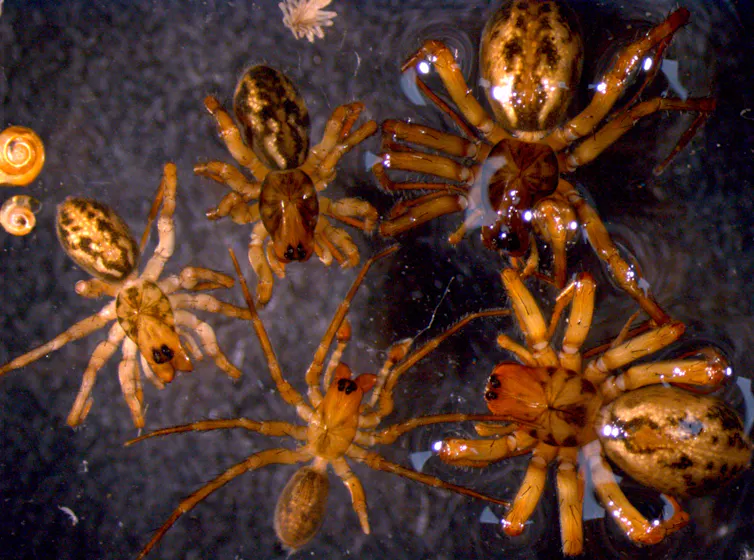
Invertebrates were showing good signs of recovery on both islands. There were more invertebrates overall and generally more species found across sites. Invertebrates preyed on by mice showed particularly strong recovery, such as spiders and fly larvae.
Recovery wasn’t equally spread. On Antipodes Island, native spiders, beetles, worms and pseudoscorpions showed the greatest signs of recovery, while native flies were the biggest beneficiaries on Macquarie Island.
Why the difference? For over 150 years, rabbits thrived on Macquarie Island, grazing its remarkable grasslands, megaherbs and herbfields. More than a decade after they were removed, the plants and landscape have still not fully recovered. That means less habitat for invertebrates. Macquarie also had invasive rats.
Eradication is worthwhile
Our results add to the body of knowledge showing eradicating invasive species from islands brings benefits.
Australia’s coral-fringed Lord Howe Island has been rat- and mouse-free since 2019. Native invertebrates and birds are bouncing back.

Islands are hotspots for both biodiversity and extinction. Getting rid of rats, mice and other pest species can bring endemic and native species back from the brink – and begin restoring wider ecosystems.
Eradication has to be coupled with ongoing biosecurity measures for visitors and cargo to ensure rodents and other species don’t return.
Our research makes the case for eradicating rodents on more islands, such as New Zealand’s sub-Antarctic Auckland Island and South Africa’s Marion Island, where mice are decimating native species.
Mice and rats continue to be problems on Australian islands, from larger Norfolk and Christmas Island to hundreds of smaller islands. Long term, we can stop invasive rodents from taking such a heavy toll on island species and restore ecosystems.
Dr Melissa Houghton from Biosecurity Tasmania contributed to this article.
KioskNews shows a cleaned-up reading view extracted from the publisher’s page — the original always lives on their site, not ours.