‘10,000-tonne level talent’ biologist Zhao Yingming leaves Chicago for Hangzhou
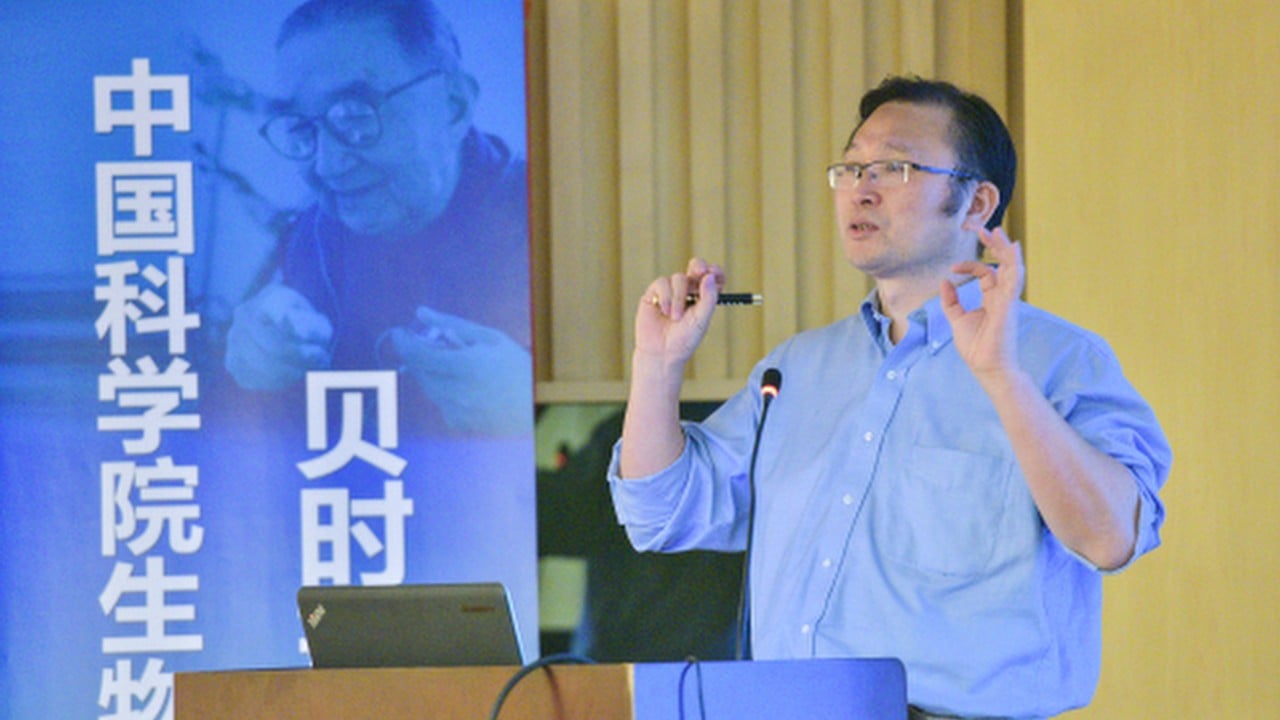
In early November, a low-resolution photo of an internal meeting circulated on China’s social networks, accompanied by a caption with only one sentence: “It is said that he is a top-tier introduced talent at the 10,000-tonne level.”
The main person in the photo is leading biologist Zhao Yingming, who was the Louis Block Professor in the Ben May Department for Cancer Research at the University of Chicago. He has just joined Zhejiang University in Hangzhou, according to sources.
Zhejiang University has not yet announced his appointment, however, an insider at its medical school confirmed that the professor had joined. By the time he appeared in Hangzhou, his homepage on the University of Chicago’s website had been removed.
Zhao’s research focuses on proteomics – the study of proteins and their modifications – and epigenetics, how chemical changes to DNA and histones regulate gene expression without altering the underlying genetic code.
These tags act like switches, sending metabolic changes within our bodies to the genes in the cell nucleus and controlling whether the genes are activated.
Zhao has identified more histone modification sites than any other scientist in the world.
In the first half of this year, Zhejiang University surpassed Harvard University in the Nature Index global academic institution rankings, taking first place worldwide. Harvard had held the top spot since the index’s inception in 2014.
Zhao’s departure not only means the United States has lost a pre-eminent pioneer in epigenetics, but it also reflects a dramatic shift in the global balance of scientific research power. In the biomedical field, long regarded as the US’ surest bastion, the reverse migration of top Chinese scientists is accelerating.
The South China Morning Post has contacted Zhao for comment.
Zhao received a Bachelor of Science degree in physical chemistry from East China University of Science and Technology in 1984, and earned a PhD in analytical biochemistry from Rockefeller University in the United States in 1997.
Can Hong Kong become a new centre for frontier medicine?
In October 2008, he joined the Ben May Department for Cancer Research at the University of Chicago as a tenured associate professor. In late 2011, he was promoted to tenured professor.
Zhao’s work focuses mainly on discovering previously unknown “small chemical tags” on proteins – such as lysine crotonylation, succinylation, and lactylation.
This core work reveals the mechanisms by which they regulate gene expression through the metabolism-epigenetics axis.
He has achieved considerable success in this field.
According to the leaked photo, Zhao has published more than 210 papers, including in top journals such as Cell and Nature.
These papers have received more than 61,500 total citations. He also received the University of Chicago Distinguished Professor Research Award in 2022.
He has so far identified around 1,200 histone modification sites – more than the combined total discovered by other scientists worldwide over the past half-century.
In September 2025, at the invitation of the Nobel Assembly, Zhao attended the 2025 Nobel Conference on Metabolites at the Nobel Forum of the Karolinska Institute in Sweden and delivered a lecture titled “Metabolite-Coupled Lysine Acylation Pathways”.
He was the only proteomics researcher invited and the only ethnic Chinese scientist to speak at the conference.
Zhao is one of several full-time American professors to join Zhejiang University in recent months.
Before him, a number of professors had joined Zhejiang University from top US institutions including the National Institutes of Health and Johns Hopkins University. Their fields covered frontier areas such as gut microbiota, epigenetics and ophthalmology.
KioskNews shows a cleaned-up reading view extracted from the publisher’s page — the original always lives on their site, not ours.