Stop hostile talk, Taiwan urges China
‘EQUALS’: The ROC and PRC are not subordinate to each other, which is the consensus among Taiwanese, who are the only ones who can decide Taiwan’s future, MOFA said
By Huang Ching-hsuan and Chen Yun / Staff reporters


Taiwan yesterday urged China to stop its hostile rhetoric toward Taiwan as the US welcomed President William Lai’s (賴清德) commitment to Taiwan Strait stability in his Double Ten National Day speech.
Lai on Saturday described Taiwan as a “city upon a hill” and said that “Taiwan cherishes peace, but we will not give up our freedom. We are open to exchanges, but will not accept subordination.”
China’s Taiwan Affairs Office said Lai’s speech “disregards facts, distorts the truth, misleads the public and reveals ulterior motives.”
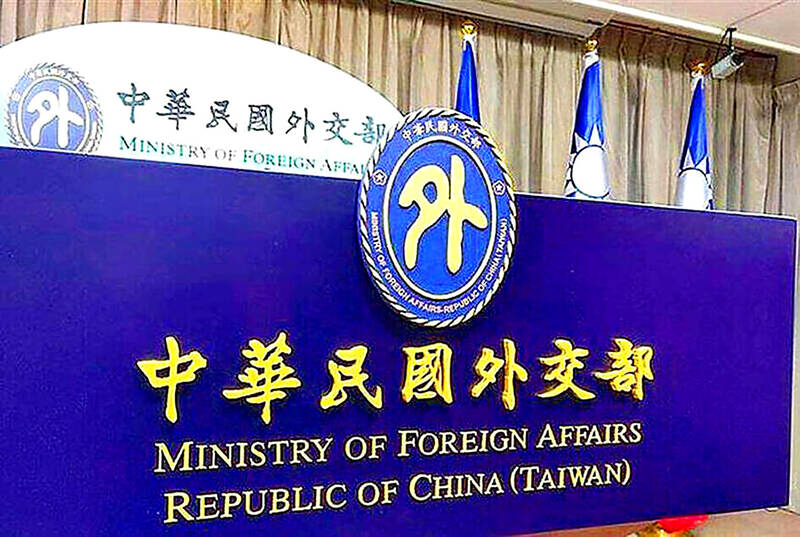
The Ministry of Foreign Affairs’ name and logo are displayed at the ministry in Taipei in an undated photograph.
Photo: CNA
Taiwan is part of China and Taiwan’s future “can and must be decided jointly by all the Chinese people, including our compatriots in Taiwan,” it added.
The Ministry of Foreign Affairs (MOFA) said China has no right to dictate Taiwan’s future, urging Beijing to stop hostile rhetoric that could heighten cross-strait tensions and to abandon the use of force or coercion to change the “status quo” in the Taiwan Strait.
The Republic of China (ROC) and the People’s Republic of China (PRC) exist as equals and are not subordinate to each other, a reality recognized by the international community and the consensus among Taiwanese, the ministry said.
Taiwan’s future can only be decided by its 23 million people, and China has no right to interfere, it added.
“Taiwan will continue to collaborate with global democratic partners and remain committed to safeguarding national sovereignty and supporting Taiwan’s sustainable development, as well as preserving peace, stability and prosperity across the Taiwan Strait and the region,” the ministry said.
A US Department of State spokesperson said the US welcomed Lai’s commitment to maintaining peace and stability across the Taiwan Strait in his National Day address.
Separately, Brookings Institution senior fellow and former American Institute in Taiwan chairman Richard Bush said he was struck by the moderate tone Lai took in his speech while discussing cross-strait relations.
Lai took a pragmatic view of potential threats while remaining open to dialogue, he said.
In Taipei, National Taiwan University political science associate professor Chen Shih-min (陳世民) yesterday said Lai’s speech reflects three main principles: maintaining stability, expressing a clear stance and reiterating Taiwan’s commitment to safeguarding peace.
It also did not provide Beijing with any excuse for military coercion or provocation against Taiwan, he said.
Lai’s statement that Taiwan “welcomes the US and China managing their competition through dialogue and reducing the risk of conflict and war” makes it clear that the nation welcomes a dialogue between the US and China, he added.
The president reiterating that Taiwan is a protector of peace and stability in the Taiwan Strait and that enhancing defense capabilities is not a provocation but to deter war also demonstrated that Taiwan would not be the first to use force and that it opposes all forms of violence, Chen said.
That dispels China’s narrative that “Taiwan is a disturber of peace and stability or a provocateur in the Taiwan Strait,” he said.
Chinese President Xi Jinping (習近平) during a meeting last month with US President Donald Trump said China and the US fought together against Japan in World War II, Chen said.
Lai in his speech set the record straight, saying that it was the ROC government that fought alongside the US during the war, he added.
The president also detailed Taiwan’s economic achievements, and the figures demonstrated that as the nation reduces its dependency on China, its economy boomed and it became more connected to the world, Chen said.
National Chung Cheng University Department of Political Science professor Tsai Jung-hsiang (蔡榮祥) said Lai’s speech reiterated the definition of peace, rectified historical facts and formed alliances with the international community.
Lai emphasized that peace must be maintained through strength, while providing a clearer definition of what that means: developing asymmetric weapons, enhancing national defense capabilities and aligning with the combined strength of Indo-Pacific nations, he said.
KioskNews shows a cleaned-up reading view extracted from the publisher’s page — the original always lives on their site, not ours.