BHEKISISA: A rural mother’s 30-year journey of caring for a son with cerebral palsy
Cerebral palsy often announces itself in the space where a milestone should be.
For Keneilwe Dikoma, it was when she took her baby for his six-month check-up at a clinic near their home in Lotlhakane, a village of scattered homesteads and open veld in North West. By then, Lorato should have had the physical skills healthcare workers look for to make sure babies are on track – rolling over, pushing up with straight arms and sitting.
Dikoma was a teenager at the time, just 16, and it was her first child. He was a peaceful baby and smiled a lot from early on. She was smitten.
“I had a baby and I was happy,” she told Bhekisisa’s TV programme, Health Beat, about those early days, the time before the check-up, that September day in 1995 when her life would change in ways she could have never anticipated. That was the day the clinic sister told her something was wrong, that Lorato should have been sitting up by now, and sent her to the closest hospital.
She wouldn’t know it yet, but Dikoma would never go back to high school as she planned. Her life would be consumed by Lorato, who would be diagnosed with a condition she didn’t even know existed.
All she knew then was that she was scared. She started asking herself: Why me?
A secret language
At Gelukspan District Hospital, Lorato was diagnosed with cerebral palsy (CP), a group of permanent conditions affecting movement, posture and muscle control that are caused by damage to a child’s brain, or by that brain not developing normally. It can happen before or during birth, or at any point up to the age of two. Although the brain injury itself doesn’t get worse over time, the way it affects a child can change as they grow.
Globally, it is one of the most common causes of physical disabilities that start in childhood. Locally, CP is the most common condition for which provincial health departments are sued for medical negligence – with the highest payouts per case.
CP affects people differently. Lorato, now 31, has spastic quadriplegic CP, which affects all four limbs.
He uses a wheelchair and is wholly dependent on others to wash him, feed him and dress him. A tightness constantly grips his body, pulling it into a twist that has caused severe scoliosis, a curve in his spine. His body often jerks in movements which are difficult for him to control.
It’s not clear how much he understands – people with CP can also have intellectual disabilities – though those close to him say Lorato knows far more than he is able to express. His ability to communicate is limited; he uses sounds and eye movements to let people know what he needs, and can say a few words, but it is a sort of secret language unintelligible to most people.
But everyone in the village knows Lorato. He’s a happy person, who laughs and squeals with approval, which is much of the time. He’ll go to any gathering he can – from a funeral to a birthday party. He loves gospel, and insists the TV be on full volume if a choir comes on.
It is from the church community, Dikoma says, that he gets the most joy. If he misses a Sunday, he’ll go quiet and become withdrawn for a couple of days, sometimes refusing to eat.
“They accepted him, made parties for him, everything,” says Dikoma, who is able to let Lorato go on church trips and to youth groups on his own. By now, they too know his secret language.
Silent and seizing
Lorato was born in a rural clinic, silent. No one ever told Dikoma why her child did not cry after she gave birth, or why, days later, he began to have fits. Mother and child were sent to Gelukspan, then Klerksdorp Hospital, where he could have better care. The seizures subsided and, two weeks later, they were sent home without anyone realising he had CP.
The early signs of CP are subtle enough that many might miss them. So it’s not surprising that Dikoma, a teenager with a new baby, didn’t know what was happening.
In the first six months, there might be a stiffness or a floppiness in their body; when lifted, their back could arch backward; their legs may cross and scissor.
/file/attachments/orphans/KeneilwetakescareofLorato_486283.jpg "The home Keneilwe Dikoma built for her children. The long-drop toilet is out of sight (it’s a structure behind the house that can’t be seen in the picture). Lorato cannot use it safely or balance on his own, so his mom washes him on his bed and helps him go to the toilet there. (Photo: Albert Tibane)")
Researchers say the earlier the diagnosis – as it was for Lorato at his six-month check-up – the better it is for the child. CP is usually only diagnosed between 12 and 24 months, though it can come much later in poorer countries.
CP has many possible causes, including infections, stroke, premature birth, genetics and birth asphyxia – when a baby doesn't get enough oxygen around the time of birth.
A study at Tygerberg Hospital in Cape Town reviewed the records of 613 children with CP seen at its clinics between 2010 and 2020. For 17% of those children, researchers identified brain injury linked to premature birth as the cause; in 15%, the injury came after birth, half of those from meningitis, an inflammation of the protective lining of the brain and spinal cord, caused by tuberculosis (TB) or other bacterial infections, something healthcare workers in Gelukspan told us are what they see most often.
But in the Tygerberg study, the largest single cause found, in about four in 10 children, was birth asphyxia. In the womb, oxygen travels from the mother’s blood into the placenta, the organ that passes it on through the umbilical cord and to the baby. Oxygen supply can fail for several reasons, including when a mother’s blood pressure drops; the placenta is torn from the womb; or the umbilical cord knots or squeezes shut. A prolonged labour can also affect the baby’s oxygen flow.
Healthcare workers who saw Lorato in his early days suspect that the latter is what happened, but his medical records don’t exist. Dikoma was so young, and it all happened so many years ago in a rural clinic where apartheid and Bophuthatswana still lingered, so she doesn’t know where things may have gone wrong.
Birth asphyxia rates can be reduced – SA’s own health department says so, and has said as much since 2011. Its recommendations are basic: staff should be trained to revive newborns (get them breathing in the case of low oxygen) and handle emergencies during labour; transport between clinics and hospitals needs to work better and hospitals need the equipment and guidelines to cool babies whose brains have been harmed by a lack of oxygen – treatment that can limit further brain damage in district hospitals like Gelukspan.
It is when negligence creeps in that families suffer the devastating consequences. CP is at the heart of more than 60% of SA’s medical negligence cases, according to the South African Legal Resources Council, and accounts for some of the state’s biggest payouts.
Meeting Mmatumelo
When the frightened Dikoma arrived at Gelukspan in 1995, she met Undine Rauter, head of the hospital’s physiotherapy department.
Rauter had arrived two years before, coming from Germany as an eager 28-year-old Lutheran missionary with training in physiotherapy. For years it had been little more than a dumping ground for people with severe disabilities whose families could not, or would not, care for them at home.
She was determined to help. She learned Setswana, and embedded herself in the community; the women in a sewing circle gave her a Setswana name: Mmatumelo, meaning mother of faith.
/file/attachments/orphans/UndinecheckedLoratosprogress_831803.png "Undine checked Lorato’s progress and showed his family how to help him at home when they could afford the trip to the Parent Guidance Centre at Gelukspan District Hospital. (Photo: Undine Rauter)")
/file/attachments/orphans/AttheParentGuidanceCentre_512402.png "Undine checked how Lorato was sitting and moving, and looked for ways to help him sit more comfortably. (Photo: Dikoma family)")
“Mmatumelo asked me then whether I would be able to stay with my child at the hospital,” Dikoma says. “I went home, packed my things and came back with him.”
At the time, the Parent Guidance Centre at the hospital was fairly new. It was a place where parents and children could stay for several weeks and work with the physiotherapy team to learn how to care for a child with disabilities and what to expect as they grew. Mothers were taught how to feed, position, lift and exercise their children and could later return for refresher courses. The goal: bring physiotherapy care into the home and the community so knowledge gets passed along, making institutional care a last resort.
Dikoma stayed at the hospital with Lorato for six weeks.
“I really struggled to accept it in the beginning,” she says. “But they sat me down, and they explained properly what kind of child he was. I had to care for him. I didn’t have a choice. After all, he is my child.”
Although medicines and surgery can help manage it, in 2019 researchers found strength training and exercises done at home are what work best.
“Disability is definitely not about fixing things,” Rauter told Health Beat.
“If you see a child with a disability in isolation, you will not achieve anything. You need the family context. You need the mother to buy in and to embrace the child, with all their limitations and all of their abilities.”
‘This is how we do it’
In a review of data from 27 countries, researchers found that about one to two babies in every 1,000 born in high-income countries have CP. Figures for low- and middle-income countries are much harder to pin down.
A South African study often referred to found CP rates five times higher than figures commonly reported for high-income countries – but it is now almost 25 years old and covers just one rural area of KwaZulu-Natal. That gap in knowledge is exactly why SA needs a national CP register, say advocates and researchers; knowing how many people have CP, what type they have and where they live would help the country plan services, track trends and work out where prevention efforts are succeeding or failing.
/file/attachments/orphans/AtherapyroomattheParentGuidanceCentre_447207.jpg "A therapy room at the Parent Guidance Centre, where parents are taught how to support children with cerebral palsy. (Photo: Albert Tibane)")
Researchers have recorded accounts of women carrying disabled family members on their backs to get them care. Travel by car isn’t easy either; the bounce and jolts delivered by uneven, potholed dust roads like the ones around Lotlhakane can make the trip painful for those with a disability. Even when there is a clinic nearby, it doesn’t mean it’s going to have what you need when you get there.
The clinic nearest to the Dikomas’ home is now a mobile one, and it doesn’t always carry Lorato’s medication. If they don’t have it, she takes a taxi to Gelukspan, which is 27km away. When Lorato needs to get to the hospital for his appointments, it is far more costly. He cannot travel in a taxi, so Dikoma must hire a car for R300, round trip. That uses up almost one-seventh of his monthly R2,200 disability grant.
“I am a single mother with three other children and I am not working,” she says. “That money must pay for our food, clothing, everything.”
The most basic needs of daily life with a disability like CP are compounded by poverty.
/file/attachments/orphans/ThehomeKeneilweDikomabuilt1_612640.jpg "The home Keneilwe Dikoma built for her children. The long-drop toilet is out of sight (it’s a structure behind the house that can’t be seen in the picture). Lorato cannot use it safely or balance on his own, so his mom washes him on his bed and helps him go to the toilet there. (Photo: Albert Tibane)")
In the Dikomas’ three-room cement-block house there is no indoor plumbing, just a red JoJo tank to collect water. Lorato can’t use the longdrop. He wouldn’t be able to lift or balance himself, or even wheel himself across the red-soil yard, which is broken up by patches of gravel and rubble.
So, when he needs to go, he tells his mom and she lays him down on the bed in the room he shares with his mother and three siblings. She places a nappy underneath him and cleans up afterwards.
She explains this matter-of-factly, the way you describe a path you have travelled for three decades.
“This is how we do it. There is no appropriate toilet for him.”
Falling away
In 2024, News24 reported that locals were calling Gelukspan the “hospital of death”, without a kitchen or operating theatre. When Health Beat visited Gelukspan earlier this year, the problems weren’t difficult to spot: abandoned construction on hospital wings and run-down buildings badly in need of paint, repairs and general maintenance.
Meanwhile, the weeks-long programme at the Parent Guidance Centre that the district health office once funded became a victim of its own success. As more people heard about the programme and signed on, sustaining the amount for housing parents and children for weeks became difficult, and the courses were steadily shortened. By 2016, funding slowed to a trickle and eventually the courses stopped altogether.
Now people with CP are allotted time on Tuesdays for support and guidance. Before the funding cuts, the team had its own vehicle to travel to communities three times a week. But that service eventually fell away. Staff now juggle home-based visits with their hospital workload, using their own cars and claiming back travel costs to get to those who can’t easily get to them. It has left care inconsistent and unreliable.
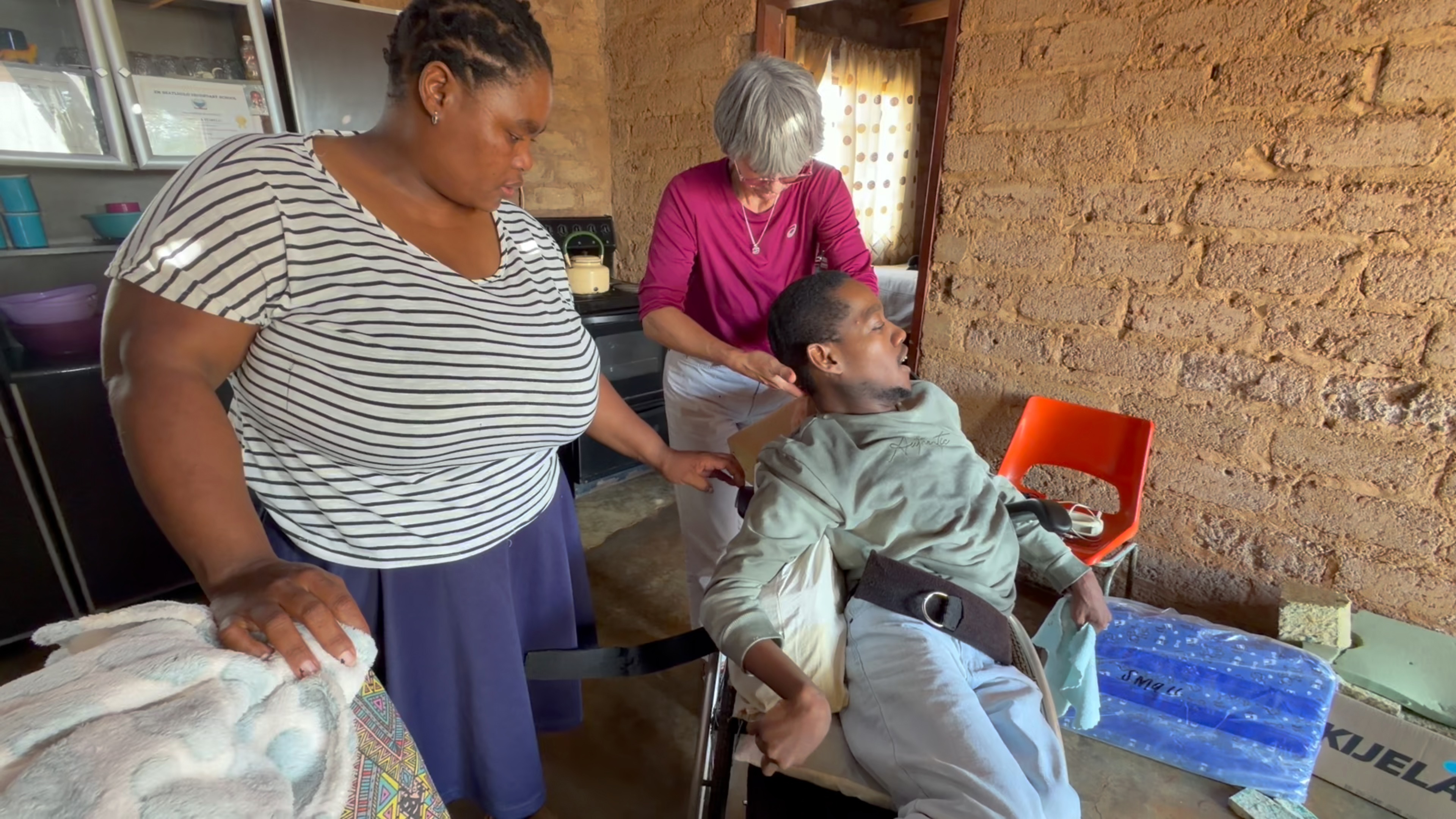
Money for basic equipment also became a problem. As wheelchairs and other equipment to aid the disabled began to give out, the therapy team carefully repaired and reused what it had. That’s left Lorato with a wheelchair that no longer fits. Not only does it cause him pain, it also limits how much he can go out.
But even if he could go out more, there aren’t a lot of spaces where people like him can go. In the gap left at the Parent Guidance Centre, where mothers would support one another as well as get training on how to care for their children, Dikoma and others in the community are lobbying local government to provide a space for activities for children and adults with disabilities.
“At least they would do something,” Dikoma says. “They wouldn’t just feel useless like if they’re only getting up, eating, sleeping. So we have tried to open a centre, but we are delayed by the government. The social workers we meet are not active. We tell them about the various disabilities prevalent in our village – some who don’t talk, who don’t hear. There are so many of them.”
/file/attachments/orphans/Onahousecall_878053.jpg "Undine brings foam blocks to see if she and Keneilwe can help Lorato sit more comfortably and safely in his chair. The therapy team drives long distances on rough roads in their own cars to reach families at home. (Photo: Albert Tibane)")
Passing on
Dikoma has been passing on what she has learned for years. She started by going to her local clinic to teach pregnant women and new mothers what disability looks like and how to catch it early.
“Initially you feel ashamed,” she says of the new mothers. “You ask yourself, what will other people say? So you just stay at home. I can say to them: yes, it is difficult to have a child with a disability, but you have to accept it. In Gelukspan they taught me that moms shouldn’t make excuses and hide their children at home. They should be free and happy, and thankful for what God had given to them. They should be proud of their children, not ashamed of them.”
It was the weeks at the centre, when mother and child could be together with nothing to distract them, that helped Dikoma the most.
“At home you can do a maximum of two hours of exercises. You have other responsibilities – you are cleaning, cooking. But when you go there, it's just you and your child.”
Yet somehow Dikoma has been making it work for the past 30 years. Ask her what it would be like to lose her son and she’ll tell you she doesn’t have an answer.
“I wouldn't know what to do, should God take him,” she says. “No, I can’t imagine that. I love him too much.”
But ask her what would help now and her answers are precise, and mirror what so many caregivers in rural SA have said. Transport, when the children need to get to a clinic or hospital.
Cars for the therapists to travel to the rural areas twice a month. A disability grant that would compensate for the fact that a mother who cares for a child with a severe disability already has a round-the-clock job and can’t get another to support her family. A wheelchair that fits. And a house with a toilet. DM
This story used reporting from Bhekisisa’s May Health Beat programme.
This story was produced by the Bhekisisa Centre for Health Journalism. Sign up for the newsletter.
KioskNews shows a cleaned-up reading view extracted from the publisher’s page — the original always lives on their site, not ours.