Smart tech like robotics, automation to be used at more BTO sites from 2027: Chee Hong Tat
SINGAPORE – The use of smart technology like robotics and automation will be stepped up in the construction of Build-To-Order (BTO) flats to help speed up the building of new homes.
So far, the use of smart technology has yielded encouraging results. It will be scaled up at more BTO construction sites in 2027 to boost construction productivity and reduce manpower needs, said National Development Minister Chee Hong Tat.
Speaking at the HDB Awards Ceremony held at the Resorts World Convention Centre on Sept 25, he said: “As we build more and build faster, we must also build smarter... What matters is not how sophisticated the technology is, but whether it can help to solve practical problems on our worksites.”
One such effort is using robotics for labour-intensive processes like floor screeding. While conventional methods require workers to manually set up level pegs, screeding robots use lasers as a guide and can help workers in levelling and smoothing floors before tiles or vinyl are laid.
Two robots have been deployed under a trial project in 80 flats across two BTO projects in Bukit Merah and Ghim Moh.
In 2027, these robots will be trialled in at least four more BTO projects to assess their performance under different site conditions. HDB will then study their potential for wider deployment.
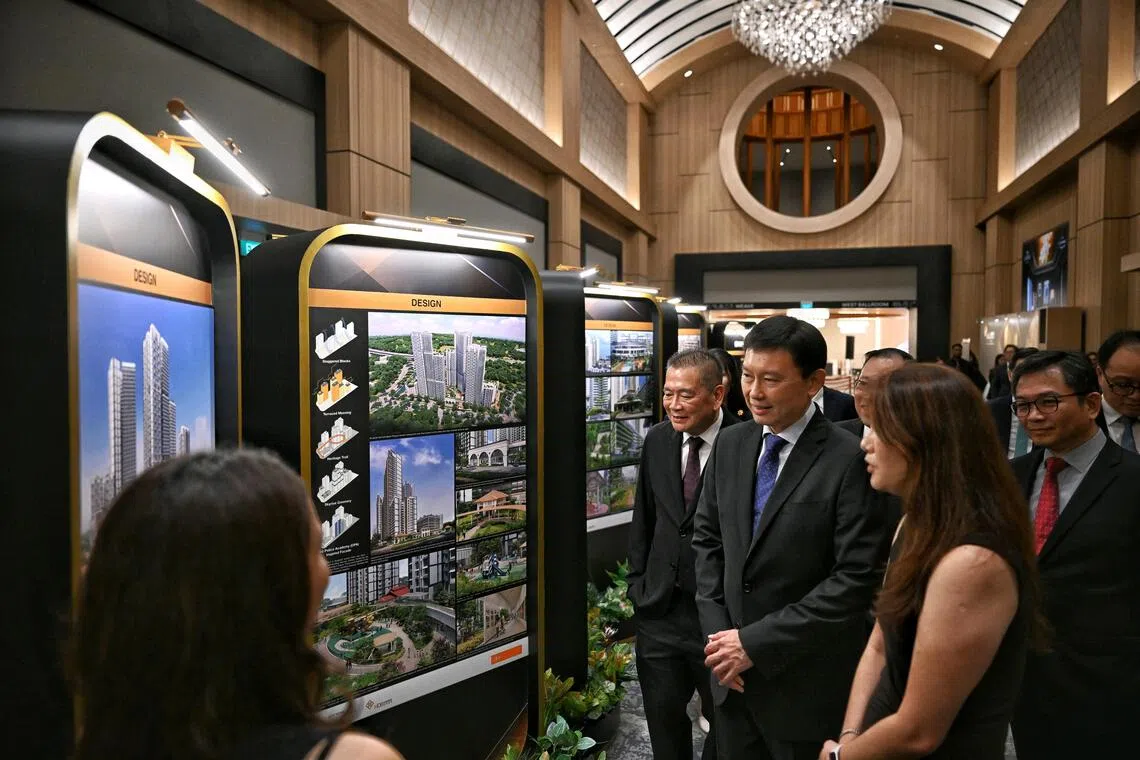
National Development Minister Chee Hong Tat (centre) at the HDB Awards Ceremony held at the Resorts World Convention Centre on Sept 25.
ST PHOTO: ARIFFIN JAMAR
Smart hoists – a temporary lifting system installed on the outside of a building – will be used at about half of BTO sites tendered from 2027, to free up workers for other tasks.
A smart hoist works like a lift, with buttons for each floor, and has safety features such as sensors that scan for obstructions and cameras that detect if workers are wearing the appropriate gear.
One worker can supervise up to three smart hoists, compared with a conventional hoist that needs a dedicated operator to manually steer it across floors using a joystick.
Chee said: “While this may sound like a relatively simple improvement, the manpower savings add up across many blocks and projects, leading to a sizeable overall increase in productivity.”
One HDB block typically has at least one hoist.
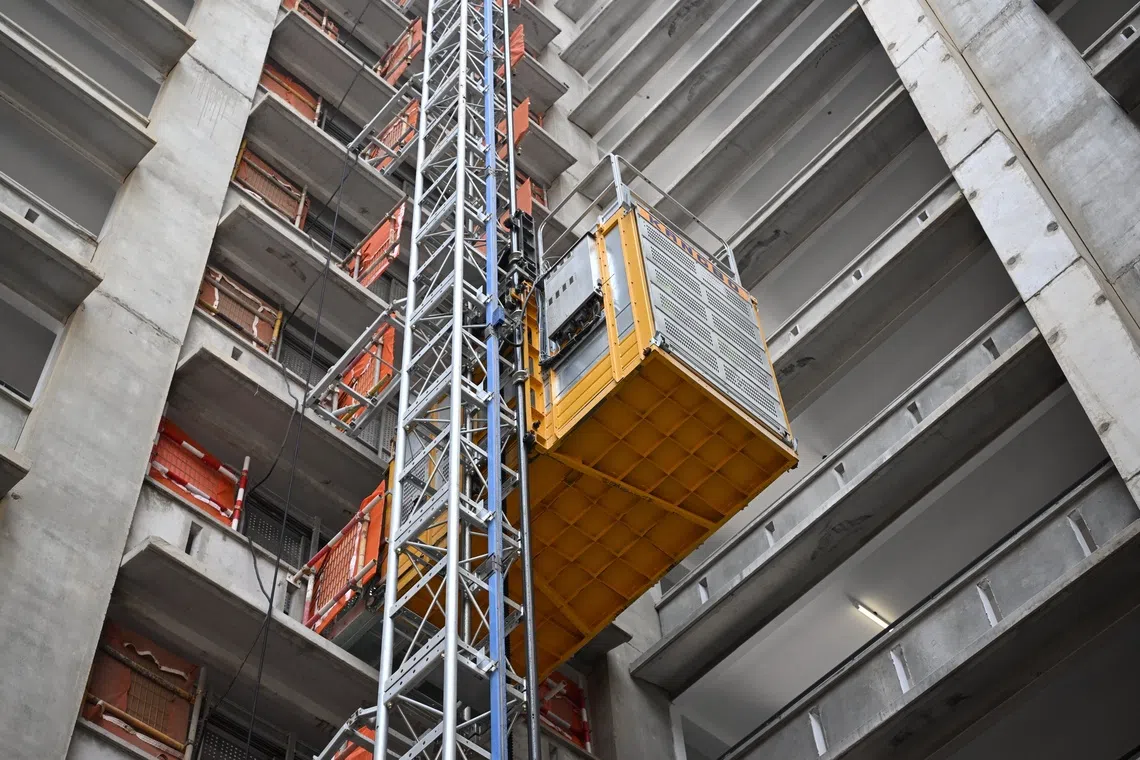
Smart hoists – a temporary lifting system installed on the outside of a building – will be used at about half of BTO sites tendered from 2027, to free up workers for other tasks.
ST PHOTO: CHONG JUN LIANG
Chee said he has asked HDB to work towards deploying these technologies in all new BTO projects.
In addition, under the shortened time for completion scheme introduced in 2023, contractors tendering for selected BTO projects commit to completing them three months earlier.
As part of the tender, contractors propose construction methods and technologies for improving productivity and shortening construction times.
Around 10 projects currently fall under the scheme.
One solution that will be implemented is an inloader – a heavy-duty transport vehicle – that is equipped with a hydraulic jack for loading and unloading precast components so that cranes do not have to be used.
HDB is also piloting an excavator for earthworks in Tengah that uses satellite positioning and digital terrain models for more precision.
And to reduce repetitive work by contractors, HDB will launch on Sept 28 a catalogue of precast components. The catalogue has detailed specifications and drawings – of 17 components at present – so they do not have to be developed from scratch for every project.
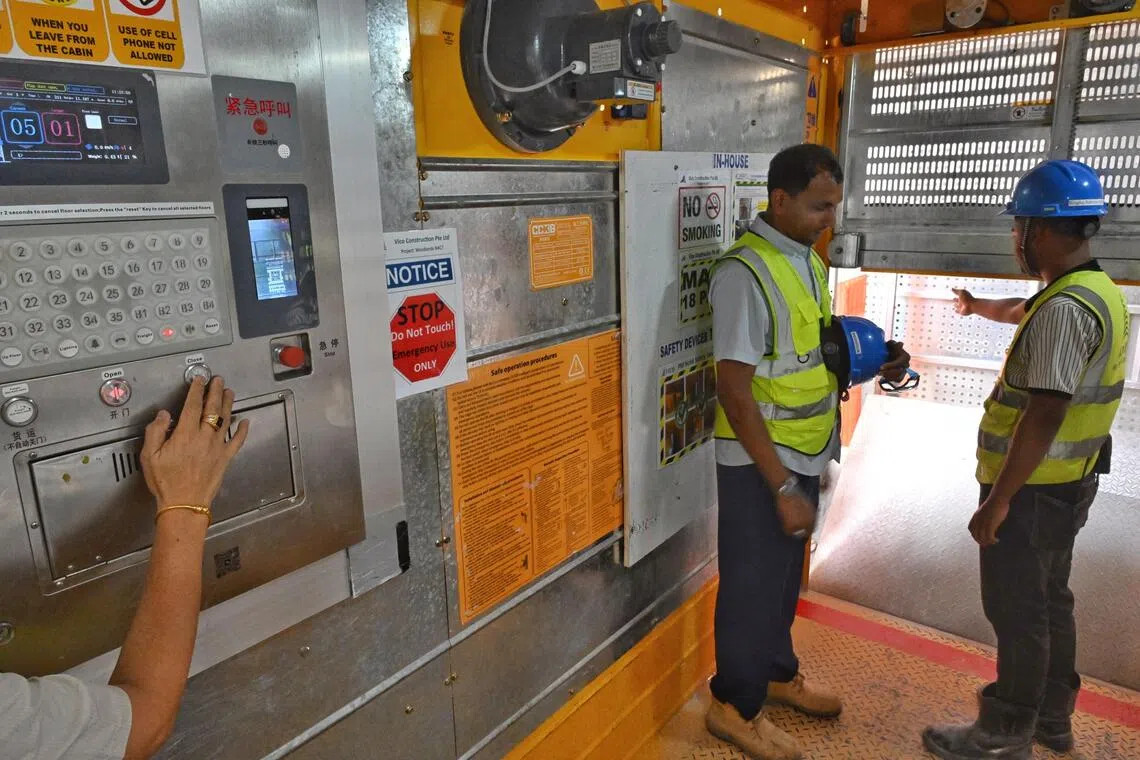
The door of the smart hoist will not close if it detects safety hazards, such as a worker without a helmet or a hand in the way of the door.
ST PHOTO: CHONG JUN LIANG
This could help save up to 20 per cent in project man-hours, Chee said.
HDB added in a statement on Sept 25 that while the catalogue provides greater consistency, there is still flexibility for consultants to design distinctive BTO projects.
With the catalogue, standard components such as staircases and household shelters will have common specifications across all HDB projects. It also has variations for other components such as facades, bathroom units, columns and beams.
HDB said the catalogue helps to strengthen supply resilience as contractors can procure standardised components from a wider range of suppliers.
On Sept 25, 30 projects received awards from HDB for their achievements in design, construction, engineering and landscape.
Two design consultants – LOOK Architects and 3PA – won awards for innovative designs for BTO projects in the new estates of Berlayar and Mount Pleasant respectively, with HDB noting that they had thoughtfully integrated nature and heritage into the projects to give them distinctive identities.
The design of Berlayar Residences drew on the Southern Ridges and waterfront, while Mount Pleasant Crest incorporated elements from the former Old Police Academy.
Isabelle Liew is a journalist at The Straits Times. She covers housing issues in Singapore, with a focus on public housing.
KioskNews shows a cleaned-up reading view extracted from the publisher’s page — the original always lives on their site, not ours.