Bangladesh Market Sees Surge In Solar Panel Demand Amid Energy Crisis
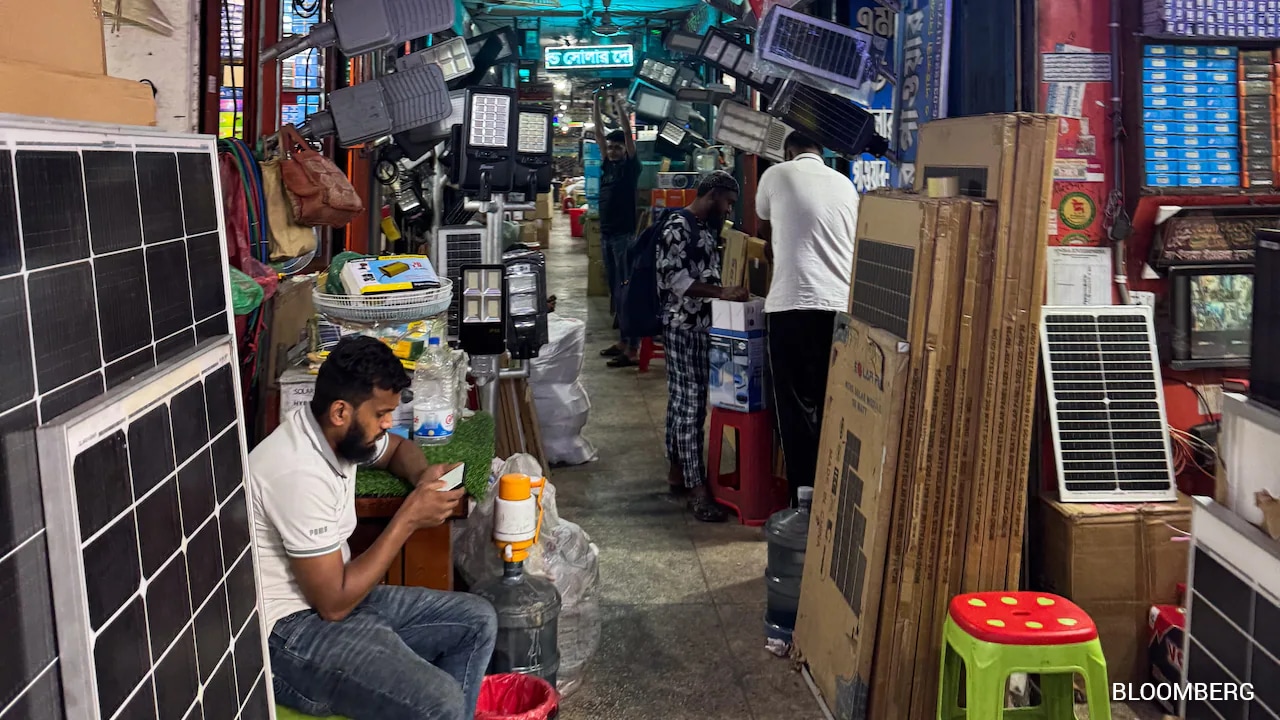
A cramped market in the heart of Dhaka has become an unlikely ground zero for Bangladesh's energy transition. Down narrow aisles crowded with shoppers and delivery workers, tiny storefronts are overflowing with rows of solar panels and batteries.
Monju Hossain, a sales representative for Dongjin Group Bangladesh, said the retailer is struggling to keep up with demand, with sales jumping 50% in recent months from a year earlier. The country's worsening energy crisis, triggered by the war in the Middle East, is pushing households and businesses to seek alternatives to an increasingly unreliable grid.
"The blackouts in Bangladesh have gotten worse, which has increased the need for our equipment," said Hossain, in a shop on the second floor of the Kaptan Bazar. "Demand from industrial customers has increased significantly, as they have to keep factories running."
The busy market offers a glimpse of how the Middle East energy shock is accelerating the shift away from fossil fuels in poorer countries. From the Philippines to Pakistan and Nigeria, people are turning to solar and batteries to cut utility bills or just to keep the lights and machinery on. It's a threat to the long-term demand outlook for liquefied natural gas, given that populous developing nations like Bangladesh have long been touted as high-growth markets for the super-chilled fuel.
The South Asian nation of 180 million has been one of the hardest-hit by the disruption to energy flows from the Persian Gulf. Load-shedding - or rolling blackouts - have stretched to as long as 18 hours a day in some parts of the country this year as LNG exports from Qatar, formerly Bangladesh's main supplier, slowed to a trickle.
To help make up the shortfall, Bangladesh has been buying LNG on the spot market, at around triple the price of its contracted supply from Qatar, forcing utilities to hike electricity bills. That combination of higher costs and power cuts is pushing consumers toward renewables. Even Prime Minister Tarique Rahman has installed solar panels on his house, according to local media reports this week.
An informal survey of more than three dozen stalls at the Kaptan Bazar - one of Bangladesh's biggest hubs for solar equipment - found that all of shops have seen demand increase to varying degrees. A plunge in the cost of solar panels and batteries in recent years has made the technology more affordable for regular households, spurring sales not just in Dhaka's markets but across the country.
China, the world's dominant manufacturer of solar and battery equipment, is helping enable the shift. Bangladesh's imports of the equipment from the country more than doubled to about $140 million in the March through September period from a year earlier.
Panels made by China's Jinko Solar Co. and Longi Green Energy Technology Co. are by far the most popular due to their low price and reliability, according to the Dhaka store owners. Buying a 750-watt panel, enough for a single household, costs about 15,000 taka ($121), compared to about 38,000 taka a year in electricity bills.
Adding a battery and associated equipment will quickly boost the outlay by several times, but those costs can be recouped within a decade for a normal family, Dongjin Group's Hossain said.
The shift to solar is being abetted by Dhaka, which cut import tariffs on the equipment in September. The government is aiming for renewables to make up 20% of the power mix by 2030 and 30% by 2040, according to a local media report this week that cited Prime Minister Rahman. That's up from just 2.5% last year.
Authorities have accepted that more clean power will reduce the country's vulnerability to this and future energy shocks, according to Shafiqul Alam, the lead analyst for Bangladesh at the Institute for Energy Economics and Financial Analysis. The cut in solar import taxes is a help, but it's more beneficial for high-income households that can afford to buy the systems upfront.
"For lower-income groups, they might consider models like India's capital subsidy," he said, referring to a program that provides households with subsidies and other payments for installing solar equipment.
Abdul Hakim began installing rooftop solar at his ceramics factory in Dhaka about six months ago. He now sees enough enthusiasm for the technology that his company is considering expanding into the energy business itself, supplying panels and lithium batteries.
"Demand is high," said Hakim, managing director of Excellent Ceramics Industries Ltd. The next step for Bangladeshi consumers is lithium, he said. "For the backup, they need a lithium battery." Still, the kiln at Hakim's factory runs on natural gas and can't be fully replaced by solar.
The country's textile and garments plants - Bangladesh's top export - which supply international brands like H&M and Ralph Lauren have a similar problem. Textile manufacturing is energy-intensive, with gas-fired boilers producing steam that's used in dyeing and finishing the fabrics.
Mosharaf Hossain, one of Bangladesh's leading industrialists, said his clothing factory's on-site boiler produces far more power than he could generate from solar panels on the available land, and even if he could, renewable energy couldn't fully meet his needs.
"Solar only produces electricity, not steam for industrial boilers," said Hossain, the chairman of the Mosharaf Group, one of the country's biggest textile producers.
Despite solar's unsuitability for some industries, the energy crisis is forcing companies in almost every part of Bangladesh's economy to think about how renewables can help cut costs.
At the InterContinental Hotel in Dhaka, grid outages plunge the building into darkness several times a week, before onsite diesel generators restore power less than 10 seconds later. For guests, it's a brief inconvenience, but it forces the hotel to burn more diesel at a time when prices for the fuel are near record highs.
The hotel is looking at installing solar panels on its roof, according to one of its managerial staff. Lithium-ion batteries could allow it to store that power and reduce its reliance on the costly diesel generators, he said.
(Except for the headline, this story has not been edited by NDTV staff and is published from a syndicated feed.)
KioskNews shows a cleaned-up reading view extracted from the publisher’s page — the original always lives on their site, not ours.