Oil billionaire heir's appointment as UK university professor sparks outrage
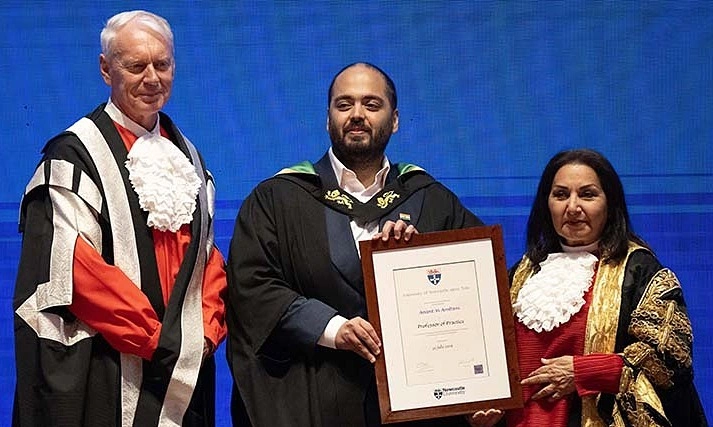
Britain's Newcastle University has faced criticism for awarding a sustainability professorship to Anant Ambani, an oil billionaire's son and the owner of the scandal-hit Vantara wildlife center in India.
Newcastle University said on Thursday it awarded the professorship of practice in sustainability to Ambani "in recognition of his significant contributions to advancing a more sustainable future."
"Work at Vantara closely aligns with the University's world-leading research on global conservation and biodiversity targets," the university in northern England said.
It also noted his role as an executive director at Reliance Industries, a retail and oil conglomerate headed by his father and billionaire tycoon Mukesh Ambani.
 |
|
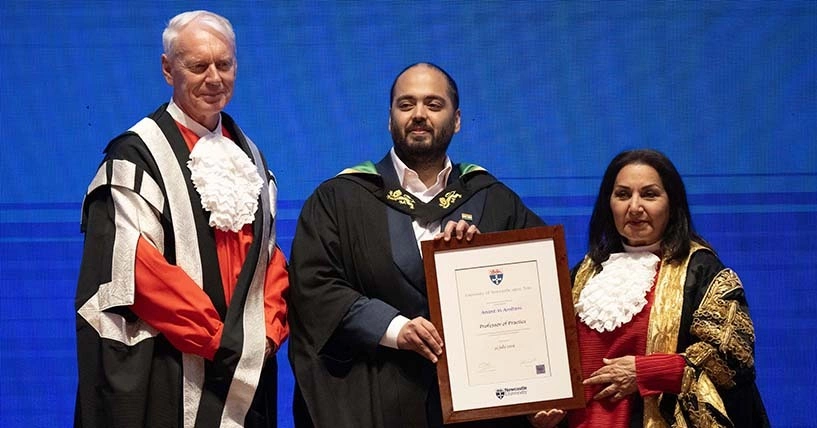
Anant Ambani (C) is presented the Professor of Practice certificate at Newcastle University. Photo from the university's website |
"Newcastle University is really stooping low here and making a mockery of sustainability," Lyla Mehta, a researcher at the Institute of Development Studies, affiliated with the University of Sussex, said on social media Thursday.
"Universities are supposed to be places that question power and hold corporations to account, not give them academic legitimacy," Mehta earlier told The Guardian, which first reported the story.
Vantara, which calls itself the world's largest rescue center, last month announced a major reset of its procedures following concerns about its rapid and vast acquisition of animals from around the world, including endangered species. Vantara has consistently denied any wrongdoing.
Wildlife conservationist Prerna Singh Bindra questioned the characterization of Vantara, a sprawling 3,500-acre (1,416-hectare) facility, as a conservation site.
"It's a captive facility, a zoo. So how is this conservation? We need to protect wild animals in their natural habitats not zoos," Bindra told AFP.
"When we're talking about a university, you're nurturing, mentoring, skilling a generation of conservationists," added Bindra.
"But here you are changing the entire paradigm of conservation from protecting them in their natural habitat, to one that says that accumulating animals in zoos is conservation."
KioskNews shows a cleaned-up reading view extracted from the publisher’s page — the original always lives on their site, not ours.