After Satya Niketan, the rebuilding of the city must begin
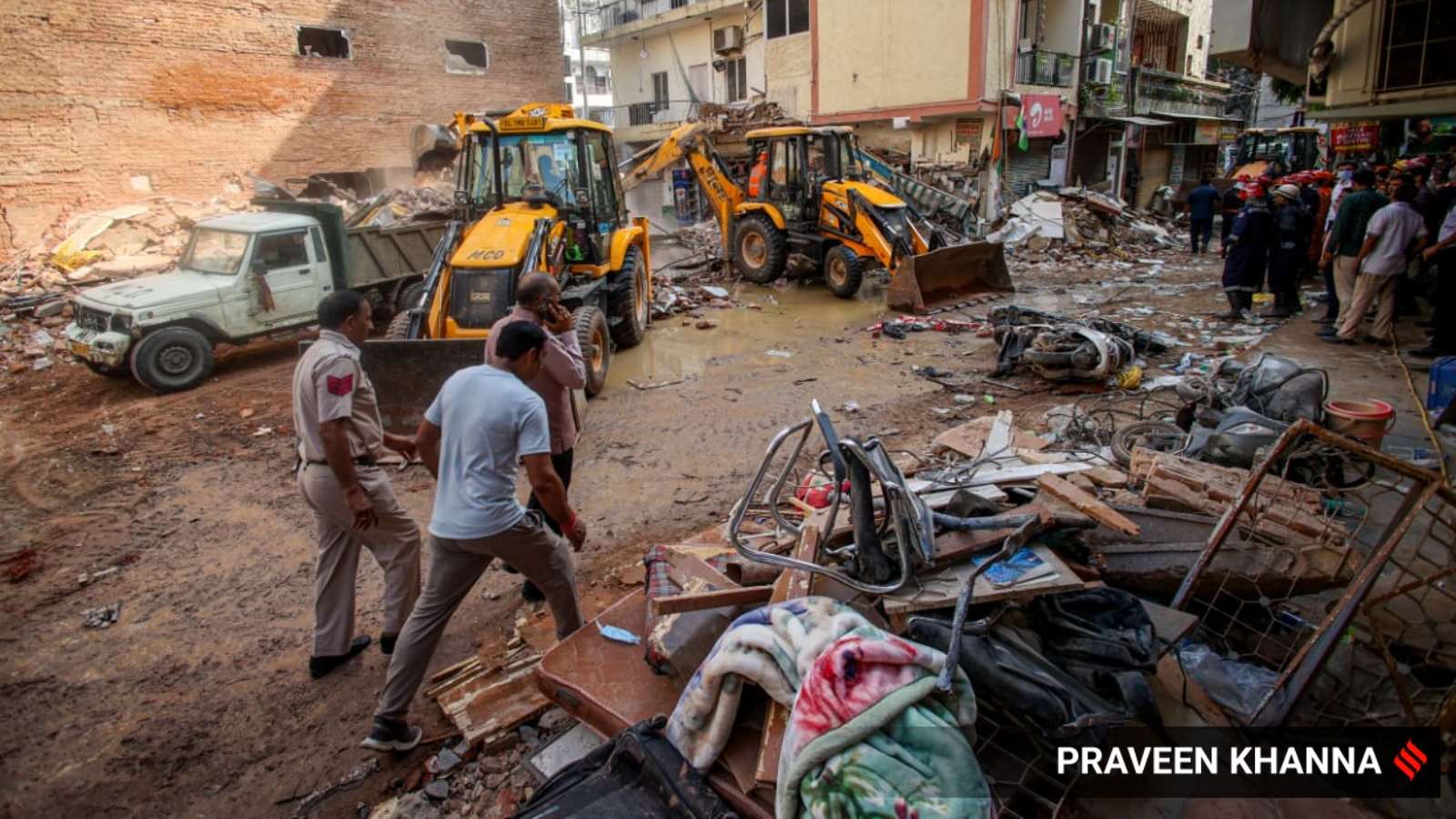
Rescue underway a day after building collapsed at Satya Niketan in New Delhi. (Express Photo by Praveen Khanna/File)
Every year, after the monsoon arrives, streets get flooded, and as more rain washes the city and water wends its way into basements and foundations, walls buckle, and buildings collapse. People are trapped inside; some die. At Satya Niketan, 50 Delhi University students were huddled in a makeshift arrangement in an unauthorised building. Seven died, and many others are in serious condition in local hospitals. Could the tragedy have been averted? Given the building’s condition, its age, its unauthorised status, and location in a dense neighbourhood, the answer is a resounding no. As climate change alters weather patterns, causing flash floods and drenching cities with sudden and enormous quantities of rain, it is critical to build physical safeguards that, along with civic governance, can be effectively enforced. For that, several steps are required.
First is the physical mapping of Lal Dora areas, the shadow pockets that evade municipal planning and exist in virtually all big cities. Almost 60 per cent of Delhi’s population currently lives in unauthorised structures — mostly in slums, low-rise makeshift tenements, or high-density four-to-five storey buildings in urbanised villages. While street maps of most illegal colonies exist, there needs to be a building-by-building documentation of the types and sizes of all structures, an assessment of their physical condition, along with an enumeration of the inhabitants. Advanced infra-red and other imaging techniques allow for a reasonably accurate assessment of the buildings’ structural condition.
Gone are the days when buildings were made to last for generations. The life-span of structures built in this century is barely 30-40 years; for those in Satya Niketan — because they follow none of the required safety codes — even less. Even within this short time frame, buildings need to be checked regularly, and if need be, demolished partially or wholly, and replaced.
Most buildings are designed for a specific function — their inappropriate use and heavy load on floors can weaken and damage the structure. A block of flats is designed for domestic use, but in unauthorised colonies many are converted into stores and restaurants, thus increasing the number of occupants and altering the weight on floors. Even makeshift hostels compromise living space to give a more lucrative return to the property owners. Unless building authorities approve a designated building function and allocate minimum floor space per person, no occupancy permit should be issued.
What then of the density of the colony layout? Builders take no responsibility for the ground they share with neighbouring buildings, but a spatial evaluation of the overall surrounding layout becomes essential to establish safety standards. Is there adequate natural ground around the structure to absorb rainwater? Are there enough wide-mouth drains to move water quickly? Local storm drainage conditions and the open ground available need to be assessed. In most cases, too much building in too small a ground area traps excess water, directing it into basements and foundations, eventually destabilising the structure.
Finally, there is the question of urban governance. Are political parties and their municipal agencies capable of being effective civic authorities? Or should all control of roads, buildings, transport and other infrastructure come under one legal entity, say, the mayor? What indeed is the value of the battery of bye-laws if they can’t be enforced? What is the point of the structural evaluation of buildings if inspectors and site engineers can be easily bribed?
Some years back, a newly constructed apartment in Bengaluru crumbled into a heap of dust just as soon as it was completed. It was approved as a three-storey structure, but the builder decided to increase his profit by adding two more floors illegally, thereby weakening the structural capacity of the columns. The collapse killed 12 people.
What was the square-foot gain in income for every life lost? How do you monitor construction activity that could harm, even kill, its occupants?
In the Satya Niketan case, alterations were being carried out in the basement, potentially risking damage to the building. More rooms to house more students, a canteen perhaps? What was happening there was anybody’s guess, but it was enough to destabilise a structure almost half a century old, and bring it crashing down.
By 2030, Delhi will have a population of nearly 40 million, making it one of the world’s densest cities. More students and more migrants from nearby towns will make this their home. Soon civic authorities will need to ask more difficult questions. Can the city continue to accommodate people in every possible leftover space, without services or security? Will builders merely build higher with more unauthorised floor space, and endanger more lives? Or, is it time to seek thoughtful and radical alternatives? Is there space in the municipal mind for new and experimental ideas?
KioskNews shows a cleaned-up reading view extracted from the publisher’s page — the original always lives on their site, not ours.