Trump just renamed AI. He’s telling us what’s coming next
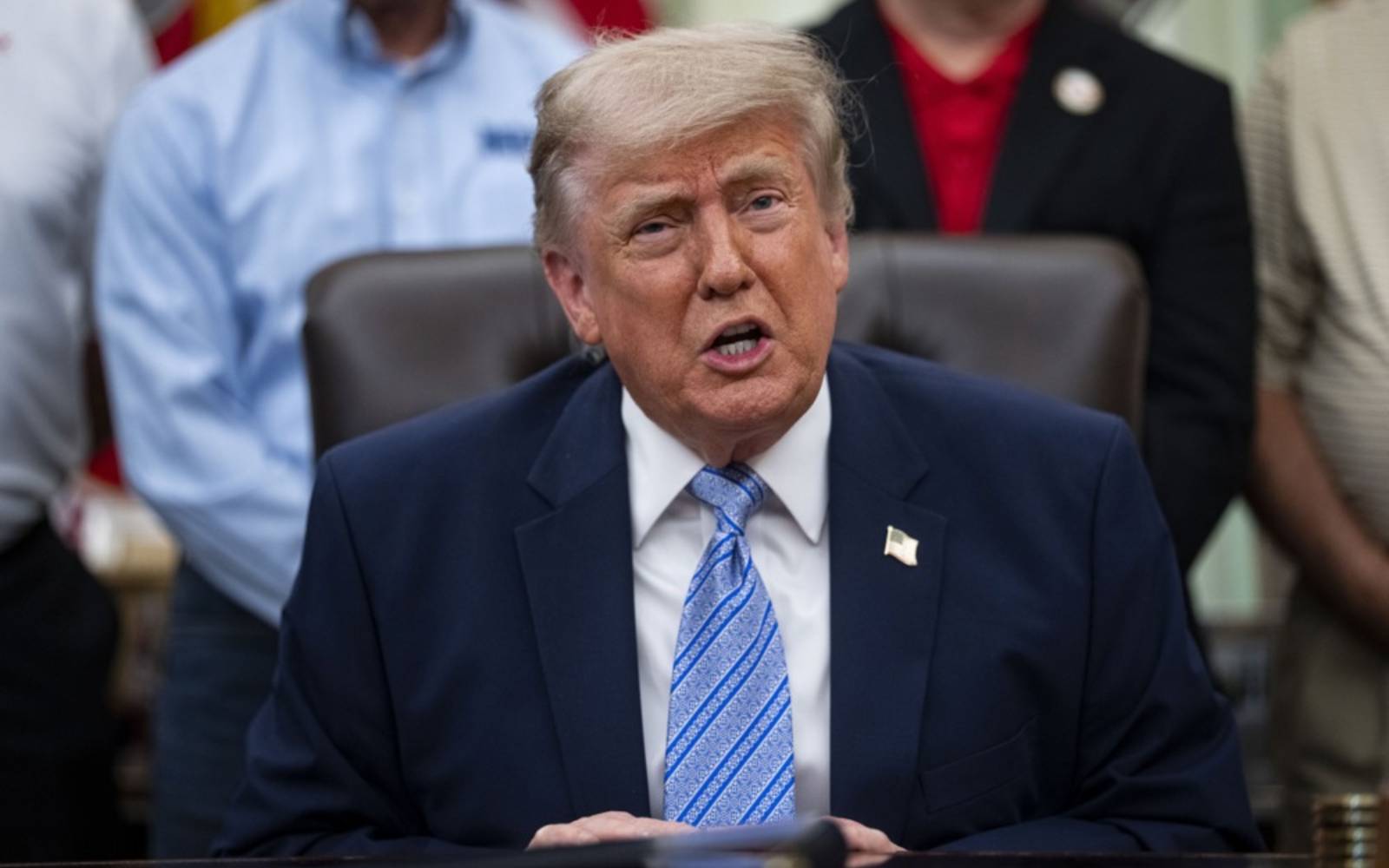

“From this point forward, all of United States documents and hopefully the world’s will be changed to use the much more accurate term ‘super’ as opposed to artificial.” That was Donald Trump at the United Nations General Assembly on Sept 22, and true to form, he didn’t stop at a soundbite.
A week later, he signed an executive order titled “Inaugurating the Era of Super Intelligence”, ordering federal agencies to swap “artificial intelligence” and “AI” for “super intelligence” and “SI” across official documents and websites. The same day, executives from Meta, Nvidia, Google, OpenAI, xAI and Anthropic signed a separate, voluntary White House Accord on Super Intelligence.
It’s tempting to laugh this off as branding, especially since Trump’s own explanation was that “artificial” “makes intelligence sound fake. It is not fake.” But wait a minute.
Words matter, and this one has a specific meaning. The term was popularised by philosopher Nick Bostrom, then at the University of Oxford, in his 2014 book Superintelligence, and it describes not a machine that matches us but one that vastly outperforms the brightest humans in practically every field.
Today’s systems aren’t there yet, and Trump may simply think “artificial” sounds cheap. But when Meta has had a division literally called Meta Superintelligence Labs since 2025 and the world’s most powerful government adopts the same vocabulary, I can’t help but feel they are preparing us for something far beyond today’s chatbots.
So what does that world look like? Three questions keep nagging at me.
Do we still need schools?
Six years ago, I argued in this column that AI could help fix our broken school system, pointing to Chinese and American platforms that taught maths at each student’s own pace. The evidence has since piled up faster than I expected.
In 2025, the World Bank published the results of a six-week after-school programme in Nigeria’s Edo State, where students worked in pairs with Microsoft Copilot, a GPT-4-powered assistant, in up to two 90-minute sessions a week under a teacher’s supervision. The gains, the lead researchers later wrote, “correspond to nearly 1.5 years of typical learning in just six weeks”, outperforming around 80% of the education programmes tested in randomised trials across the developing world.
Now imagine that this tutor isn’t merely good but superintelligent and available to every child in every kampung at any hour. The classroom as a place where a teacher pours the same facts into a roomful of young heads at the same speed and we simply can’t compete with that.
But schools will survive, because they’ll become the place where children learn what no machine can learn on their behalf: how to make friends, lose gracefully, argue without hating and work alongside people who aren’t like them. As I wrote back then, the secret ingredient is EQ, or emotional intelligence, and a superintelligent tutor only makes it more precious.
Why would we even work?
In 1930, the British economist John Maynard Keynes predicted that within a century we would be so much richer that “three-hour shifts or a fifteen-hour week” might be all the work we would need. We are four years from his deadline, and Malaysian law still sets the normal working week at up to 45 hours, three times what he imagined.
Elon Musk, never one for understatement, thinks the machines will finally deliver on that promise. “In a benign scenario, probably none of us will have a job,” he told the VivaTech conference in Paris in 2024, with what he called “universal high income” taking the place of wages.
I’m not going to pretend that’s guaranteed, since whether superintelligence brings abundance for all or riches for a few depends on who owns the machines.
But if we get it right, Keynes already told us what our real challenge would be: “how to use his freedom from pressing economic cares, how to occupy the leisure, which science and compound interest did for him, to live wisely and agreeably and well.” Work won’t vanish so much as become something we choose, like a Sunday evening game of futsal.
What does a world of superintelligent humanoids look like?
Years ago, I toured a factory outside Shenzhen that was frantic with activity yet almost void of human life. Those were single-purpose machines, impressive but hardly intelligent.
Today’s humanoids are something else entirely. In July 2025, China’s Unitree priced its R1 humanoid at 39,900 yuan, about RM24,000, while Musk has said Tesla’s Optimus could eventually cost RM82,000 to RM123,000 once it’s mass-produced.
Investment bank Morgan Stanley expects close to a billion humanoids in use by 2050, mostly in industry and commerce. Put a superintelligent mind inside each of those bodies and the list of “AI-proof” jobs I published in this column in 2020, from construction worker and mechanic to nurse and caregiver, goes straight into the bin.
Picture a machine that harvests paddy in Kedah at dawn, rewires your house by noon and sits with your ageing parents through the night, never tired and never impatient. That isn’t a dystopia. It’s the end of drudgery.
Whatever Trump’s reasons for choosing the name, the industry he’s naming has made no secret of where it’s heading. Keynes addressed his essay to “our grandchildren” – the generation that would first have to decide what to do with all that freedom, and it turns out those grandchildren are us – or at least the younger ones among us.
The writer can be contacted at [email protected].
The views expressed are those of the writer and do not necessarily reflect those of FMT.
Subscribe to our newsletter and get news delivered to your mailbox.
KioskNews shows a cleaned-up reading view extracted from the publisher’s page — the original always lives on their site, not ours.