She reads, therefore she is: Writer-journalist Shanta Gokhale on her memoir
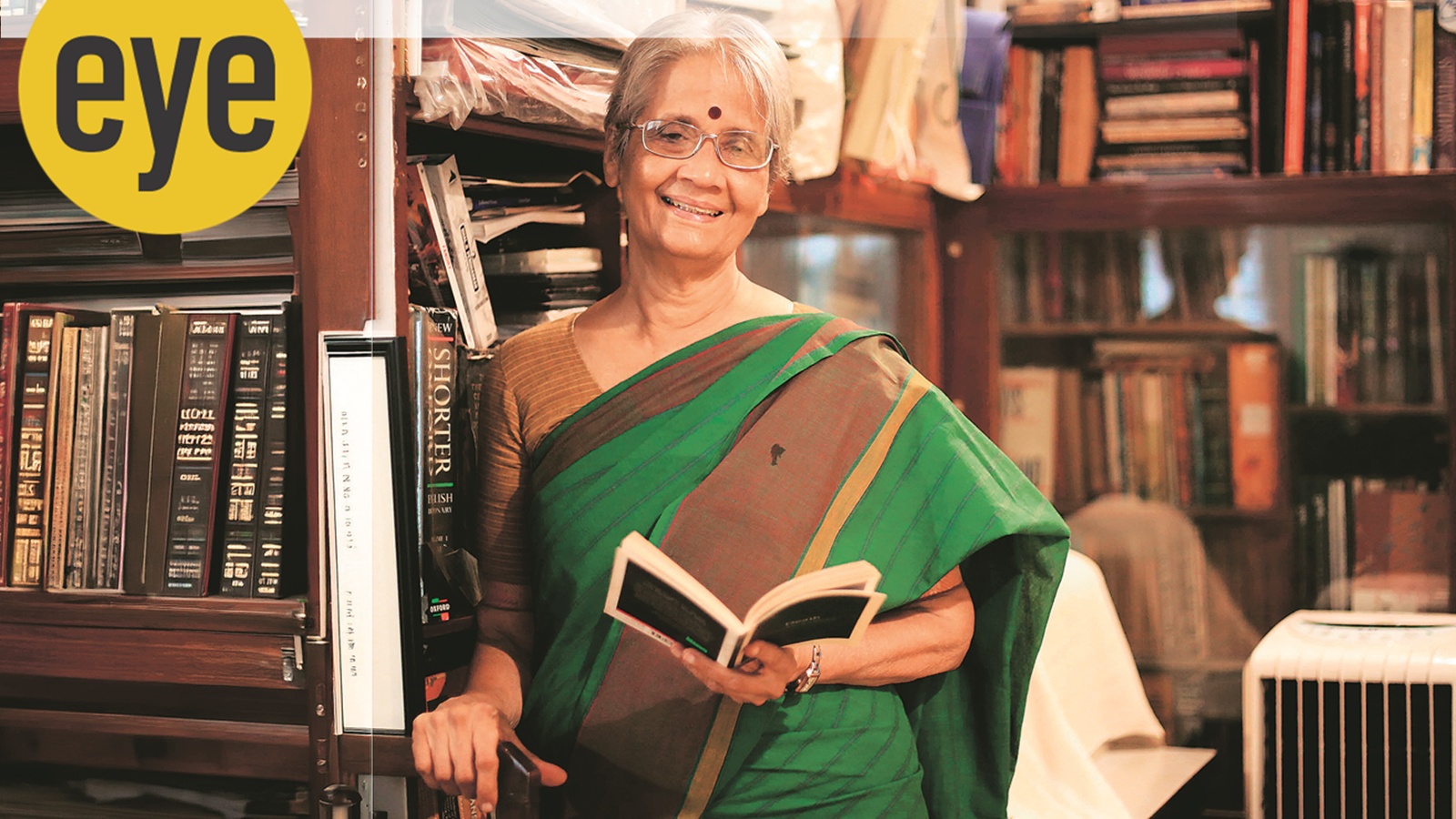
Most autobiographies are organised around what a life did. Shanta Gokhale’s is organised around what it read.
Of Ancestors and Friends: A Life with Books belongs to a smaller tradition of self-writing done as a reader rather than as a writer. It maps nearly eight decades through the books she read, reread and carried, and through the routes by which they reached her. The Covid-19 lockdown supplied the occasion and the time to reread. Gokhale is a novelist, translator, theatre critic and former arts editor of The Times of India, and the author of Marathi novels Rita Welinkar (1992) and Tya Varshi (2008). She calls the memoir a “ramble” written free of the deadlines and word counts that governed 60 years of journalism. If it is a ramble, it is a disciplined one.
The title carries the book’s central distinction. Some books become ancestors: They shape how one thinks before one notices. Others become friends, met again at different ages and found changed. “Old Friends” returns to Jean-Paul Sartre, Simone de Beauvoir, Albert Camus and Franz Kafka. “Nearest Neighbours” turns to writers who became companions and interlocutors, among them Kiran Nagarkar, Jerry Pinto and UR Ananthamurthy, and to playwrights from her home state of Maharashtra. Shri Na Pendse and Alka Saraogi share the pages with Jane Austen, Naguib Mahfouz, Kazuo Ishiguro, Salman Rushdie and Henrik Ibsen. At the top of her ancestors’ shelf sit Anna Karenina, Middlemarch and Madame Bovary, books she rereads “in order to live.”
This is a chosen lineage. Gokhale writes in Marathi and English, names Shakespeare as her first ancestor, and declines to be filed under a single language. Her account of growing up between Marathi, Hindi and English borrows Arun Kolatkar’s image of the bilingual writer as a pencil sharpened at both ends. Her reflections on the translator’s role follow from this. Translation appears as the most exacting form of reading, where one that must then answer for itself in another language.
What held me most is how the books found her. Gokhale’s anecdotes amount to a history of how print moved through one Bombay household and beyond it. Her father, a journalist, accumulated books with what she now recognises as an instinct for what would last: Dostoevsky, 1984 (George Orwell), The Grapes of Wrath (John Steinbeck), The Catcher in the Rye (JD Salinger). On a summer holiday in Pune, he carted along an aluminium trunk of books, Albert Camus and Jean-Paul Sartre among them. In 1956, the trunk went to London, packed alongside pickles, snacks and shampoo. A family library, in other words, travelled with the household’s other provisions.
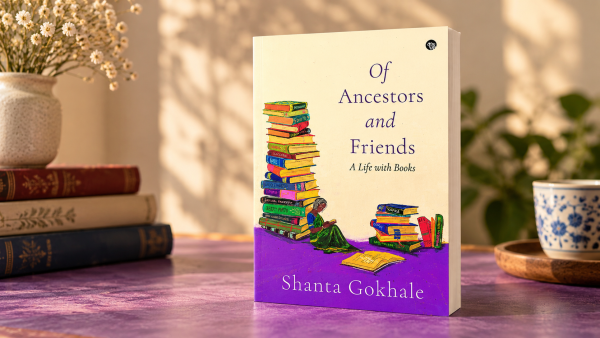 Of Ancestors and Friends: A Life with Books. (Image generated using AI)
The economy of access changed at Bristol, where she read English. The university’s hushed libraries hid reference books and stifled a reader raised on Bombay’s noise and on books carried home. She chose to make books her primary expenditure. Her first purchase, a second-hand Complete Works of Geoffrey Chaucer, became more hers, she writes, the more ragged it grew. She values new books for their smell and old ones for the stains and marks that tie her to earlier owners. She is intrigued by inscriptions in used copies, and wryly wonders whether a true book lover may “borrow” without asking. She even enlists Walter Benjamin’s Unpacking My Library (1931) against anyone who asks whether she has read everything she owns.
Gokhale’s anecdotes are a record of circulation through inheritance, transport, institutional restriction, resale, marginalia and informal lending. Having spent years among Delhi’s second-hand booksellers, I found these the book’s most quietly instructive pages. A reading life, they show, is shaped as much by how books reach a reader as by what lies inside them.
Story continues below this ad
Rereading is the book’s method. Gokhale has read Camus’s The Outsider (1942) three times, first at 19 and again at 50, three years after her mother’s death, finding in its protagonist’s refusal to despair something to live by. She asks why page-turners such as AJ Cronin’s novels and The Forsyte Saga (John Galsworthy, 1922) left no trace while Middlemarch (George Eliot) kept drawing her back. In the sixties, she notes, not reading Sartre made one invisible. She still argues with him, valuing his questions over his answers. Taste is also made against others. Her Bristol tutor, the poet Charles Tomlinson, curled his lip at her enthusiasm for The Alexandria Quartet and told her a writer must suffer. She dismissed the advice, and the romantic myth behind it.
Her reading is not sealed off from the Republic. Gokhale sets Orwell’s 1984 beside the Emergency. She extends CP Snow’s “two cultures” to a third in contemporary India, myth, typified by claims that ancient Indians flew interplanetary aircraft. Watching Sartre’s No Exit staged in Mumbai as Band Darwaze, she concludes that hell lies less in other people than in our dependence on their judgement. Interviewing Rushdie, she places herself among his midnight’s children, a generation formed by the promises and contradictions of post-Independence India.
Three threads run beneath the surface and reward attention. The first is form. In 2019, Gokhale published One Foot on the Ground: A Life Told Through the Body. This book is its companion, the same life told through books and together, they make an unusual diptych. The second is the theatre critic inside the reader.
Her chapter on Ibsen’s A Doll’s House reconstructs the play’s first reviews, the applause and the lone conservative dissent, reading a play through the history of its audiences. The third is gender. Anna Karenina, Dorothea Brooke, Emma Bovary and Nora Helmer sit close together in this book, alongside de Beauvoir. What these women meant to the woman reading them is a question worth asking of it.
Story continues below this ad
I was simultaneously travelling with Shanta Gokhale and her books everywhere she has been, and back to the literature classroom. From the first chapter, I started keeping a tab of the books mentioned, and realised I would rather keep this book with me as a tab of my TBR and past-read books.
KioskNews shows a cleaned-up reading view extracted from the publisher’s page — the original always lives on their site, not ours.