India’s LNG imports could hit 8-month low in November: Why are shipments down?
India’s liquefied natural gas (LNG) imports in November are on track to fall to their lowest since March amid increased competition from European buyers, surging prices in the international market, and seasonal reduction in demand from the power sector with the weather cooling.
Super-normal import volumes in October are also likely to have help meet some of November’s demand. While supplies from all major sources have declined evidently due to these reasons, the fall in volumes from West Asia is additionally being attributed to increased targeting of LNG tankers around the Strait of Hormuz in recent weeks.
Imports of LNG, or super-chilled gas, into India in the November 1-27 period stood at 1.73 million tonnes, or about 64,000 tonnes per day on average, according to vessel tracking data from commodity market analytics firm Kpler.
As per estimates, the full-month figure could end up at around 1.8-1.9 million tonnes. In October, India imported 2.85 million tonnes, or about 92,000 tonnes a day, of LNG. November volumes are also expected to be lower on a year-on-year basis, as India imported 2.20 million tonnes of LNG in November 2025.
The last month in which LNG imports were under 2 million tonnes was April, when volumes were at 1.94 million tonnes. In March, which was effectively the first month of the West Asia war, LNG imports had fallen to 1.67 million tonnes as supplies from the Gulf were hit due to the disruption in energy flows through the Strait of Hormuz.
Over subsequent months, imports recovered rapidly as robust LNG demand led to Indian importers competing hard to pick up cargoes from the spot market even at sky-high prices. As supplies from traditional heavyweight suppliers like Qatar and the UAE, which depend in the Strait of Hormuz to export their LNG, were disrupted, imports from the US, Oman, and African suppliers jumped. In April-October, India’s monthly LNG imports averaged at 2.38 million tonnes.
By October, imports from the Persian Gulf had also recovered notably as Qatar and the UAE turned more aggressive in using tactics like switching off the LNG tankers’ transponders, or “going dark”, to avoid detection in a precarious maritime security environment.
Ship-to-ship (STS) transfers also picked up significantly and facilitated the flows out of the Gulf. In STS operations in the Strait of Hormuz, the supplier usually takes on the responsibility — and the risk — of sending the cargo through the strait, after which a tanker waiting in safer waters takes it to its destination.
Reasons behind lower LNG imports in November
Commenting on the slump in LNG imports in November, Kpler’s LNG and natural gas analyst Sonal Ranjan said: “I would say it’s likely a mix of a couple of factors. First, power demand has moderated, easing the need for gas-fired generation, particularly as coal-fired power plant outages have come down from their September–October highs and coal availability has improved.
October also saw record LNG arrivals into India, so some carryover inventory buffer from those higher imports may have helped meet consumption requirements in November. At the same time, elevated spot LNG prices continue to weigh on demand from price-sensitive industrial consumers.”
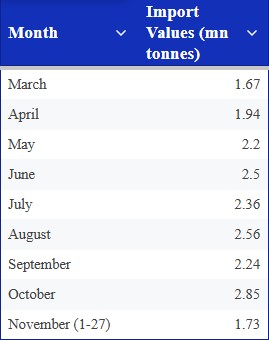 India’s LNG imports since the beginning of the West Asia War (Source: Kpler)
As per data from the Central Electricity Authority (CEA), gas-based power generation in the November 1-25 period was 980.55 million units, or 39.22 million units a day. In the whole of October, gas-based power generation stood much higher at 96.77 million units per day, or 2,999.75 million units. At 56.40 million units per day, gas-based electricity generation in November 2025 was also notably higher than in the current month.
“I’d put some of the drop in India’s November LNG imports down to seasonality…What made this November different was how sharply prices rose just as demand was easing. Asian spot LNG prices had been high since the (West Asia) crisis began, but by mid-to-late October they were around $35 per mBtu (million British thermal units), nearly $10 higher than in mid-September. For Indian buyers looking at November deliveries, that was a big jump at a time when they could afford to buy less, and they were quick to pull back on spot purchases,” Abu Dhabi-based energy analyst Natalia Katona told The Indian Express.
Moreover, Europe has also become a more attractive destination for cargoes as European gas stocks were unusually low heading into winter, when gas consumption goes up in the continent. European importers have been willing to pay more to secure LNG cargoes, which has incentivised flows to the continent, particularly from Africa.
“That helps explain what we’re seeing in India’s arrivals. India took five cargoes from Angola in October, compared with just two so far in November, while Nigeria is expected to supply two cargoes this month, down from four in October. We’re also expecting two fewer US cargoes to reach India this month than last,” Katona said.
“For cargoes coming out of the Middle East Gulf, there’s also the risk of crossing the Strait of Hormuz. Attacks have picked up since mid-October, and over the course of October and November three LNG carriers have been hit by drones or struck naval mines. The last incidents involving LNG carriers before that were in July. With fewer gas carriers making the crossing in November, that risk is another reason India is seeing fewer cargoes from the Gulf this month,” she added.
Mapping India’s LNG imports
The West Asia crisis pushed India to secure cargoes from non-Hormuz dependent supply sources, as New Delhi has been prioritising supplies over price considerations amid demand from various sectors, which include city gas distribution, fertiliser, power, and ceramics. India depends on LNG imports to meet about half of its natural gas requirement.
Before the West Asia war broke out in late February, about 60% of India’s LNG imports came through the Strait of Hormuz. After falling in March and April — the first two months of the West Asia war — India’s LNG imports trended consistently higher on a year-on-year basis over the next six months, before registering a decline in November.
India’s LNG imports from all major suppliers are notably lower on a sequential basis in November. Like in October, the US, the UAE, and Oman are the top three suppliers of LNG to India. LNG imports from the US stood at 0.42 million tonnes in the November 1-27 period. In October, India imported 0.63 million tonnes of American LNG.
The second-largest source of LNG for India in the first 27 days of November was the UAE, supplying 0.32 million tonnes of super-chilled gas. In all of October, LNG imports from the UAE totaled 0.51 million tonnes. Next on the list is Oman, supplying o.30 million tonnes of LNG to India so far in November. In October, Oman supplied 0.45 million tonnes of LNG to India.
Qatar, which was India’s largest source of LNG before the war, is at the fourth spot in November so far with supply volumes totaling 0.20 million tonnes, down from 0.44 million tonnes in the whole of October. LNG imports from Angola and Nigeria stood at 0.14 million tonnes each over November 1-27. In October, India imported 0.33 million tonnes of LNG from Angola and 0.28 million tonnes from Nigeria.
KioskNews shows a cleaned-up reading view extracted from the publisher’s page — the original always lives on their site, not ours.