Your dream university bedroom: how to get that Insta glow-up

Uni means many hours cramming in the library and equally as many partying, but there is also a surprising amount of downtime – so a bedroom that is enticing to hang out in is key. Whether it’s in halls, a house share or your family home, here’s how to make even the most basic of spaces more special.
Make a plan
Before you start chucking stuff into boxes, take a moment to prepare. Scope out what exactly your accommodation consists of. For example, is there a single or double bed? Does your room have a sink? Most student halls of residence will provide images of the different types of rooms it offers on its website.
Map out your mood
Moving into student accommodation is most likely your first opportunity to create a room that really reflects you and your interests. This can be hugely exciting, but it’s also intimidating. While TikTok and Pinterest are full of ideas for creating “your dream uni bedroom” it’s worth bearing in mind that the space is only going to be yours for a year. Don’t get caught up in making it perfect – instead focus on making it comfortable. The aim is a space that feels cosy on days when you might be missing home or have an essay deadline looming over you, but also a fun space you’ll want to hang out with your new friends.
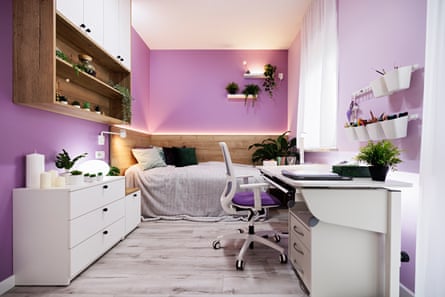
“It’s nice to have a space you like but it’s not the be-all and end-all if you don’t love your room,” says Seraphi Bouchier Hayes, a recent graduate who spent her first year sharing with 17 other girls. “It’s quite fun to just lean into how imperfect uni halls are,” she says, reminiscing on her orange-themed single room.
Flossie Hughes, an interior stylist and founder of the preloved homeware brand Finders Finders Finders, says a mood board can be helpful. “It doesn’t have to exclusively contain interior references,” she says. “Fashion, nature and other archive images will help you create an extra special space. A colour combination or texture in an outfit you love can also be translated to a room.”
Get savvy with sourcing
Make a list of things you already have and things you need to get. It can be helpful to divide it into categories such as bedding and storage. Once you’ve worked this out, it’s time to source. Some sites such as UniKitOut offer student starter packs (from £199) featuring everything from bedding to kitchen gadgets, but you probably don’t need everything in such kits and it might work out a bit cheaper to buy what you do need separately.
If you or your family are part of your street WhatsApp group, it’s worth messaging to flag what you need in case someone is planning a clearout. Car boot sales, charity shops and secondhand platforms such as Vinted can also be fruitful. Hughes, whose younger sister is starting uni in September, says she is helping her create “a Y2K vibe” on a budget. On her list are a shaggy sheepskin rug and a capiz lampshade, which are “all easy to source secondhand”, she says.
Living away from home for the first time can be overwhelming, so it’s nice to create your own cocoon-like retreat. A spokesperson for John Lewis describes students as now taking “sleep hygiene very seriously”. University mattresses are typically chosen for their durability rather than comfort. Searches for single mattress toppers are up 100% month on month while anti-allergy duvets are up more than 1,000%. A year-round duvet that will keep you warm during bitter winter months but cool once spring rolls around will save you both space and money. Look for a tog rating of about 10.5.
Style your storage
To avoid the dreaded floordrobe and losing your ID card among a pile of books and half-drunk cups of tea, organisation is key. If you have space under your bed, use flat rolling boxes to store spare bedding/towels or bulky jumpers. They are also handy for shoes. If your wardrobe only features a rail, a hanging organiser that features shelves is useful for T-shirts and jumpers. Remember you won’t be allowed to drill or nail anything to walls so opt for things like over-the-door hanging hooks that can be used for coats and bags or even towels.
Vicky Silverthorn, a professional home organiser, suggests freeing up wardrobe space by using slim hangers such as these non-slip versions from Amazon. She also prefers dedicated trouser hangers because “they take the trousers higher up on the rail, meaning you can fit more things underneath them”.

Storage doesn’t have to be restricted to clear plastic boxes. Wicker baskets for blankets and shoes, colourful miniature crates (see Hay) for books and beauty products, old jam jars for stationery or makeup brushes and vintage ceramic plates and bowls for jewellery will all help you avoid clutter while still being nice to look at.
Bouchier Hayes recommends a portable shower caddy if you don’t want to share your favourite products. She also flags that the last thing anyone ever wants to do is laundry since it takes so long. As a result, she suggests having a spare set of bedding to use while you wait for the first one to dry, plus extra towels. Silverthorn suggests a dirty-clothes bin with a removable bag such as this is useful for taking to the laundry room.
Give your childhood bedroom a glow-up
According to Ucas, last year, a record 89,510 of 18-year-olds with uni offers planned to remain living at home. If you’re not flying the nest, try giving your existing bedroom an adult glow-up. Sell anything you’ve outgrown and use the proceeds for the transformation. Hughes, who lived at home during university, started by switching up the layout. “Rearranging the furniture made it feel like a new room,” she says. “It felt fitting for the next exciting chapter of my life.”
It can help to think of your room as different zones: sleep, work and relaxation. Fresh sheets and some statement cushions will add a grownup touch to a bed. Bouchier Hayes suggests placing dried flowers in a vase on a desk. If you have the space, think about adding a dedicated reading chair too.
Add the finishing touches
Once you have sorted out the essentials, it’s time to add some personality to your space. An easy way to brighten up a blank space is with your choice of bedding. Try mixing and matching different prints and patterns for added interest. John Lewis has a smart striped set from £25, while Urban Outfitters offers everything from hot pink cinched designs to leopard print and ditsy florals from £20.
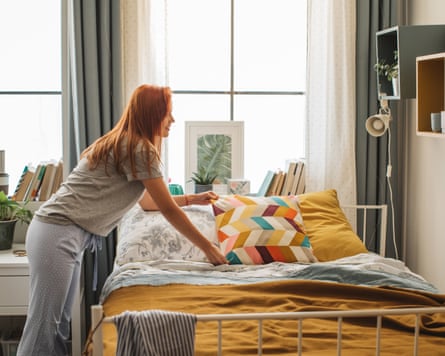
Pre-drinks tend to centre around one person’s room, so a big bedspread or throw is also useful for when inevitably everyone ends up sitting on your bed and spilling a BuzzBallz.
Bouchier Hayes says “loads of fairy lights” and a lamp for a bedside table or desk are best if you hate “harsh overhead lighting”. Candles are banned, so instead opt for battery-operated tea lights. Pinterest reports that among users aged 18-24, searches for mushroom lamps are up 60%, while salt lamps are up 50% month on month.
Most accommodation won’t allow things like sticky tape so hang frames using self-adhesive fastening like Command Strips instead. Hughes suggests buying cheap framed posters secondhand then taking out the existing image and replacing it with your preferred choice. “Add some coloured card to the background if the frame is too large for your image,” she says. “The picture doesn’t have to sit in the centre, an intentionally offset picture in a large frame with 99p coloured card can look incredibly sophisticated.”
Bouchier Hayes used a large pinboard for printed photos that she then added to throughout the year. It’s worth thinking beyond posters too. Hughes suggests framing things that evoke good memories. For her it’s a receipt from her favourite restaurant but she also suggests “a ticket from a trip, a coaster from the pub and a scribbly sketch or note from a friend”.
KioskNews shows a cleaned-up reading view extracted from the publisher’s page — the original always lives on their site, not ours.