US women in politics spark conversation on motherhood
Last summer, Representative Sara Jacobs would run up to her office to give herself injections of hormones before rushing back to Congress for a session with her fellow lawmakers.
The shots were for the second round of freezing her eggs, a medical procedure that can give women more time to have children.
"It was an empowering decision that gave me more agency," the 37-year-old said, adding that the process was challenging.
"Your body hurts. Your hormones are crazy. It's kind of like puberty and menopause at the same time."
Jacobs announced she was beginning the egg freezing process in 2021, at a time when she said few lawmakers were discussing the topic in the halls of Congress.
The process - which can cost more than $10,000 (£7,400) and is rarely covered by insurance - involves doctors harvesting eggs from the ovaries and freezing them for a future pregnancy.
This week, Democratic Representative Alexandria Ocasio-Cortez announced she too was beginning the process of freezing her eggs, documenting the daily mechanics of giving herself hormone shots on social media.
Watch: Key moments from Karoline Leavitt's White House tenure
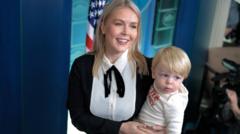
The left-wing Democrat's announcement sparked a conversation about the challenges of balancing motherhood and a demanding career, the same week that White House Press Secretary Karoline Leavitt announced she would be leaving the Trump administration to spend more time with her family, including her infant.
"The truth is since returning to the White House after the birth of my daughter, I have felt in my heart that I cannot be the best mum my two young children deserve while devoting the constant time, energy and attention required of [being] the White House press secretary," Leavitt said.
Several women with busy careers spoke to the BBC about the challenges of juggling their work with motherhood in the only industrialised nation that does not mandate paid parental leave.
Less than a quarter of workers in the US have access to paid family leave through their employer, according to the Bureau of Labor Statistics. More than 120 nations around the world - including all European countries - provide paid maternity leave.
In the US, women are increasingly having children at older ages, while more are choosing not to have children at all. From 2016 to 2023, the average age of all mothers giving birth in the US rose from 28.7 to 29.6, according to a 2025 report from the US Centers for Disease Control and Prevention.

Michele Heisler (left) says raising her children while working as a professor of medicine meant long nights, and lots of help
Michele Heisler, a professor of internal medicine at the University of Michigan, gave birth to her first child after going back to medical school at the age of 30. She was pregnant with her son during her third year of medical school.
Heisler, who serves as medical director for non-profit Physicians for Human Rights, said she had only been able to dedicate enough time to her career because of access to resources - including nannies - and a husband who was an equal partner in parenting.
"Unless it's clear that both are equal parents, [child rearing] is always going to fall on the woman, and then you're going to have to take a step back in some way," Heisler said.
Heisler said a flexible schedule is what allowed her to pursue her career to the fullest - staying up late at night to work and waking up sometimes at 05:00 to get her research done - so she could spend time with her children.

Legal scholar Seema Patel says she stays up late to finish work after her children are in bed
Seema Patel, an associate professor of law at UC Law San Francisco, also stays up late at night to try to finish her work so she doesn't have to miss moments with her children.
"The reality is that these years in your kids' lives are so fleeting, and I'm super aware of the time," she said.
Patel worked for San Francisco's Office of Labor Standards Enforcement, which became the first local government in the US to pass a law requiring employers to provide paid parental leave.
But through her career as a workers' rights lawyer, she has seen many lower-wage workers and parents who are not lucky enough to have access to paid time off.
When Patel began working as a federal attorney, her boss advised her to save up her vacation days in case she eventually wanted to have children and needed to take leave. She ended up taking the advice.
"I was a brand new, young attorney who had not even contemplated that stage of my life, but I had to in that moment, face that question of - I better be saving my vacation days," she said.
But even with some maternity leave and a dedicated partner, as her children - now ages 13, 11 and seven - have grown older, the work-life juggling act remains a challenge.
"I have a high-producing job," she said. "How can I do that while also being there for my kids and attentive to them? I don't have an answer."

Congresswoman Sara Jacobs documented her journey freezing her eggs on social media
For now, Jacobs, who has completed two rounds of egg freezing, plans to hold off on having children while her job requires her to fly across the country from California to Washington.
"Figuring out how to be a mum when I'm gone half the time across the country, it's logistically complicated," she said.
Jacobs said she was impressed by her fellow lawmakers who have managed to make it work. Only a handful of women have given birth while in Congress, while a few dozen lawmakers are mothers to children under the age of 18.
The federal government, like many US employers, does not offer paid parental leave, Jacobs noted.
"Both Congress and the general American workplace were designed by and for men who had often stay-at-home spouses who handled all of the domestic work," she said.
"It's going to take a lot of work for us to create a society where the domestic work is really shared equally between women and men."
In the meantime, Jacobs feels reassured to have a back-up plan for whenever she does feel she can fit children into her busy career.
"I hope to be able to do that one day, but I just haven't figured the time is right just yet."
KioskNews shows a cleaned-up reading view extracted from the publisher’s page — the original always lives on their site, not ours.