'Clear And Present Danger': Rajeev Chandrasekhar Calls For AI Guardrails
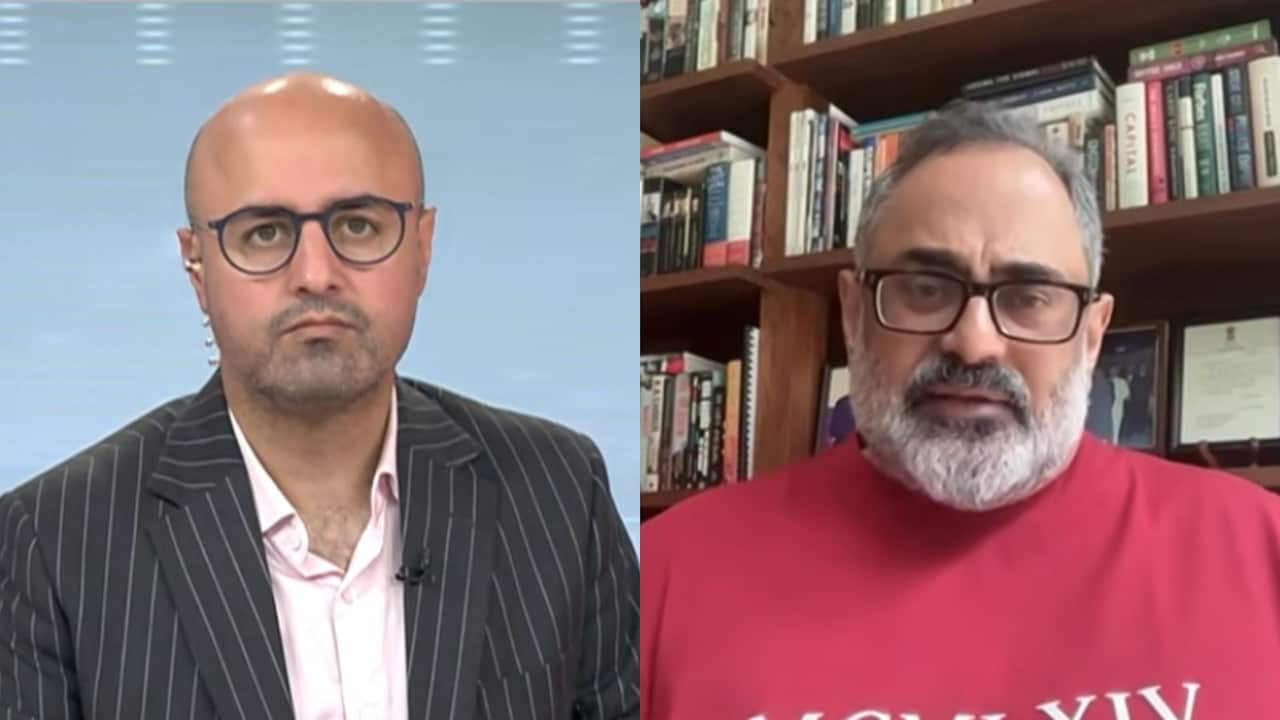
As leading artificial intelligence companies confront growing concerns over the misuse and potential risks of frontier AI, former Union Minister of State for Electronics and Information Technology Rajeev Chandrasekhar has called for stronger governance frameworks, arguing that innovation and regulation need not be opposing forces.
In an exclusive interview with NDTV Senior Executive Editor Aditya Raj Kaul, Chandrasekhar said governments globally were struggling to keep pace with rapid advances in AI, even as the technology increasingly acquires the ability to amplify criminal activity, disinformation and threats to democratic systems.
His comments come amid a renewed global debate over AI safety after Anthropic published a 154-page report documenting nine months of AI misuse. The report has intensified discussions about whether companies developing increasingly powerful AI systems can adequately regulate themselves and whether governments need stronger statutory oversight.
Chandrasekhar rejected the framing that humanity is simply "losing a race" against AI.
"I don't think this is a race that is to be lost," he told NDTV. Instead, he said, the central challenge was ensuring that AI and the internet remain "safe" and "trusted" for hundreds of millions of users while innovation continues.
According to Chandrasekhar, the gap between technological progress and governance has become increasingly apparent. He pointed to the rapid evolution of social media and the more recent acceleration of AI as examples of technologies where governments have struggled to respond at the same pace as platforms.
'Wrong Framing' Of AI Existential Threat
On whether AI could eventually pose an existential threat to humanity, Chandrasekhar argued that the debate was being framed incorrectly.
Rather than reducing the issue to a binary choice between technological progress and catastrophic consequences, he said governments should establish safety principles and guardrails while allowing innovation to continue.
"The centre is really about allowing innovation to go forth," he said, while simultaneously developing safeguards to prevent technologies from being misused to cause harm or facilitate criminal activity.
Chandrasekhar described Anthropic's report as a "fire alarm" and said it should be read by anyone interested in the future of AI. He argued that the document illustrates how the risks associated with AI have moved beyond hypothetical scenarios.
The former minister also said the wider public conversation around AI had been disproportionately focused on technological breakthroughs, business opportunities and wealth creation, while questions surrounding democracy, society and public safety had received less attention.
AI As An 'Orchestration Layer'
One of the most significant concerns raised during the interview was the potential use of AI to amplify influence operations and disinformation through social media.
Chandrasekhar argued that AI could now function as an "orchestration layer", enabling malicious actors to automate activities that previously required substantial human effort.
He said AI systems could potentially generate large numbers of social media accounts, create content for those accounts and make such activity appear authentic. The resulting content could then be amplified through social media networks.
According to him, this represents a fundamental change from earlier forms of online manipulation, because AI can potentially increase both the scale and apparent authenticity of coordinated campaigns.
"This is not about free speech," Chandrasekhar said, arguing that the right to information should not be interpreted as a right to deliberately create disinformation capable of undermining democratic processes.
He described the challenge as particularly significant for democracies, where citizens depend on access to reliable information to make political and civic decisions.
India's Governance Challenge
Chandrasekhar said India had recognised the broader issue of platform accountability and digital safety for several years, pointing to the Information Technology Rules introduced in 2021.
He argued that the principles of safety, trust and platform accountability remain relevant as AI becomes increasingly integrated into digital platforms.
At the same time, he acknowledged that India, like other countries, still has "a lot more to be done" when it comes to AI governance.
For India, he said, the challenge is particularly urgent because of the country's enormous digital population, social and linguistic diversity, and the importance of protecting democratic processes.
Chandrasekhar also argued that AI governance should not remain confined to governments, bureaucrats, think tanks or technology experts. The media and wider public, he said, need to participate in the conversation.
'Not Innovation Versus Regulation'
Despite his concerns, Chandrasekhar stressed that he was not opposed to technological innovation. With a background as an entrepreneur and former technology minister, he said he believed innovation would remain critical to India's economy and its younger generation.
The question, he argued, was how to ensure that AI contributes to India's ambitions rather than undermining them.
"India is not 1.4 billion guinea pigs," he said. "We are citizens."
His central argument was that the debate should move beyond the simplistic choice between innovation and regulation. Instead, he called for a broader discussion on practical guardrails that can preserve technological progress while addressing risks to citizens, businesses and democratic institutions.
As governments, technology companies and researchers worldwide grapple with increasingly capable AI systems, Chandrasekhar's intervention adds to a growing demand for a governance framework that seeks to balance innovation with safety, accountability and public interest.
KioskNews shows a cleaned-up reading view extracted from the publisher’s page — the original always lives on their site, not ours.