Permanent Alien
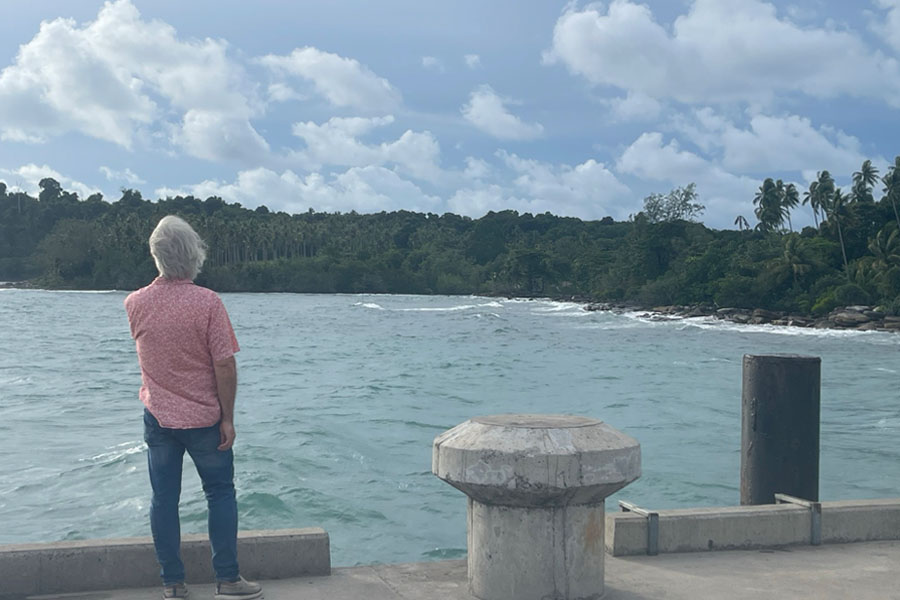
As usual, I’m listening with just one earbud. This time to Sting: “I’m an alien, I’m a legal alien.” Both my vocal cords join in.
Alien.
I’ve been coming to Thailand for thirty years and have lived here since 2014. Over the years, the word has come to play an increasingly absurd role in my life. I’m an alien in Thailand, and I see little prospect of that changing.
And honestly, before coming to Thailand, I had never thought of myself as an alien. It took the Thai authorities to inform me that I was one. Officially, I’m an alien, but to most Thais I’m a farang, which, incidentally, is also the Thai word for guava. Bottom line, I am different and will remain different. An alien in a country I now call home.
Recent statements of Thailand’s Prime Minister, Anutin Charnvirakul, got me thinking about it again. He is not exactly known for his eloquence or hospitality towards foreigners. Among his public remarks:
“You should be grateful we have let you come here.”
“If you are going to die, go die back home. You do not need to come and die here.”
Earlier, during the COVID era, as Minister of Health, he did express his frustration with those stubborn, individualistic foreigners, uttering the now-infamous words: “Ai farangs, those tourists” — roughly, “those damned foreigners”.
Admittedly, I should not forget the context of his words, primarily directed at foreigners breaking Thai laws. But they raise an uncomfortable question. “We have let you come here.” The words establish the distinction between host and guest. Thailand the host, the foreigner guest. The host grants permission; the guest receives it.
Perfectly reasonable when someone arrives for a two-week holiday.
But what if the guest stays for twelve years? What if he is married to a Thai, builds a home, pays taxes and becomes part of the local community? How much of a guest is he? And why should his country of birth necessarily remain the place where he is expected to die?
Thailand has every right to decide who may enter and who may stay. But surely there is a difference between someone passing through and someone who has spent years building a life here. Recognising that difference would not mean granting foreigners special privileges. It would simply mean acknowledging a reality that already exists.
Take myself as an example. I am building my second house here in Thailand. My wife bought a plot of land with money officially declared hers for the occasion. And just a few days ago, I spent my time counting 80 truckloads of soil and paying for them afterwards. An engineer came to investigate the ground. Construction workers will follow, and local businesses will benefit. Fair to say that my money is settling down in Thailand rather more comfortably than I have since my arrival.
And while day-to-day life is little affected by the paper reality, an alien like me is racking his foreign brain over who or what he actually is. I am certainly a Thai tax resident, subject to the country’s tax laws and filing obligations. Over the years, my commitment to Thailand has become permanent. Thailand’s commitment to allowing me to stay has not.
Thailand does offer routes to permanent residence and citizenship. But for someone in my circumstances, neither provides a straightforward solution. I have built a life here, yet my right to continue living it remains conditional.
That stings. All the more because the difference becomes painfully obvious when I look at my own marriage. My wife is Thai. When we lived in the Netherlands, she became Dutch after a few years. There was a proper ceremony when she acquired Dutch nationality, with a certificate and a handshake from the mayor, and all. And she was delighted.
Now we live in Thailand, her country. She is Thai. I am still an alien.
Same marriage. Different country. Remarkably different welcome.
If all goes well, we’ll be going on holiday later this year. Most likely Vietnam. During that break I’ll be a tourist, a guest.
But when I come back to Thailand, I don’t recognise myself in those terms.
Having lived here for many years, with family and friends, memories and plans… yes, even a home, I don’t think those terms rightly apply to me anymore. How can I do everything legally possible to stay, with no intention of leaving, and still be considered a guest? Strange, to say the least. Plaek, as the Thais would say.
On social media, reflections like these often get the predictable response:
“If you don’t like it, you can always leave.”
And there’s some truth in it. Nobody forced me to come to Thailand, and I certainly don’t expect the country to change its laws just to accommodate me. Nor do I believe that spending money here entitles me to special treatment.
But leaving? After all these years? Leaving what, exactly? My home, my wife, my friends, the life we’ve built together?
I don’t need the Thai government to tell me where my home is. But I will need its permission to continue living there till the day I die.
Here.
Jay is a guest writer based in Thailand. He writes essays, stories and columns on identity, connection, loss and the questions that shape how we make meaning of the world. Read more of his work at Inside-Out.
KioskNews shows a cleaned-up reading view extracted from the publisher’s page — the original always lives on their site, not ours.