Moby-Dick; Tracing the success of a Great American Novel
“Call me Ishmael” is one of the most recognisable opening lines in literature. But when Herman Melville’s Moby-Dick; or, The Whale, came out in 1851, it wasn’t immediately successful. It sold poorly, got mixed reviews, and did nothing to revive Melville’s declining reputation. By the time he died in 1891, he and the book were largely forgotten. It took decades for that to change.
How did a book that failed in its own day become one of the most studied and admired novels in American literature? The Moby-Dick that appeared in October 1851 had grown far beyond the sea adventure Melville first set out to write. He had written and rewritten it, drawing on his own experiences at sea, on the books he had read about whales and whaling, and on one of the most notorious disasters in the history of the industry.
By the middle of the 19th century, whaling was big business. Whale blubber was rendered into train oil, used to lubricate machinery, and light cities. New Bedford, one of the centres of the American whaling industry, was known as “The City That Lit the World”. But the animals themselves remained largely a mystery.
The Essex disaster
On November 20, 1820, a sperm whale struck the whaleship Essex in the southern Pacific. Twenty men escaped in three boats and spent about three months at sea, facing starvation and dehydration; some eventually resorted to cannibalism.
One of the survivors, first mate Owen Chase, later wrote an account of the disaster. Melville read it, and the Essex became one of the sources for Moby-Dick. Chase described the whale as coming towards the ship “with twice his ordinary speed”, and said it appeared to have “tenfold fury and vengeance in his aspect”.
Melville turned that single encounter into something much larger.
Ishmael, an outsider who goes to sea looking for something he can’t quite name, befriends Queequeg, a tattooed harpooner, and joins the crew of the Pequod under Captain Ahab, who lost a leg to a great white sperm whale named Moby Dick. Ahab is set on finding and killing the whale. His obsession takes over the voyage, despite the objections of his first mate, Starbuck, and a whaling expedition becomes a hunt the crew can’t escape.
The novel that runs into 135 chapters moves between adventure, philosophy, descriptions of whales, religious references, and long passages of whalelore. Narrative and essay-like sections are mixed together.
It’s also funnier than its reputation suggests. Ishmael’s friendship with Queequeg provides some of the book’s lighter moments. “Better sleep with a sober cannibal than a drunken Christian,” he thinks, after being made to share a bed with the harpooner.
Then there are the questions that keep readers coming back. Ishmael, Ahab, and the ship Rachel all have Biblical names, and the story can be read through a religious lens. Ahab’s pursuit of the whale resembles idolatry. Moby Dick can be read as a symbol of God, nature, fate or something more unknowable. Readers down the ages have found in it a story about obsession, nature, religion, race, friendship and American identity.
Melville and Hawthorne
Melville met Nathaniel Hawthorne on August 5, 1850, when a group of writers and publishers climbed Monument Mountain in Massachusetts. Melville was 31. Hawthorne was 46 and already well known for The Scarlet Letter. The encounter affected Melville deeply. He later wrote that Hawthorne had “dropped germinous seeds into my soul”.
The two began corresponding. Soon after, Melville moved with his family to Arrowhead not far from Hawthorne. Hawthorne read Moby-Dick and praised it in a letter that has since been lost. Melville’s response survives: “Your heart beat in my ribs and mine in yours, and both in God’s...”
Melville dedicated his book to Hawthorne’s “genius”. The exact nature of their friendship has been debated ever since. What’s clearer is the effect on his writing: during this period, he moved further away from the straightforward adventure story he had begun and towards the strange, symbolic, mixed-form novel that Moby-Dick ultimately became.
A messy publication
Melville had first contracted with British publisher Richard Bentley for a book then known as The Whale. He kept the printing in New York so he could oversee the proofs while continuing to revise the manuscript, writing to Hawthorne about having to “work and slave on my ‘Whale’ while it is driving through the press”. The British edition, 500 copies, was published on October 18, 1851. The American edition followed on November 14 from Harpers, under the title Moby-Dick.
The two editions differed greatly. The most important difference was that the British edition had no epilogue. That appears to have been a production error, but it mattered. Without it, British readers were left with a first-person narrator who seemed unlikely to have survived the destruction of the Pequod. The Spectator objected that “nothing should be introduced into a novel which it is physically impossible for the writer to have known”, and other reviewers asked how the author could be alive to tell the story. The American edition had the epilogue, revealing how Ishmael survives: floating on Queequeg’s coffin till he’s rescued by the Rachel.
The poor British reviews didn’t help the book’s reception in America, and Melville’s career continued to decline. By 1856, Hawthorne recorded that Melville had “pretty much made up his mind to be annihilated”. When Melville died in 1891, Moby-Dick was out of print. Billy Budd, another of his major works, remained unpublished.
That changed in the 20th century. Melville’s birth centenary in 1919 renewed interest in his work. Raymond Weaver’s 1921 biography, Herman Melville: Mariner and Mystic, and a 16-volume edition of Melville’s works published between 1922 and 1924 helped drive the “Melville Revival”.
Every modern writer of standing from William Faulkner to DH Lawrence has been struck by Moby-Dick with the latter calling it “the greatest book of the sea ever written”.
A novel that was once dismissed as too long and too strange, is now read as a sea adventure, a philosophical novel, a comedy, a tragedy, and a catalogue of what Melville knew and imagined about the natural world.
Ahab’s obsession can be read as a warning about the desire to master nature; Ishmael’s curiosity points the other way. “It is not down on any map; true places never are,” he says. And it’s Ishmael who survives to tell the story. “I know not all that may be coming, but be it what it will, I’ll go to it laughing,” he says.
In the decades after Melville’s death, the book that failed in his lifetime became, as The Oxford Companion to English Literature puts it, “the closest approach the United States has had to a national prose epic”.
Back in New Bedford
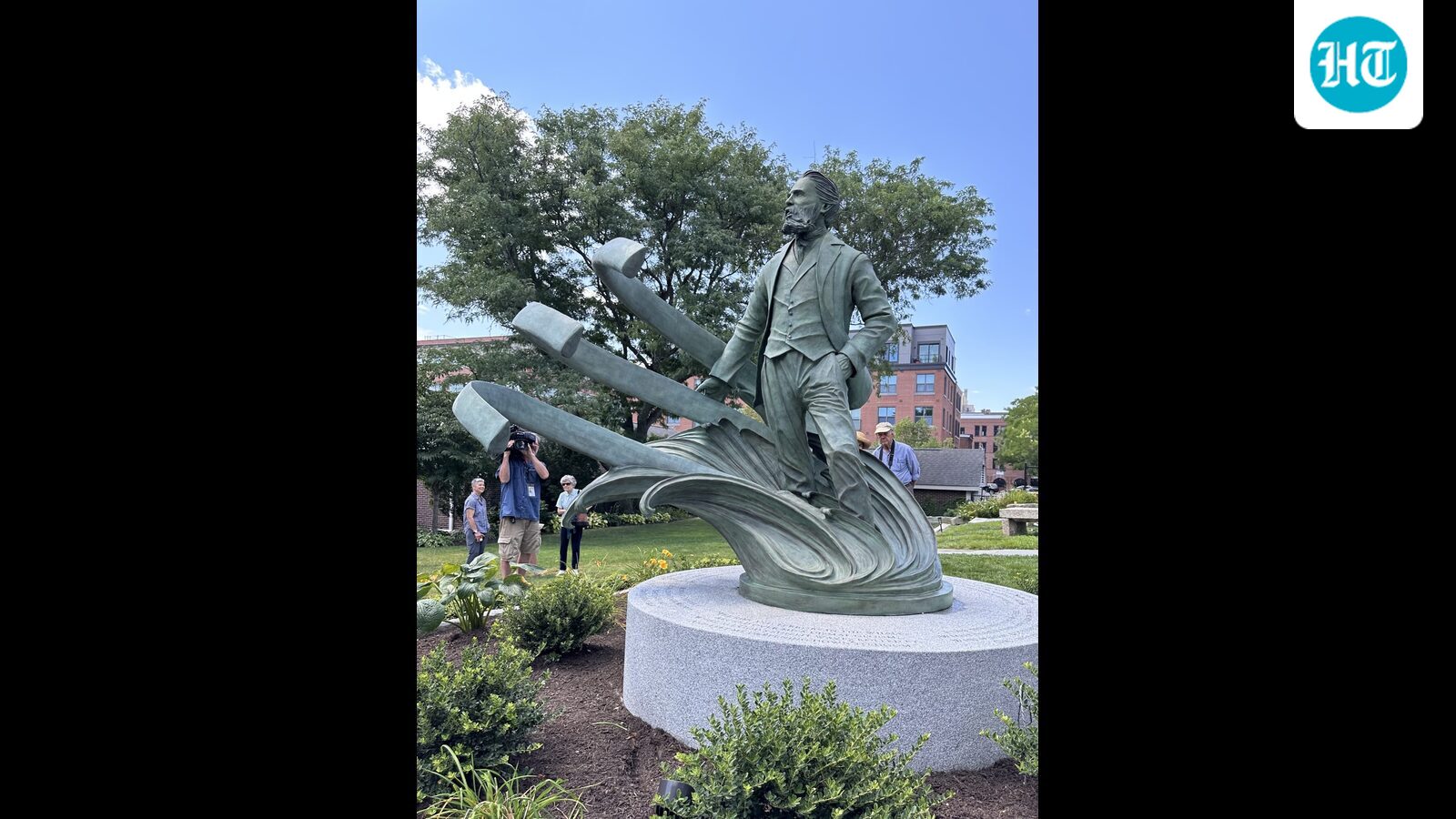
In 2026, Melville has returned to the city that helped shape the book. On August 14, a new bronze statue of the author was unveiled outside Seamen’s Bethel in New Bedford, where he worshipped before sailing from the harbour aboard the Acushnet.
The 7.5-foot sculpture, by artist Stefanie Rocknak, shows Melville surrounded by whale ribs, waves rising around his feet, looking towards the harbour and the sea. Chapter 9 of Moby-Dick takes Ishmael and Queequeg to the Whaleman’s Chapel, where Father Mapple delivers his sermon about Jonah and the whale. The statue’s design draws on that scene.
“[Moby-Dick’s] imprint on American culture has been broad and indelible. It is the most famous work of prose in the English language; it has inspired the emulation of countless authors, playwrights, musicians and painters the world over; it is the most assigned novel on college campuses; it has shaped America’s national identity,” said Jon Mitchell, Mayor of New Bedford, during the dedication ceremony.
Melville left New Bedford as a young sailor. Now, 175 years after Moby-Dick was published, he’s back where the story began.
Teja Lele is an independent editor and writes on books, travel and lifestyle.
KioskNews shows a cleaned-up reading view extracted from the publisher’s page — the original always lives on their site, not ours.