Is China getting faster at integrating new nuclear missiles into its forces?
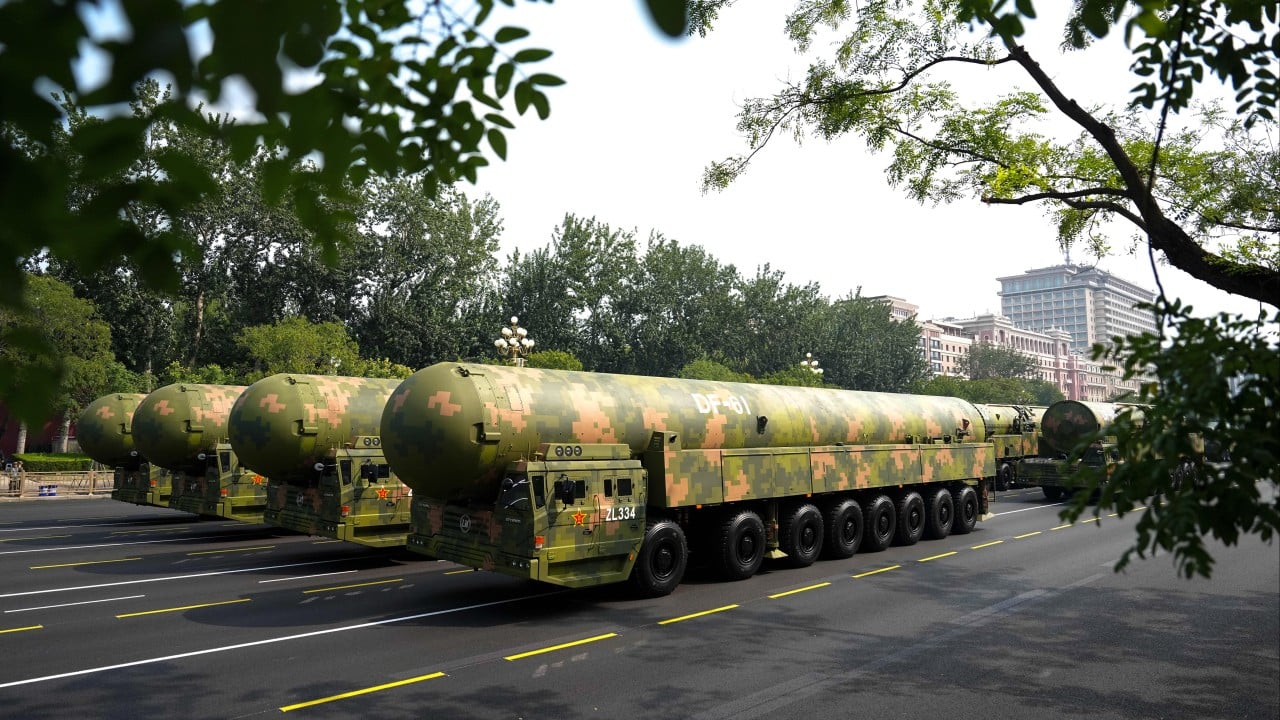
China’s newest land-based intercontinental ballistic missile, the DF-61, has made its way into routine military training much faster than earlier ICBMs, according to state broadcaster CCTV.
That raises the question of whether the People’s Liberation Army is becoming more efficient at integrating new strategic missiles into its nuclear forces.
Shao Yongling, who has worked as a researcher with the PLA Rocket Force, told CCTV on Thursday that the DF-61’s progression from its public debut at a September 2025 military parade in Beijing to routine training was “far faster than the combat capability generation cycle of traditional intercontinental missiles”.
But analysts told the SCMP that the fast progress could be to do with similarities between the DF-61 and the older DF-41 ICBM, though little is publicly known about the new missile.
China has not disclosed technical specifications for the DF-61, including its range or how many nuclear warheads it can carry.
Estimates vary considerably, with the SCMP previously reporting a possible range of 12,000km (7,450 miles) to 15,000km (9,320 miles), while defence intelligence company Janes has estimated a maximum range of about 18,000km (11,180 miles) and capacity for up to 12 nuclear warheads.
The DF-61 is the latest of several nuclear-capable ICBMs in China’s arsenal, including the DF-5, DF-31 and DF-41. All of them are operated by the PLA Rocket Force, which is responsible for land-based nuclear and conventional missiles.
The Pentagon has assessed that the older DF-31A – with a range exceeding 11,000km – can reach most of the continental United States. The DF-41 has an estimated range of up to 15,000km, according to the Centre for Strategic and International Studies.
In a CCTV report marking the 66th anniversary of China’s first successful ballistic missile launch, Shao said the DF-61 had completed development, design finalisation, trial fielding and reliability verification before it was unveiled, suggesting it was already technically mature.
He said its compatibility with the rocket force’s command, communications and support networks, together with the service’s experience training ICBM crews, had allowed units to familiarise themselves with the weapon quickly.
Shao added that routine training involved field manoeuvres, repositioning and launch procedures – all aimed at strengthening the ability of land-based nuclear missiles to survive an attack and get past enemy defences.
The missiles are intended to allow China – which has a no-first-use nuclear policy – to retaliate if attacked with atomic weapons.
Ankit Panda, a nuclear weapons specialist at the Carnegie Endowment for International Peace, said earlier Chinese ICBMs had generally taken far longer to enter service, judging from open-source evidence and US intelligence assessments. He said the DF-61 “does appear to be notably quicker”.
But that comparison has limits. “We don’t have good enough public or open-source information about the development and testing of this system yet,” Panda said.
Tong Zhao, another Carnegie nuclear specialist, compared the histories of two earlier missiles. The DF-31 was first publicly displayed in 1999 but, according to many international researchers, did not enter operational service until around 2006. In comparison, the DF-41 underwent a series of reported flight tests between 2012 and 2018, according to Janes, before it was unveiled at a 2019 military parade.
China has disclosed neither the DF-61’s development timeline nor a verifiable flight-test record. However, Beijing said last year that all weapons showcased in the 2025 parade – where the DF-61 made its debut – were in service already.
Zhao said the DF-61’s progress might be considered unusually fast if it was an entirely new design, but that might not be the case if it was an upgraded DF-41 with improvements made to its launch procedures, survivability or its ability to break through missile defences.
Mackenzie Knight-Boyle, of the Federation of American Scientists’ Nuclear Information Project, said the DF-61 and DF-41 had nearly identical launchers and missile canisters, though images of the DF-61 missile had not been publicly released.
“The speed at which the missile has progressed through training as well as its compatibility with existing command and support networks would make sense if it is, in fact, a modified version of the DF-41 ICBM rather than an entirely new missile,” Knight-Boyle said.
“We can’t assume from this … that the rocket force has become faster or more efficient at developing new ICBMs,” she added.
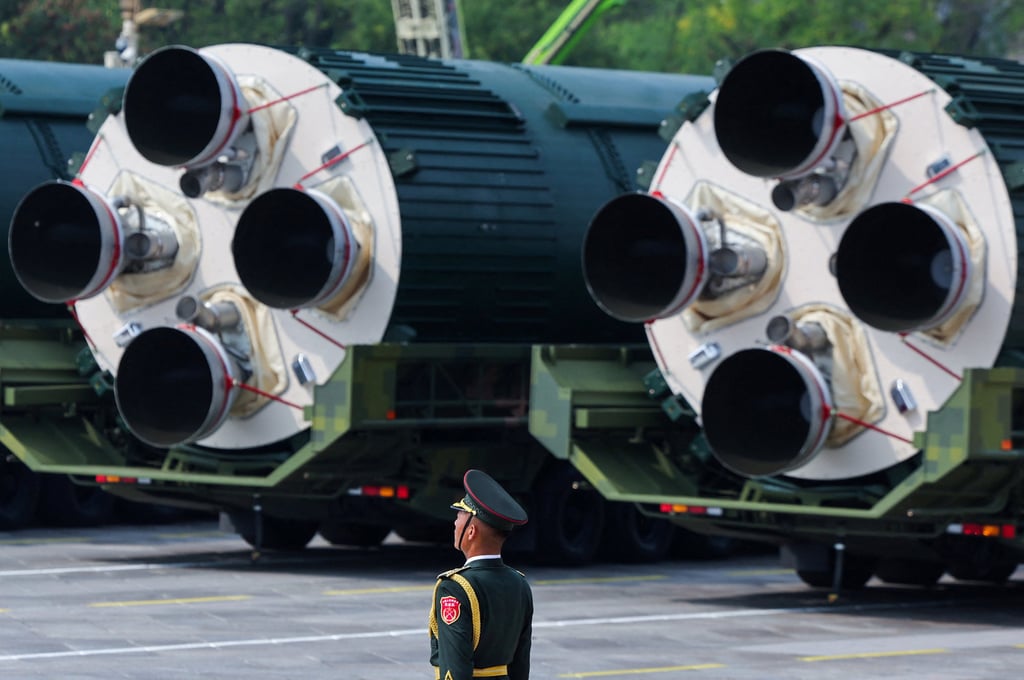
Beyond questions about its development, the DF-61’s operational readiness is also difficult to establish. Entering service does not necessarily mean full operational readiness, which also requires trained personnel, launch vehicles, infrastructure and the ability to carry out assigned missions.
A former US intelligence analyst, speaking on condition of anonymity, said he had not yet seen any satellite imagery confirming an operational DF-61 unit. Deployment would also depend on available infrastructure and sufficient production of missiles and launch vehicles to equip operational units, he said.
A faster integration of new missile systems could have broader strategic implications.
David Logan, an assistant professor of security studies at Tufts University, said China’s increasingly survivable nuclear forces could embolden Beijing to use military force by reducing its vulnerability to a US nuclear first strike.
But greater confidence in its arsenal’s survivability could also reduce the risk of unintended escalation, he added, by easing fears of losing its weapons before they could be used.
“The bottom line is that systems like DF-61 may lead to greater uncertainty on the US side about China’s ability to flexibly scale and shape its strategic force,” Panda from Carnegie said.
“This could drive insecurity in the United States and intensify competitive pressures.”
KioskNews shows a cleaned-up reading view extracted from the publisher’s page — the original always lives on their site, not ours.