Sops, debt and Ed Sheeran song: At 60, why Punjab falls, Punjabi rises
Anniversaries may prompt one to look back and ask some tough questions. On November 1 every year, Punjab remembers the formation of a smaller, Punjabi-speaking state in 1966.
The state was carved after years of the Akali Dal-led Punjabi Suba movement which was initially dismissed as parochial in the wake of India’s Partition. The 1955 States Reorganisation Commission, in its report, refused to recognise Punjabi as a distinct, independent language. The Arya Samaj had also once urged Punjabis to abandon their language. That battle is now history.
Punjabi has travelled farther and wider than its critics ever imagined. Even the renowned British singer Ed Sheeran uses it effortlessly. Remember his 2025 hit song “Sapphire” in which he sang the line, “Cham cham chamke sitare wargi (she shines like a star)”, like a true-blue Punjabi? And late Sidhu Moosewala continues to command a loyal fan base across states, including Bihar and beyond. So the Punjabi language or its survival are no longer the issues.
Troubled arc
Sixty years on, the state’s real conversation is with “younger brother” Haryana, which seems to have outrun it. In Punjab’s drawing rooms, their comparison still rankles in conversations.
To be fair, Punjab won the first round in this sibling rivalry. The Green Revolution made it India’s food bowl. With just 1.53% of the country’s land, it once accounted for about 70-73% of wheat and 40-45% of rice in the central pool in the early 1980s.
Punjab’s per-capita income remained the highest in India until the mid-1990s despite reeling from militancy. Till the early 2000s, it ranked near the top among major states in per-capita income.
Today, however, Punjab finds itself near the bottom, plunging to around the 10th spot on the per-capita score by the 2020s, and to the last position among major states on the NITI Aayog’s Fiscal Health Index in 2025 and 2026.
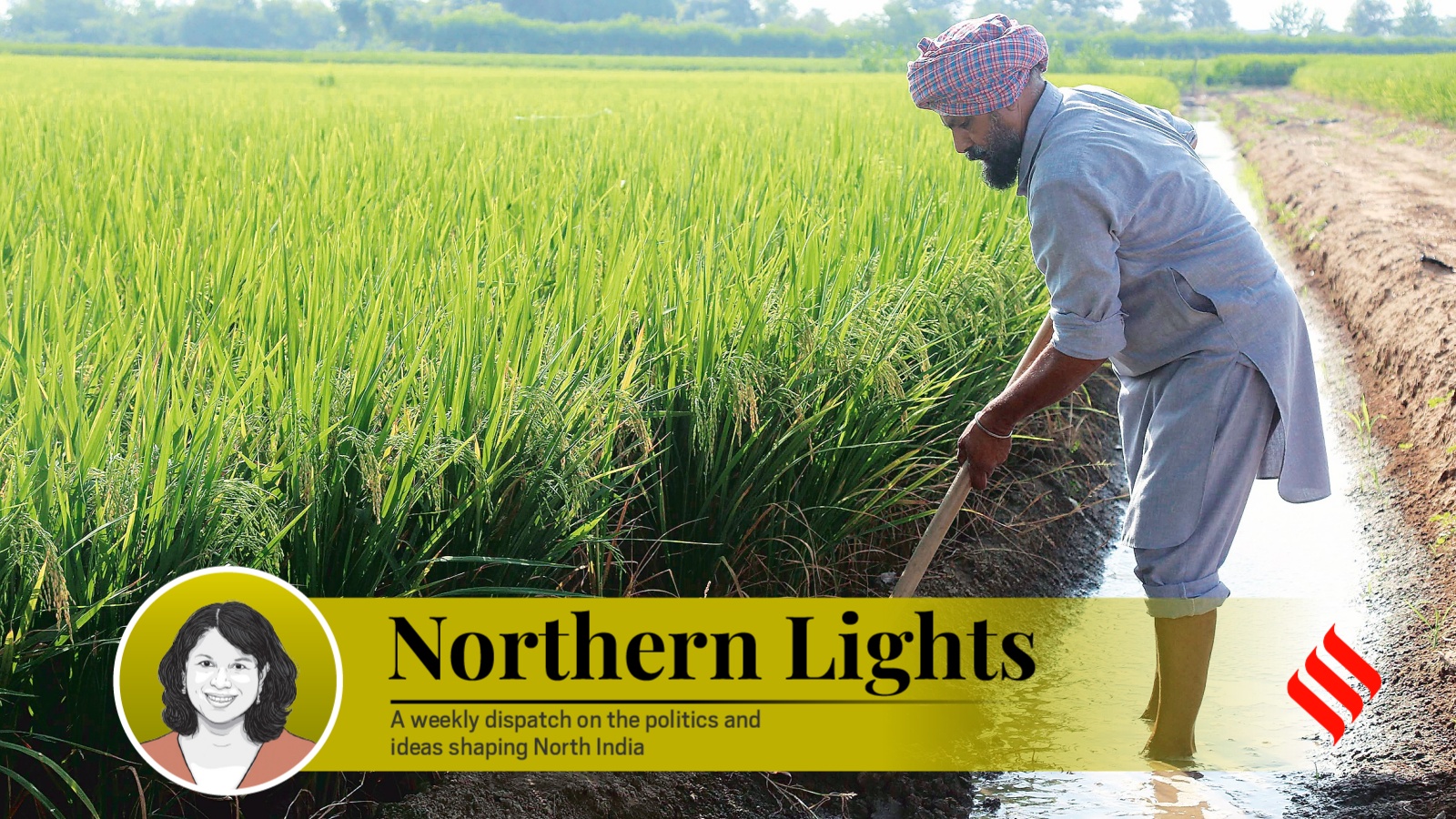
Punjab’s fall has been slow enough not to shock, and deep enough to define a generation. Its farmers have steadily continued to produce despite the diminishing returns and the spectre of rice drying up most of its water table. Despite the decades-long pitch for crop diversification, the acreage under rice cultivation keeps growing. This year, it touched a record 32.76 lakh hectares.
The costs are visible on the ground. In central Punjab, the water table has crashed from an average 7.8-9 mts below the surface in the late 1990s to more than 21 mts now. In many districts, ground water is falling by more than a metre annually as per the Central Ground Water Board. Some observers say Punjab may be exporting its ground water to the rest of India through rice.
The Centre also no longer needs Punjab the way it once did. Other states have become self-sufficient or surplus in food production. Punjab’s share in the central pool has plummeted – wheat from 70% in the 1980s to about 30% in recent years, and rice from 40% down to 20-25%. While the procurement of grains in absolute terms remains large, the state’s old leverage is gone.
Freebies amid crisis
The reasons for Punjab’s economic troubles, however, go much beyond agriculture. The state has seen a slew of populist policies being implemented as welfare schemes with successive governments across party lines vying with the other to champion them.
In 1996-97, the then Congress chief minister Rajinder Kaur Bhattal first gave free power to small farmers just as her tenure was about to end. The succeeding Akali Dal-BJP government led by CM Parkash Badal promptly extended it to all farmers. It also started Shagun, a cash gift scheme for poor families for the marriage of their daughters.
In 2002, the new Congress government led by CM Capt Amarinder Singh scrapped the free power policy and introduced a flat tariff regime. But political pressure forced it to restore power subsidy in 2005.
After his return to the helm, Parkash Badal launched the “atta-dal” scheme in 2007 and, in 2015-16 during his second consecutive term, the free pilgrimage programme for the elderly. In 2021, the Amarinder-led Congress government rolled out free bus rides for women.
The current Bhagwant Mann-led AAP government, which assumed power in 2022, has taken the freebie model to a new level. It provides 300 units of free electricity monthly to domestic consumers. The power subsidy bill alone costs the state an amount raging from Rs 15,500 crore to Rs 20,500 crore per annum.
In July this year, the Mann government launched the Mawan Dhiyaan Satkar scheme to give monthly cash to every eligible woman in the state.
These are popular sops, which many say could buy loyalty or silence. They also lock the state’s finances into a debt trap.
Once a freebie is given, it is virtually impossible to withdraw it. Every government inherits the dole and the bill. The result is a state budget in which interest payments, power subsidy, salaries and pensions together swallow most of the revenue. What remains is too little for roads, schools, hospitals, skill centres or industry. Punjab’s gross capital formation, the money spent on assets that create future growth, has lagged behind the national average by 16-26 percentage points for two decades. The cumulative investment shortfall runs into lakhs of crores.
Prof R S Ghuman, in his 2025 study “Walking with the Ups and Downs of Punjab Economy”, says over 18,700 industrial units have shut down across the state since mid-2000, 43% in Amritsar alone. Batala, the foundry hub, is almost deserted, and Mandi Gobindgarh, the steel town, is tottering.
Fraught future
From manufacturing, Punjab has shifted its focus to real estate, even as the flight of capital continues. An industrialist from Malerkotla recently said he was making investment in Telangana despite the language barrier. Most of the state’s old industrial houses have units in states as far as Chhattisgarh. There has not been any major new investments into Punjab – and the menaces of drugs, gangs, gun culture, and a hostile border do not help.
The numbers show the scale of the crisis. Punjab’s outstanding debt stood at Rs 3.46 lakh crore in 2023-24. It is projected to cross Rs 4.17 lakh crore by 2025-26 and to Rs 4.5 lakh crore by 2027. The state’s debt-to-GSDP ratio remains in the mid-to-high 40s, indicating that its outstanding debt is equivalent to nearly half of its annual economic output. Interest alone consumes more than a fifth of revenue, while debt servicing takes over 40%. The state is no longer able to balance its books without fresh borrowing. “Punjab’s finances are in the ICU,” says economist R S Ghuman.
The IT boom bypassed Punjab. The question now is, would it be the same for the AI wave, which is reshaping the world?
Observers however believe that Punjab could still do course-correction if it cuts indiscriminate freebies, raises productive investment, forces real crop diversification, and rebuilds its industry. Or else, it can just keep borrowing, distributing sops, and watching the next generation leave the state.
Sixty years after the state’s reorganisation, Punjabi continues to flourish. It is Punjab itself that needs to be rescued.
(Manraj Grewal Sharma is National Editor, North, The Indian Express)
KioskNews shows a cleaned-up reading view extracted from the publisher’s page — the original always lives on their site, not ours.