Netanyahu's Rotation Deal: Last Throw Of The Dice Or Genuine Olive Branch?

Israel's caretaker Prime Minister Benjamin Netanyahu on Saturday proposed a rotating premiership with his main rival, Gadi Eisenkot, in what could be seen as a pivotal point in the new government formation process.
Netanyahu, who is Israel's longest-serving leader, offered to go second in a rotation agreement with Eisenkot in a proposed unity government deal between their two parties.
"My responsibility as a leader requires me to set everything aside... and agree that Gadi Eisenkot will serve first as prime minister, while I will serve as alternate prime minister at the beginning of the term," he said.
READ | Netanyahu Offers To Let Rival Eisenkot Be PM First In Rotation Deal
Israel's president has told Eisenkot to try to form a government after an inconclusive October 27 election left neither his Yashar party nor Netanyahu's Likud with a clear path to power.
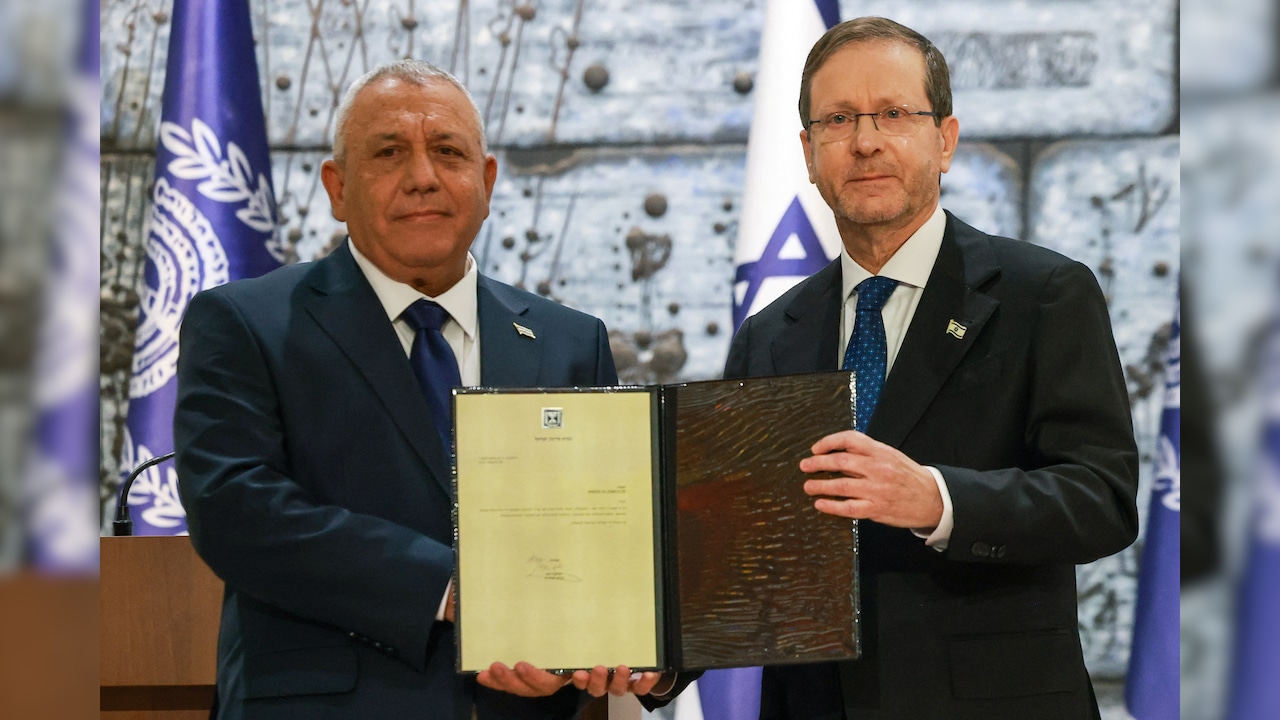
Israeli President Isaac Herzog hands Gadi Eisenkot the mandate to form a new government on November 8
Photo Credit: REUTERS
Eisenkot has said that he plans to announce a new government by the December 6 deadline and not exercise his option to extend this by 14 days.
Eisenkot's team has already reached an agreement with the ultra-Orthodox United Torah Judaism (UTJ) and has struck deals with Avigdor Liberman's Yisrael Beiteinu and Yair Golan's Democrats. Further talks are still being held with additional parties.
While it was once thought that it would be challenging to forge a government that excludes Likud due to the opposing views of Netanyahu's opponents, it now appears this may be achievable.
Beyond merely promoting political unity, Netanyahu is also keen to ensure that his adversaries do not manage to successfully negotiate a government and, in doing so, force him from office.
Why Netanyahu is offering a turn-taking government
Netanyahu's initiative is shaped by both shifting party representation in the Knesset and the increasing likelihood that Eisenkot will be able to construct a government incorporating parties that traditionally oppose the current prime minister.
Former PM Naftali Bennett has also been campaigning for a unity government. He favours the same turn-taking format, with Eisenkot first and then Netanyahu. He sees greater government stability in a wider coalition and believes that he can re-enter government without needing to justify his alliance with Arab parties to his right-wing voters.
READ | "To See How Serious It Is": After Netanyahu's Coalition Offer, Eisenkot Ready For Talks
However, there is a key issue surrounding trust. Netanyahu's allies are largely reluctant to accept a turn-taking government which would again enable Netanyahu to return to the prime ministership. In Israel's past coalitions, the opposition has been cautious about co-operating with Netanyahu.
Former PM Yair Lapid has accused Netanyahu of yet another dishonest move, while others claim that his turn-taking proposal is aimed at sabotaging coalition formation rather than encouraging unity.
Despite this, Eisenkot continues to negotiate as if a government can indeed be constructed without Likud.
For Netanyahu, should he fail to amass enough votes for a ruling government of his own, a unity government may well be his final opportunity to stay in office. Eisenkot, conversely, risks co-operating with the man whose ousting has been such a unifying force for the opposition.
Ultra-Orthodox parties - key to deciding Netanyahu's fate
Breakthroughs have occurred in Eisenkot's talks with the ultra-Orthodox United Torah Judaism. Issues of national service and financing for religious education have been discussed between Eisenkot's team and UTJ members.
National service has proven to be one of the most contentious issues in Israeli society. The army's need for personnel has grown since the October 7, 2023 Hamas assault and the resulting wars and operations.
UTJ seeks to exempt full-time students of Torah from national service and also wants to abolish penalties for those who do not serve. The party also wishes to ensure that students at yeshivas (religious seminaries) are not arrested for shirking national service.
READ | Eisenkot Signs Second Coalition Deal, With Left-Leaning Democrats
Yet, Eisenkot has included compulsory national service in his list of four core issues that coalition partners must adhere to. Likewise, Liberman has emphasised that whatever is agreed must conform to military needs and pass muster in Israel's High Court of Justice.
This therefore puts Eisenkot in something of a dilemma. While he requires UTJ's backing in parliament, compromising on this issue may conflict with one of his key policies.
Interim solutions are currently under consideration. These include legislation which would be in force for three months and a committee charged with finding a solution to the national service issue within 120 days.
It has also been suggested that the government could be inaugurated before ultra-Orthodox ministers are appointed, in the hope that Eisenkot will then have fulfilled the national service requirements.
Netanyahu is keen to thwart UTJ's ability to negotiate successfully with Eisenkot. He is endeavouring to play upon divisions within the ultra-Orthodox community in order to dissuade their representatives from backing the new government.
Nevertheless, even limited UTJ backing may greatly affect the parliamentary representation balance.
Ra'am And The Arab Vote - another difficult area
Arab parties are also presenting Eisenkot with difficulties.
With 48 seats, the change bloc comfortably outnumbers Likud, which has 40 seats (excluding ultra-Orthodox parties). UTJ has seven, Shas has six, and the Arab parties together have 19 seats.
This means that Eisenkot could form a government with UTJ, and despite Arab party votes either being cast in favour or withheld, without necessarily attaining 61 seats.
READ | 'Want An End To Israel': Netanyahu Accuses Arab Politicians Of Election Fraud
Ra'am's involvement in a government is also proving to be of particular importance.
Mansour Abbas, who heads the Ra'am, has implicitly recognised Hamas as a "terror group", a move that could pave the way for his party joining a coalition to unseat Netanyahu.
Eisenkot has stipulated that an acceptance of Israel's security system and a dedication to destroying Hamas' military and governmental infrastructure in Gaza are prerequisites for coalition partners.
While Abbas has previously spoken out against terrorism and the October 7 Hamas attack in particular, he had never formally designated Hamas as a terrorist group.
Recent comments by Abbas have also prompted speculation as to whether Ra'am will not only refrain from voting in favour of a government in a confidence vote but will in fact back it.
By referring to the new government as consisting of the change bloc, UTJ and Ra'am, Abbas may be implying that his party is aiming for a more influential role than simply external parliamentary backing.
Both Liberman and Bennett are unhappy about a government reliant on Arab parties, while Lapid and Golan are more willing to work with these parties in parliament.
Eisenkot must therefore find an adequate level of backing for a government, but also avoid a situation in which the makeup of the government becomes a drawback for his right-wing allies.
Democrats return to talks - removing further impediment
Eisenkot has also overcome difficulties with Yair Golan's Democrats, another key element of the anti-Netanyahu alliance.
The Democrats had halted negotiations with Eisenkot due to concerns over the pace of Yashar-Likud talks, especially relating to judicial reform. The impasse was solved by direct talks between Eisenkot and Golan.
Both parties have now come to broad agreements. These involve reversing judicial reforms which the Democrats say constitute a 'judicial takeover' and ensuring the independence of Israel's judiciary.
The Democrats are anticipated to be allocated four ministry posts - these include a widened public security portfolio, along with labour and welfare, communications and culture and sports.
Politically, this is highly significant as it eliminates a potential source of internal friction for Eisenkot. It also enhances the feasibility of a non-Likud government by uniting parties which otherwise differ greatly in their ideologies.
Can Eisenkot maintain government cohesion?
The political landscape is increasingly unwelcome for Netanyahu. His Likud party does not presently have sufficient seats to establish a government on its own, while Eisenkot is striving to create an alternative government through talks with a wide range of parties spanning from secular right wing to left wing and ultra-Orthodox.
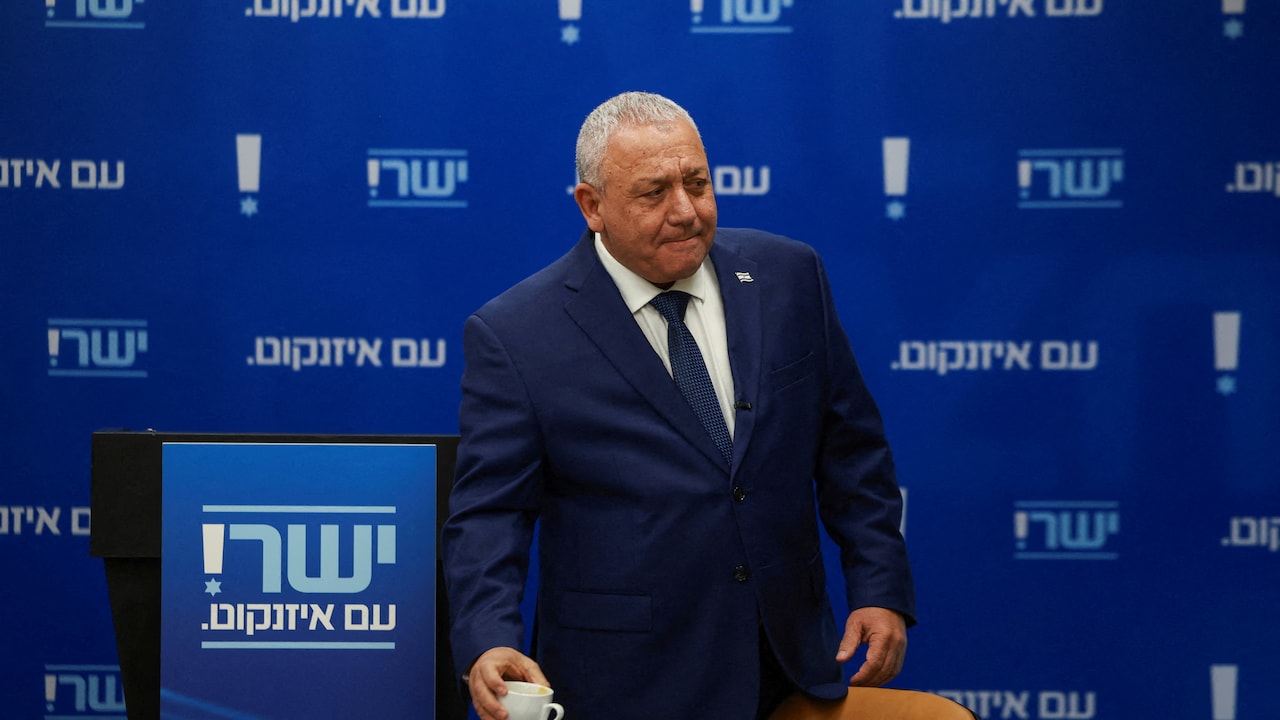
Gadi Eisenkot
Photo Credit: REUTERS
Netanyahu is especially adversely affected by the prospect of UTJ entering a government, as this might lead to the loss of a key parliamentary ally.
Even if Shas does not initially join a government, Eisenkot may still muster enough backing to win a confidence vote, assuming a sufficient number of members either abstain or do not vote.
There, however, is no certainty that Eisenkot's government will be cohesive. His coalition partners differ on issues such as national service, judicial reform, the inclusion of Arab parties and the trajectory of Israel's security policy, and sustaining such a government may well present an even greater challenge than establishing it.
For Eisenkot, becoming prime minister would be a substantial achievement in itself. Even a government in office for just one year could provide him with a distinct edge in an upcoming election. He would then be in a position to campaign from the prime ministership rather than from the opposition.Netanyahu's turn-taking proposal is therefore of major significance, and represents an effort to alter the political discourse at a time when the numerical balance is increasingly against him.
KioskNews shows a cleaned-up reading view extracted from the publisher’s page — the original always lives on their site, not ours.