Proposed COE revision: How it works and what it means for prospective buyers
SINGAPORE – For years, Category A certificates of entitlement (COEs) were meant for mass-market cars, while Category B COEs were reserved for premium vehicles.
However, that distinction has blurred more recently, with Category A COE premiums almost on a par with Category B prices – even overtaking them three times in just four months in 2026.
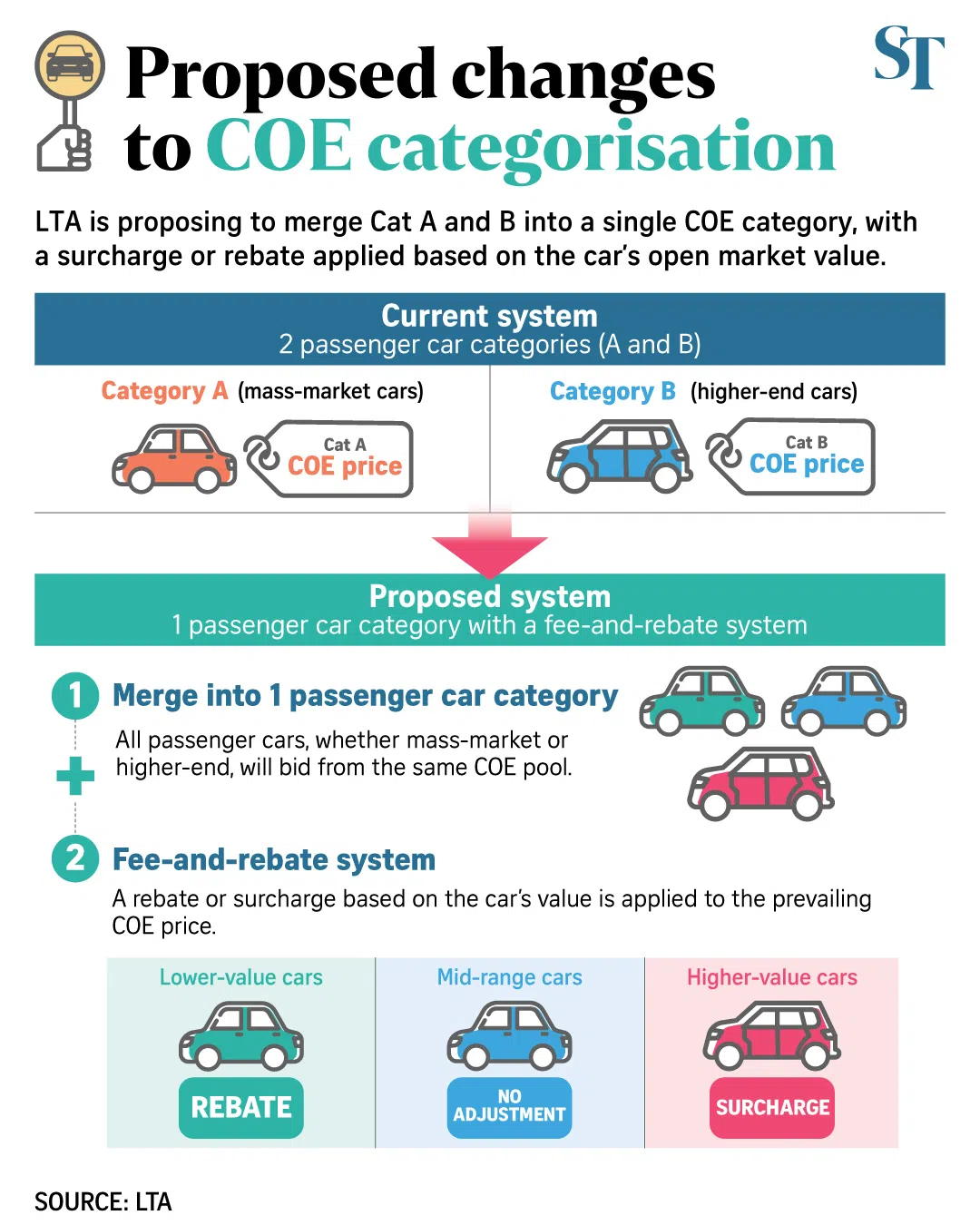
To address this, the Land Transport Authority (LTA) has proposed merging the two categories and introducing a tiered system of surcharges or subsidies based on a vehicle’s value.
Members of the public have until Nov 2 to provide feedback on these proposed changes, and the authority will share its findings by the first half of 2027.
The Straits Times takes a closer look at what the proposed revisions entail.
What is the aim of the COE review?
With the rapid adoption of electric vehicles (EVs), differentiating between a mass-market car and a luxury model has become increasingly difficult.
Currently, an internal combustion engine car qualifies for Category A if its engine capacity is capped at 1,600cc and its maximum power output does not exceed 130bhp.
EVs, on the other hand, cannot have a power output that exceeds 110kW.
However, carmakers have been able to adjust the power output of their models so that they fit within the threshold of a Category A COE.
This has fuelled stronger demand for COEs in this category, driving up prices to – and occasionally past – Category B levels.
Through this review of the COE system, LTA aims to “more effectively distinguish between mass-market and higher-end cars”, while still allowing market forces to determine COE prices.
What are the proposed changes in COE categories?
Instead of separate categories, all cars would fall under a single COE category. A rebate or surcharge would be applied based on a vehicle’s open market value (OMV).
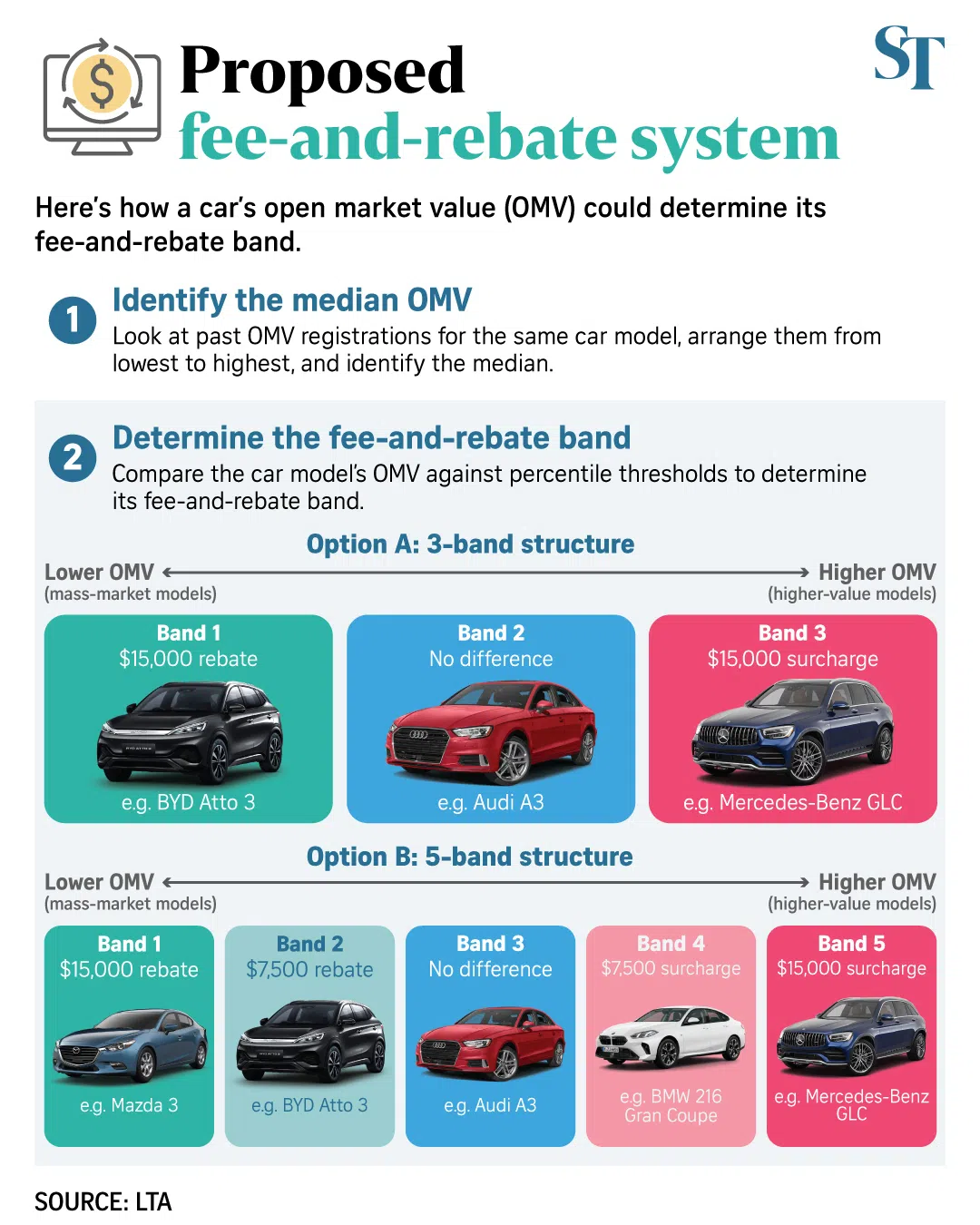
LTA has proposed two ways to structure this new system, which will categorise cars into different bands based on their median OMV, calculated using past registration data.
Under a three-band system, car models in the lowest band would receive a $15,000 rebate, while those in the highest band would face a $15,000 surcharge.
Cars in the middle band would pay the full COE amount without any rebate or surcharge.
Alternatively, LTA suggests a five-band system that “would allow for smaller adjustments”. In this case, cars in the lowest band would receive the maximum $15,000 rebate, while those in the second lower band would get a smaller rebate of $7,500.
The middle band remains unchanged.
On the upper end, the fourth and fifth bands would incur surcharges of $7,500 and $15,000 respectively.
Why use median open market value (OMV)?
OMV is the baseline cost of a vehicle before taxes, or the value at which it is imported.
The OMV can fluctuate over time, depending on factors such as exchange rate movements and changes to supply chains.
LTA therefore suggests using the historical median OMV to determine a model’s banding and rebate eligibility. For a new model, the OMV of the specific car will be used.
The authority said it would publish the band assigned to each car model annually so that potential buyers know if they would incur a surcharge before making any decisions.
What happens to Category E COEs?
COEs in Category E, also known as the Open category, can be used for any vehicle type except motorcycles, although they end up being used almost exclusively for larger, more powerful cars.
Motor traders often secure such COEs for the flexibility of registering cars without waiting for the next tender exercise.
LTA is seeking views on whether the category should be phased out – though this could impact those who urgently need to purchase a car – or modified so that the COE can only be used to register cars.
How will the proposed changes affect COE prices?
It is difficult to say how COE prices will be affected.
The proposed revisions are meant to ensure a clearer differentiation between mass-market and higher-end cars, and that those opting for the luxury models end up paying more.
They are not meant to lower COE prices.
Academics told ST that introducing rebates for models with lower OMVs could possibly result in more people shopping for cars, as mass-market models would appear more affordable.
If that happens, the higher demand would result in COE premiums increasing.
How will COE renewal work?
It is unclear if there would be any major changes made to COE renewal.
At present, car owners renew COEs based on the prevailing quota premium (PQP) of their respective categories, which is calculated using a moving average of the prices in the past three months.
While merging Categories A and B would create a single COE price and PQP, LTA noted that the price convergence in recent years meant that owners already pay similar amounts to renew their COEs.
Therefore, it remains to be seen whether introducing a surcharge or rebate model, similar to the system proposed for new car purchases, will apply to renewal.
LTA said if the proposed changes are adopted, it may consider transitional arrangements for existing car owners wishing to renew their COEs.
There are no changes to the COE bidding process, vehicle taxes and other fees.
Those interested in providing feedback on the proposals can do so here.
The consultation exercise will close at 11.59pm on Nov 2. The review is expected to be completed by the first half of 2027. It is unclear if there would be any major changes made to COE renewal.
KioskNews shows a cleaned-up reading view extracted from the publisher’s page — the original always lives on their site, not ours.