You Can See Everything in Elizabeth Holmes’s unblinking eyes. Or can you? | Jason Okundaye

Elizabeth Holmes doesn’t believe that she’s ever told a lie. She “knows” that she hasn’t committed any crime. And she has no reason to deceive you. While speaking, she is gazing at her interviewer, Nathan Fielder, with those enormous, blue, vacant, unsettling, unblinking eyes. She doesn’t break eye contact.
This is You Can See Everything, Fielder and Lance Oppenheim’s documentary, which, at her invitation, follows Holmes and her husband, Billy Evans, at their home in San Diego in the weeks up to her surrender to custody at federal prison. Holmes is the disgraced tech ex-billionaire whose startup Theranos claimed the ability to run hundreds of comprehensive blood tests from a single pinprick of blood. This false claim posed “immediate jeopardy” to the health of thousands of patients and defrauded investors of more than $700m.
What the film promises is what it says: that you can see everything, because the couple have nothing to hide. Unprecedented access is given to their lives: the cameras come in, and they don’t leave. You can see them discussing plans for a Theranos 2.0, you can see Billy’s penis in the shower, Elizabeth, or “Liz”, breastfeeding. You can see that Liz doesn’t whisk eggs vigorously enough for Billy’s liking. You can, following their logic, see that Holmes is innocent.
You Can See Everything has become a phenomenon, surpassing $100m globally since its release in the US last month, and breaking the record for the biggest opening weekend for a non-music documentary in the UK since opening here last Friday.
But why does Holmes’s story remain such a draw, 11 years on from Wall Street Journal reporter John Carreyro’s exposé? Fraudsters fascinate, of course. Anna Delvey posing as a wealthy German heiress; “the Monster of Wall Street” Bernie Madoff’s decades-long Ponzi scheme; the Tinder Swindler. Yet beyond the thrill and dreadful amazement, there is another pull: the question: “Could you detect a fraudster?” And if reality is broken down and blurred right in front of you, would you have the mental fortitude to withstand such an orchestrated illusion in real time? While watching the film, you ask whether Holmes manipulating us, or being manipulated herself? Or does the answer lie somewhere in between? Did she genuinely believe in Theranos or did she know all along that it was bunk? Is she really just that good at deceiving people?
You Can See Everything asks whether you can ever know where someone’s performance begins and ends. That is what the cameras go in to find, but thanks to the limits on what can be recorded, a documentary premised on observation and seeking truth is forced to rely on the techniques of fiction: performance, reenactment and selective disclosures. After Holmes is shown being sent to prison, the actor Amanda Seyfried, whose portrayal of Holmes in the 2022 series The Dropout earned her an Emmy, enters the frame – literally walking into Holmes’s home and making porridge on her stove in a reenactment.
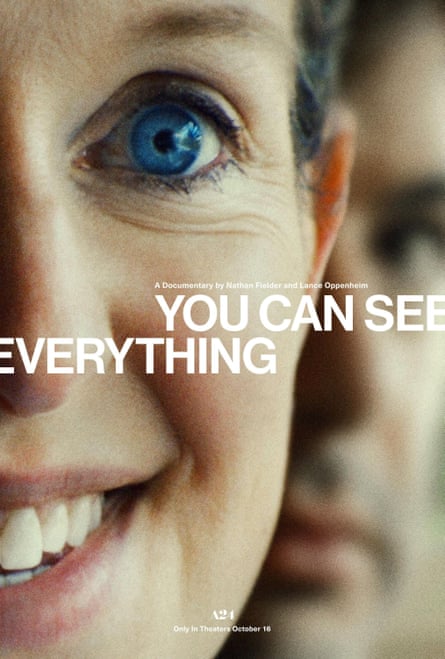
There’s an unsettled dispute around a New York Times interview in which Holmes, in reference to The Dropout, is quoted as saying: “They’re not playing me. They’re playing a character I created.” Holmes claims she said “a character they created”. But in the documentary she seems to have dropped certain memorable elements of her previous public persona: the baritone voice, the Steve Jobs-apeing turtlenecks, the private headbanging to hip-hop music. The home Holmes invites the film-makers into is so devoid of character or lived-inness that it may as well be a film set. So if Elizabeth Holmes is a performance then who, or what, are we watching in You Can See Everything?
That is why we are so fascinated by Holmes’s eyes. The film-makers know this; a single eye is the centrepiece of the film’s poster. Even while overwhelmed by the scale of Holmes’s deception, it’s her piercing eyes that Seyfried is most invested in imitating.
But what can we ever really learn from looking into a person’s eyes? Pop-psychology myths have long abounded that eyes are a reliable indicator of whether or not a person is lying to you. Liars avoid eye contact, say some. Or do they maintain intense eye contact as overcompensation? Others say they look in one direction or another. Body-language experts have weighed in to say that Holmes engages in “gaze aversion suppression” with Fielder, refusing to cut the tension when she’s questioned on her crimes. Academics have long dismissed the “lying eyes” theory, yet we stubbornly cling on: if we want to know if a child is lying to us, we ask them to repeat the statement while looking us in the eyes.
after newsletter promotion
Holmes’s unnerving gaze exposes one misconception about our voyeuristic age of media, reality television and tell-all documentaries: that if we are able to look closely enough at someone, see enough of their private life, and scrutinise every flicker of their expression, we will eventually be able to excavate their interiority, to tell good from bad, truth from lies.
In a film that becomes something of a conspiratorial thriller, you may leave with firm conclusions that Holmes is lying, a fantasist, a victim or some combination. But no matter how certain we are, we have no real way of knowing what is inside another person’s head. So in the end all you can do is look into her eyes and wonder.
KioskNews shows a cleaned-up reading view extracted from the publisher’s page — the original always lives on their site, not ours.