2026 Economics Nobel: How to keep an economy stable using policy tools
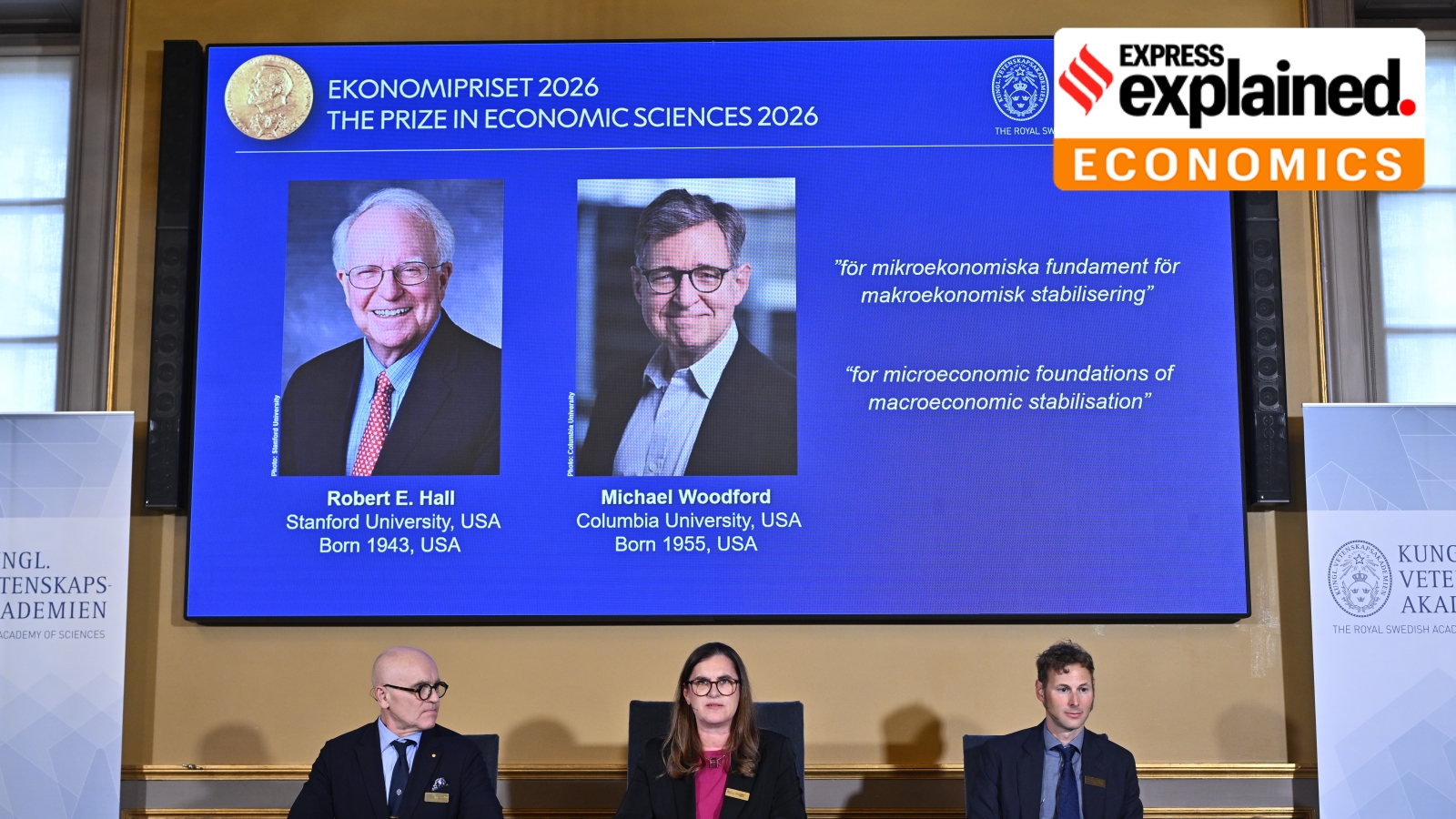
The Royal Swedish Academy of Sciences has awarded the Sveriges Riksbank Prize in Economic Sciences in Memory of Alfred Nobel 2026 — commonly called the Economics Nobel — to two American economists: Robert E Hall of Stanford University and Michael Woodford of Columbia University. They will share the prize money of 12 million Swedish kronor (approximately Rs 12 crore) equally.
The official citation states they have received the award “for microeconomic foundations of macroeconomic stabilisation”. Macroeconomic stabilisation refers to policies that governments and central banks use to “stabilise” an economy.
For instance, the Reserve Bank of India last week raised interest rates with a view to contain inflation. Inflation in India has been going up owing to a rise in crude oil prices and prices of other commodities in the wake of the US-Iran war, the blockade of the Strait of Hormuz, etc. There are also worries that inflation will rise further because deficient rainfall and higher temperatures due to El Nino may hurt food production and push up food prices.
If the government and the central bank followed the dictum that the government should not intervene and that the markets will price things correctly on their own, inflation can potentially soar quite high. That would hurt most Indians, since they are not rich enough to handle such a situation. It could lead to people cutting down all other expenses to focus on the essentials, which would cause many businesses to fail and lots of job losses. The economy, as a whole, may take a much longer time to recover — possibly years.
But an RBI intervention could stabilise the path in such a manner that the situation never becomes as dire as it could become if nothing was done.
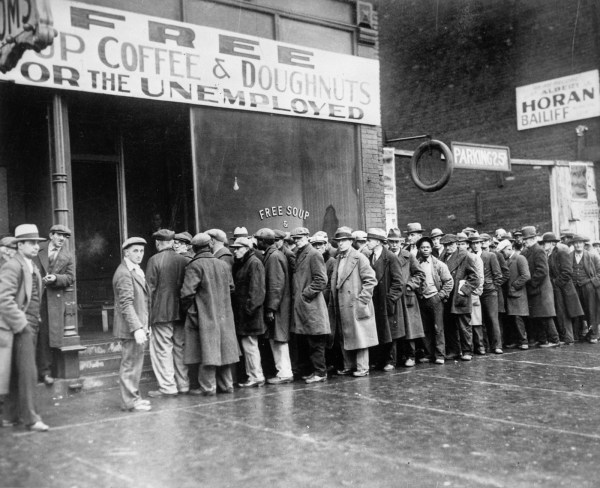 A crash in the stock markets in October 1929 marked the start of the Great Depression in the US. Photo: Wikimedia Commons
Similarly, over the past few years, the Union government has been cutting taxes — both direct taxes (personal income tax and corporate tax) and indirect taxes (GST) — with a view to boost consumption by individuals and investments by companies. That’s because in the years leading up to and during the Covid-19 pandemic (and resulting lockdowns), India’s economy struggled to grow.
Through tax cuts, the government tried to boost economic activity — the RBI also helped in those years by cutting interest rates. Without such interventions, a recovery might have taken much longer.
Story continues below this ad
These are the examples of macroeconomic “stabilisation” policies that academics such as Hall and Woodford helped refine through their work.
To understand the “microeconomic foundations” of these macro policies, one has to understand the trigger for their work.
What is their contribution?
A crash in the stock markets in October 1929 marked the start of the Great Depression in the US. As the days and months rolled by, the US gross domestic product — the value of annual output — fell by 30% and the unemployment rate soared to 25%.
Thousands of banks and businesses went under. The crisis reverberated through the world, especially affecting Europe.
Story continues below this ad
The dominant policy paradigm leading up to the Great Depression was that governments should not intervene, letting markets resolve through forces of demand and supply instead. But the widespread devastation made everyone rethink.
British economist John Maynard Keynes provided a solution that seemed to work: Governments and central banks should “stabilise” the economy through policy interventions. When growth is slow (and unemployment high), policymakers should cut interest rates and taxes, and the governments should spend more even at the cost of borrowing money itself and having a budget deficit, thus incentivising economic activity.
When the economy starts overheating and the inflation rate starts rising fast, the policymakers should slow down the economy by policies like raising interest rates. Thus, government intervention could save economies from suffering from wild fluctuations.
This broad policy formula worked until the experience of the 1970s. As the charts show, this was a decade when economies faced high inflation and high unemployment both at the same time, thanks to repeated oil price shocks. Efforts to boost a slowing economy only spiked inflation. Efforts to contain inflation further worsened unemployment.
Story continues below this ad
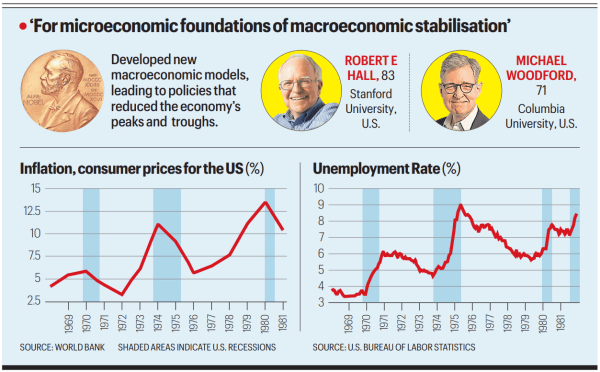 The charts show that the 1970s was a decade when economies faced high inflation and high unemployment both at the same time.
The situation became so bad (shaded areas in the charts show recessions) that the Keynesian recipe of government intervention was seen as the problem, not the solution.
Through their work from the late 1970s onward, Hall and Woodford revitalised the Keynesian approach by making it grounded in research. Keynes had assumed a linear or straight relationship between variables such as inflation and unemployment, and consumption and production. Hall and Woodford started studying the ground-level data.
Hall focussed on the demand side of the economy: questions such as, how do people decide how much they would consume, and when and how do they choose to raise or cut consumption. A better understanding of these, based on household data, has informed policy choices.
For instance, in 1982, he used microdata for a number of individual households to arrive at the insight that not everyone in the economy increases consumption based on income and future expectations; households that are living hand-to-mouth do not follow that assumption.
Story continues below this ad
Woodford’s work focussed on the supply side: how firms behaved and took decisions such as changing prices. The assumption is that markets find the ideal price based on supply and demand, but businesses don’t change prices everyday. He found that businesses look to the future when fixing prices. This means that expectations about future interest rates are important for inflation. In turn, this had a tremendous policy implication: Central banks must clearly convey what they intend to do, which is important for firms when they fix prices.
What is its significance?
Over the past few years, the global economy has faced an exceptional number of risks and challenges: from a global pandemic that brought all economic activity to a sudden halt, crushing incomes and businesses, to a growing number of wars that have spiked prices of essential commodities, to policy missteps like tariffs.
And yet, far from a recession, the economic growth continues to surprise on the upside. A big reason why policymakers worldwide have been able to avoid worse outcomes is because their policies are informed by the work of academics such as Hall and Woodford.
KioskNews shows a cleaned-up reading view extracted from the publisher’s page — the original always lives on their site, not ours.