Terry Newman: Minister’s letter does not backtrack on anti-Zionism acknowledgment
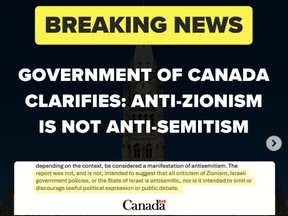
On Sunday, the National Council of Canadian Muslims (NCCM) posted a response letter to Instagram it received from Public Safety Minister Gary Anandasangaree to its request for further clarification about the national commitments to combat antisemitism initiative’s recent report, which acknowledged that antisemitism includes anti-Zionism. It began with a misleading headline: “Government of Canada clarifies: anti-Zionism is not antisemitism.” This headline was also shared on X by Canada’s former special representative on combating Islamophobia, Amira Elghawaby.
Sign In or Create an Account
Below the misleading headline was a snippet of Anandasangaree’s response letter, which clarified that the report did not intend “to suggest that all criticism of Zionism, Israeli government policies or the State of Israel” are antisemitic.
The NCCM’s post is dishonest. Acknowledging that not all anti-Zionism is antisemitism isn’t the same thing as saying that anti-Zionism is never antisemitism in any instance.

Columnist Jesse Kline keeps you up to date with what’s happening in Israel and the effects of antisemitism on life here in Canada. Friday mornings.
By signing up you consent to receive the above newsletter from Postmedia Network Inc.
A welcome email is on its way. If you don't see it, please check your junk folder.
The next issue of Channel Israel will soon be in your inbox.
We encountered an issue signing you up. Please try again
It’s not surprising that the NCCM sent the letter to the public safety minister. So far, Anandasangaree’s office has yet to explain how it will decide which expressions of anti-Zionism are antisemitic, which suggests that the acknowledgement, like the “Canadian Handbook on the IHRA Working Definition of Antisemitism,” is non-binding, non-prescriptive and essentially useless until government realizes that antisemitic anti-Zionist acts need to be properly defined and categorized and does so.
In his letter, Anandasangaree reassures Fatema Abdalla, the NCCM’s senior government affairs and public policy officer, that, “Canada’s position has not changed. Canada continues to support open, respectful and lawful debate on issues related to Israel, Palestine, the Middle East and international affairs,” and points out that even the International Holocaust Remembrance Alliance (IHRA) working definition of antisemitism “explicitly recognizes that criticism of Israel, similar to that levelled against any other country, is not in itself antisemitic.”
The public safety minister then points out that the IHRA definition was adopted in 2019 as part of Canada’s anti-racism strategy and continues to be used for these reasons. He explains that the handbook was published by the Department of Canadian Heritage in 2024 as “non-prescriptive guidance for how the IHRA definition can be practically used.”
As mentioned in the handbook, the definition “does not supersede, modify or direct an interpretation of any existing federal, provincial or municipal statute or regulation,” nor does it “constitute a binding directive on any government department or agency requiring the IHRA definition to be implemented or used in a particular manner.”
This is nothing new. The definition has always been toothless. For better or worse.
Anandasangaree explains that the reference to anti-Zionism in the recent report “reflects the understanding” in both the handbook and the definition that, “Denying the Jewish people the right to self-determination may, depending on the context, be considered a manifestation of antisemitism,” without elaborating on what those contexts might be.
He adds that the “report was not, and is not, intended to suggest that all criticism of Zionism, Israeli government policies or the State of Israel is antisemitic, nor is it intended to limit or discourage lawful political expression or public debate.”
The recent report stated outright that antisemitism “includes anti-Zionism” and “is not always obvious,” and then lists antisemitic acts such as “explicit threats, violence or hate speech,” as well as “conspiracy theories, Holocaust denial, coded language, stereotypes or the collective blaming of Jewish people.” The report provides no clarification as to how to determine whether an anti-Zionist expression or act is antisemitic, and it’s not clear that’s even a goal.
And if it is a goal of the federal government, the next paragraph of Anandasangaree’s letter suggests it will be applied unevenly, if at all.
Anandasangaree noted that the definition “has informed educational and awareness-building efforts in a variety of sectors, including some law enforcement contexts,” but also wrote that, “Decisions regarding police training and operational practices are often made by individual police services or provincial and territorial authorities as this is their jurisdiction and the Government of Canada does not direct or oversee all such activities across the country.”
Anandasangaree explains that the IHRA definition, which the recent acknowledgement that antisemitism includes anti-Zionism was based on, “does not create criminal offences, establish legal prohibitions or restrict Charter-protected freedoms, including freedom of expression,” and instead “serves as a tool to help identify, understand and respond to antisemitism and anti-Jewish hatred in its various forms.” Therefore, its “application does not alter existing rights, laws, policies or protections afforded to Canadians.”
The letter concludes with Anandasangaree’s reassurance that his government’s position “remains unchanged,” an explanation that the definition was referenced in the recent report in order to “support public awareness and understanding of antisemitism, consistent with Canada’s longstanding commitment to combating hate and discrimination while protecting fundamental rights and freedoms.”
If anti-Zionism can be antisemitic, shouldn’t these contexts be clarified and shared with all levels of policing? Otherwise, how can “protecting the public,” one of government’s stated goals, be achieved? Surely, the federal government understands that the situation calls for more than “public awareness activities.”
The next logical step is for the government to provide this further clarification; otherwise, the acknowledgement is completely toothless, as Anandasangaree’s letter appears to confirm.
National Post
Join the Conversation
This website uses cookies to personalize your content (including ads), and allows us to analyze our traffic. Read more about cookies here. By continuing to use our site, you agree to our Terms of Use and Privacy Policy.
KioskNews shows a cleaned-up reading view extracted from the publisher’s page — the original always lives on their site, not ours.