China Youth Corps ruled a KMT-affiliated body
FINAL DECISION: The KMT condemned the Supreme Administrative Court’s ruling, which means the organization cannot recover NT$5.61 billion worth of frozen assets
The Supreme Administrative Court on Thursday upheld a 2018 ruling by the Ill-gotten Party Assets Settlement Committee designating the China Youth Corps (CYC) as an “affiliated organization” of the Chinese Nationalist Party (KMT).
The decision, which cannot be appealed, means NT$5.61 billion (US$176 million) in assets frozen by the committee would not be returned to the CYC.
The CYC said in a statement late on Thursday that it could not accept the decision and “strongly objected to the court stigmatizing more than 70 years of its public service work as ill-gotten KMT assets.”
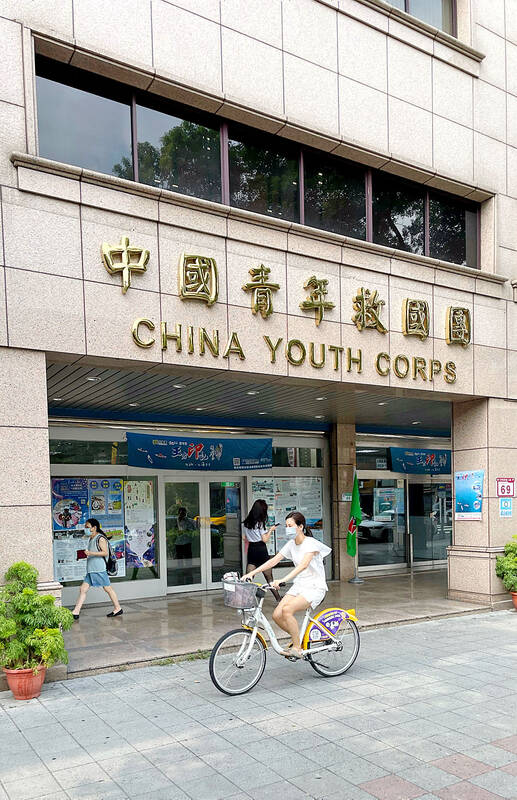
A cyclist rides past the headquarters of the China Youth Corps in Taipei on July 26, 2022.
Photo: Liu Hsin-de, Taipei Times
The KMT condemned the ruling, accusing the judiciary of acting as a rubber stamp for the ruling Democratic Progressive Party’s (DPP) targeting of political opponents.
The Executive Yuan-supervised committee was set up following the 2016 enactment of the Act Governing the Settlement of Ill-gotten Properties by Political Parties and Their Affiliate Organizations (政黨及其附隨組織不當取得財產處理條例) by the then-DPP government.
The law aims to address assets acquired by political parties and their affiliated organizations during the KMT’s authoritarian rule over Taiwan.
In its 2018 ruling, the committee said the CYC benefited from the KMT party-state system’s resources and privileges under martial law and that the KMT controlled the CYC’s personnel, finances and operations until 1999.
It determined that although a leadership change saw the CYC break away from KMT control in 1999, continued ambiguity over asset ownership meant it could not conclude the two organizations had fully separated.
Following the ruling, ownership of 61 plots of land and buildings belonging to the CYC was ordered transferred to the state and the organization’s assets were frozen.
The CYC appealed the ruling, arguing that it was established and initially run by the government in 1952, under the supervision of the Executive Yuan and the Ministry of National Defense, and that its key leaders were appointed through the government rather than by the KMT.
It said that it became an independent civilian organization after ending its affiliation with the Ministry of National Defense in 1969, pointing to the defeat of a KMT-backed candidate in its 1999 leadership election as evidence of its independence.
However, the Taipei High Administrative Court in 2024 ruled that the CYC was effectively controlled by the KMT, despite being formally under the ministry, and that the KMT’s control continued after the CYC became a civilian organization.
The court also agreed with the committee that the CYC’s 1999 break from KMT control did not mean it had fully separated from the party, as asset ownership remained unclear.
In its ruling, the Supreme Administrative Court said it found no reason to overturn the lower court’s decision, citing sufficient evidence and correct application of the law.
KioskNews shows a cleaned-up reading view extracted from the publisher’s page — the original always lives on their site, not ours.