What does China’s massive warplane build-up say about its combat readiness?
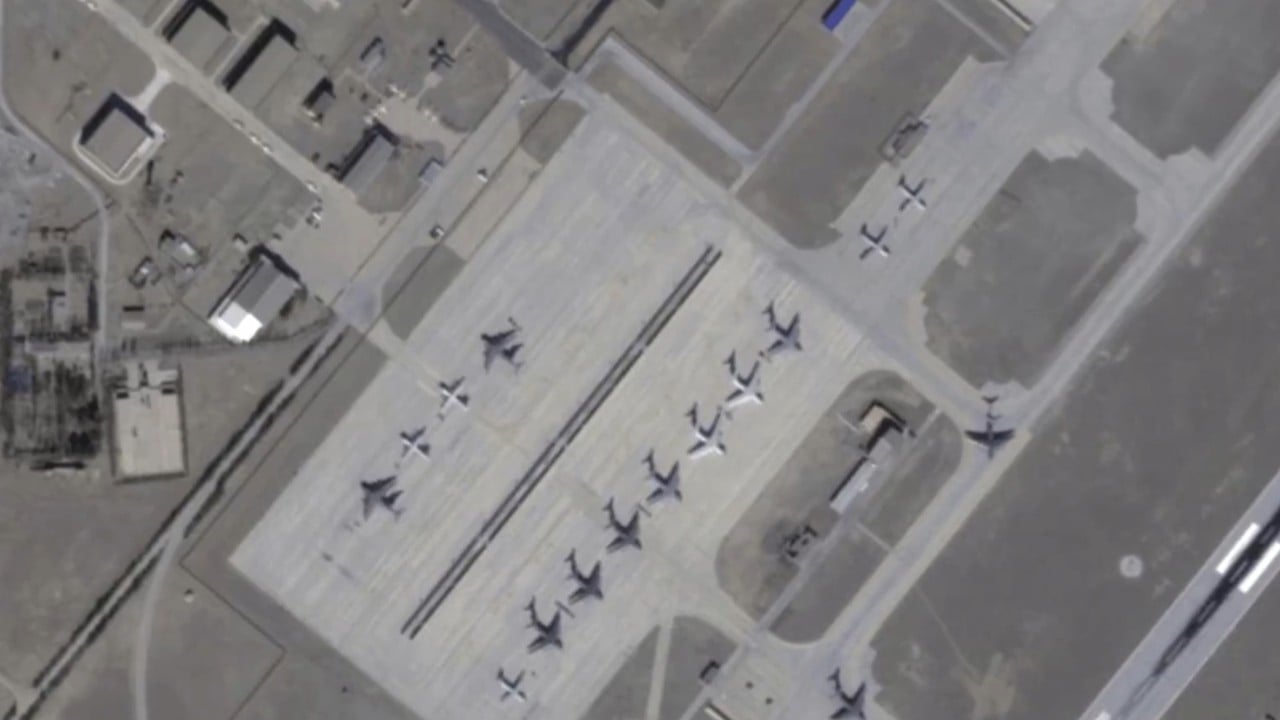
The Chinese air force appears to have significantly expanded one of its largest annual combat exercises, with satellite imagery showing nearly 300 aircraft across 11 bases in western China.
The scale of the manoeuvres suggests China may be testing its ability to bring together hundreds of aircraft for prolonged operations, while developing the coordination and logistical support needed to sustain a major air campaign, according to analysts.
The build-up, which compares with 194 visible aircraft at eight bases during a similar exercise last year, began in mid-October according to an analysis of the satellite data released on November 11 by the US-based Mitchell Institute for Aerospace Studies.
Michael Dahm, a senior fellow at the institute, said the exercise was very likely to be this year’s Red Sword exercise, adding that it could be the largest PLA Air Force drill conducted in at least several years.
Dating back to around 2000, Red Sword is one of the air force’s flagship training programmes, designed to test how aircraft, air defence units and command centres operate together as an integrated fighting force.
Experts describe it as the service’s most extensive combat training event, bringing together fighters, bombers, special-mission and uncrewed aircraft. Unlike more specialised drills, Red Sword lasts several weeks, testing how diverse units coordinate and sustain complex operations.
Dahm estimated that aircraft concealed under shelters could bring the number taking part in this year’s apparent exercise to more than 300.
Exercises involving hundreds of aircraft are relatively uncommon, although not unique to China. For example, last year’s US-led Resolute Force Pacific exercise brought together more than 400 allied aircraft across more than 50 locations in the Indo-Pacific region.
Beijing has not confirmed this year’s exercise and the year-on-year figures are not strictly comparable. The 2025 count came from imagery of eight bases taken within 24 hours while this year’s observations were gathered across October.
Even so, the build-up at the 11 bases in western China marks a sharp jump from normal activity, with Dahm noting that roughly 80 to 100 aircraft are usually parked outdoors at those locations – about a third of the number seen last month.
For Timothy Heath, founder of US-based consultancy Perceptum, the growing scale of the drills shows China’s armed forces are improving their ability to conduct complex operations involving different aircraft types deployed from across the country.
In a conflict, that could allow the air force to concentrate aircraft in one area and continue combat operations “despite losses”, said Heath, a specialist on the Chinese military.
10:01
What do we know about China’s two next-generation aircraft?
Michael Bosack, director of the Parley Policy Institute, cautioned that while amassing aircraft did not itself demonstrate proficiency in large-scale operations, it suggested Beijing was working towards that capability.
“Proficiency in executing large-scale air operations is not something that can be cobbled together at the last minute,” he said. “It takes practice to manage air space, ramp space, supply chains and life support for both the air and ground crews.”
According to Heath, conducting an exercise of this scale presents three main challenges: navigation, command and control, and logistics.
Pilots must find their way to unfamiliar bases, which then have to handle their arrival and coordinate flights by different aircraft types. Each type might need its own spare parts, fuel, lubricants and technicians, he said.
“Red Sword is thus as much a test of the PLA Air Force’s logistics system as it is of its command, and control, and flight operations capabilities.”
Still, Bosack warned that massing aircraft in a conventional conflict was “not the wisest decision” because it “essentially allows an adversarial force to ‘shoot fish in a barrel’”.
He said concentrating forces was useful in rear areas that were sufficiently insulated from enemy attack, where units could be received, staged and integrated before moving forward.
Heath said that wartime damage to airbases could force pilots to operate from unfamiliar locations – a skill that Red Sword would help to develop.
According to Bosack, western China is a useful training ground because of the freedom of movement – the same reason the United States holds its large Red Flag exercises in Alaska and Nevada.
A campaign over Taiwan or the western Pacific Ocean would be far harder, Bosack said, citing air defences, airspace constraints and limited ramp space. “Saltwater corrosion control and weather are two important considerations,” he added.
Meanwhile, the range of aircraft observed in western China suggested the PLA Air Force was seeking to integrate different missions into a single operation – “stepping up to match the standards that other top-tier militaries are already comfortable with”, he said.
However, whether China’s air force is closing that gap cannot be judged from satellite snapshots alone.
A truer measure of progress would be how rapidly aircraft could be launched, the types of missions they performed and how long that pace could be sustained, Bosack said.
Even so, according to Heath, the imagery strongly suggested an expanded turnout that reflected real, if incremental, gains in capability.
The air force spent years building its capacity to run large-scale operations with diverse aircraft across multiple bases, he said, making this year’s exercise “another step in a long series of PLA Air Force training events to enhance combat readiness”.
KioskNews shows a cleaned-up reading view extracted from the publisher’s page — the original always lives on their site, not ours.