A girl, a bow and a dream: How 17-year-old Kumkum took down Korea’s archery giants at Asian Games
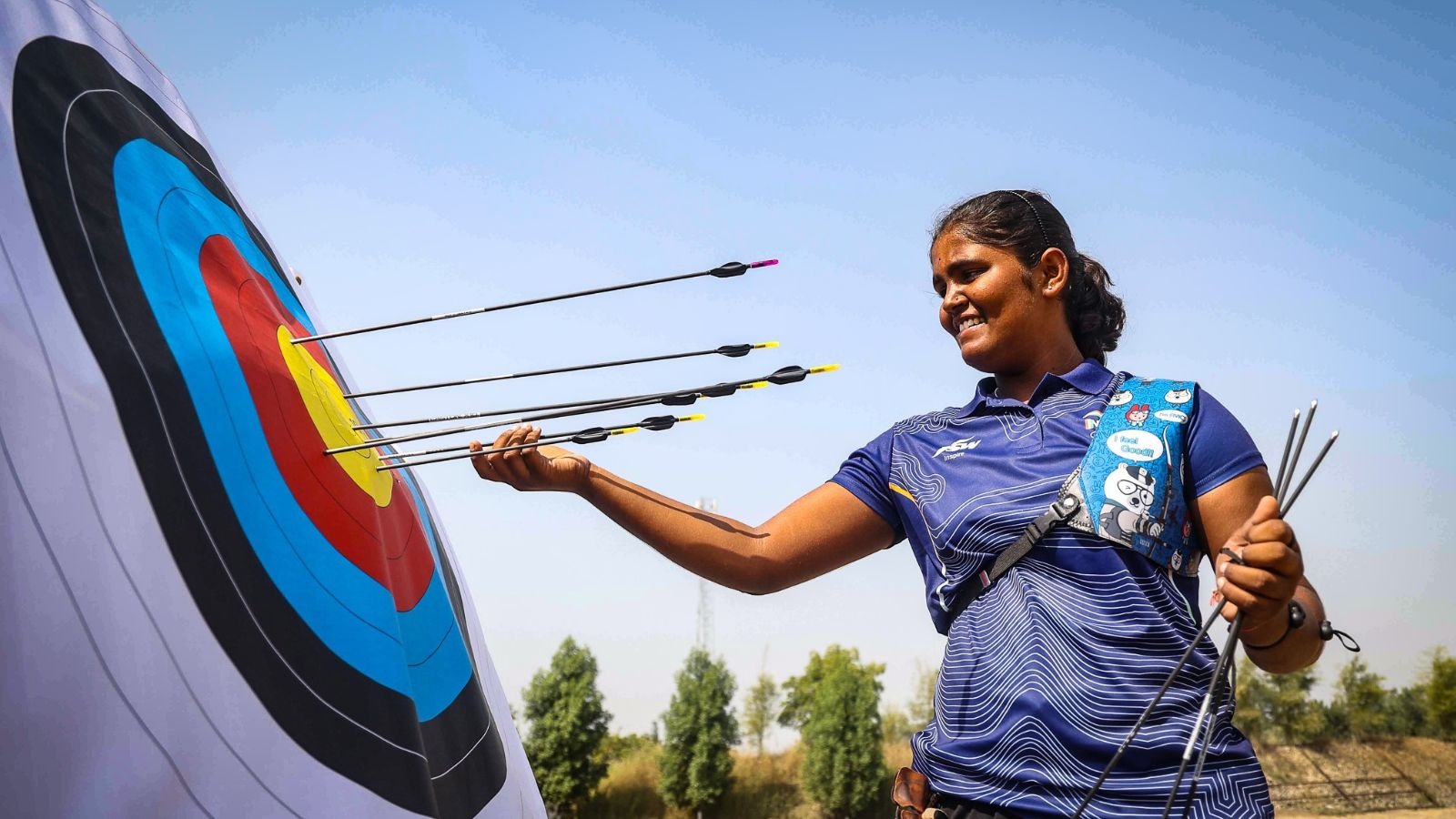
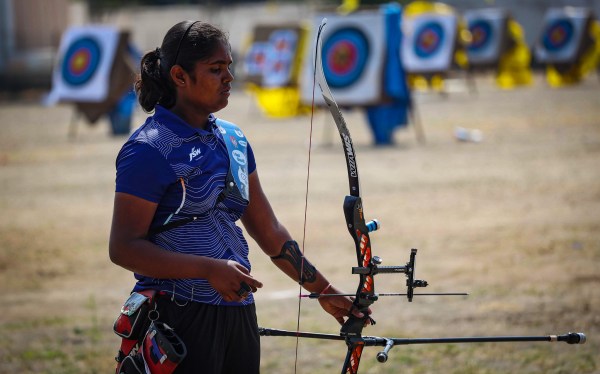
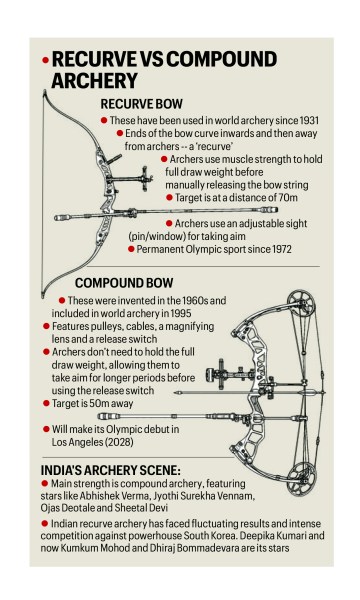
Nashik archer Gaurav Namdeo has no clue yet that the recurve archery bow he gave away five years ago has won India two gold and a silver at the 2026 Asian Games. He passed on his bow to fellow state archer Kumkum Mohod from Amravati, who, though she now owns three brand-new bows, chose to go on the big stage with the second-hand one earlier this month.
“A bow doesn’t make an archer. An archer turns a bow into a gold medal,” the 17-year-old says, mirroring her coach Praful Dange’s refrain: “Bande mein dum hona chaiye (A person should have grit).”
India’s finest performer at the Asian Games, still a teenager, has emerged from Amravati, a low-key but ambitious Tier-3 city in northern Maharashtra. She comes from an environment where the temperatures can be punishing — she needs an umbrella even to walk out to collect her arrows before practising — and where she has had to work hard and take nothing for granted. It’s what adds to the “dum”, what kept her going for the women’s individual recurve gold in a high-stakes final and the women’s team recurve gold against the all-conquering Koreans, shattering their three-decade-long stranglehold on Asiad archery. A mixed team silver completed her haul.
‘Amravati golden girl’
A day after she arrived in the city to giant hoardings and a road rally, where city officials jostled to revel in her success, Kumkum is back at Amravati’s Tapovan archery training facility. Not too impressed with the media attention, she is eager to get back to regular training. The practice court, she says, is the only place where she feels normal.
However, she poses for pictures with everyone. A Padma Shri winner in his late 70s who has come with his entourage to applaud her feat of beating the “ballaadhya (mighty)” Koreans and clinching gold. A star-struck cab driver, whose daughter has been watching reels of the “Amravati golden girl”, whose story is making fathers dream big for their daughters. Both leave after extracting a promise from Kumkum: she will give her best to bring India an Olympic medal. “Lai duur jaaychey (We have a long way to go),” they say.
At her two-storey house, some of the walls are etched with ‘Kumkum Olympic gold in 2028’ in her handwriting. Inside, coach Praful Dange and parents Anil and Rupali Mohod huddle after celebrating with pedas. “We have to ensure none of us flies too high and gets carried away with success,” Dange says. “Only the Olympics matter. If she floats, we will bring her down to earth.”
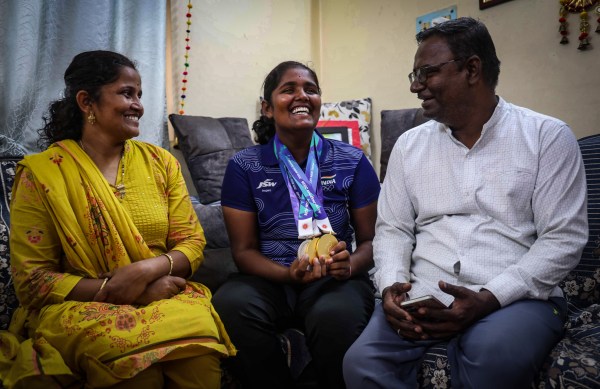 Parents Anil and Rupali Mohod
Contentment is the biggest enemy of athletes, Kumkum’s father believes. He also holds that Kumkum should not take luxury for granted, as “it kills motivation”. Anil bought Kumkum archery shoes just thrice in her life — the first two for Rs 400 and another pair for Rs 1,600 when she transitioned to the recurve bow from the Indian wooden ones.
Story continues below this ad
“She wore old shoes till the soles tore off; we always travelled sleeper class, never AC,” Rupali recalls.
Kumkum now has 10 pairs of shoes, three bows, and more sponsors are coming in.
Anil, however, has spent big on the arrows. An archer, he says in Marathi, can never have an empty quiver. “Myaanet talwaar aani quiver madhe baan aslech paahije (The sword must be in its scabbard, and there must be arrows in the quiver).”
Once during Covid, he found Kumkum in tears. “I asked her what was wrong, because her performance was dipping. She said she was holding back and shooting, fearing the arrows would break. She asked how I would keep funding her kit,” he recalls.
Story continues below this ad
The next day, Anil bought her a stock of arrows for Rs 15,000. “I will never let you run out of arrows,” he promised.
He has put a decade of savings into keeping her kit replenished, sold off his mithai box-making business and devoted fully to taking her to tournaments. “It was her mother’s dream for Kumkum. How could I let down the two most important women in my life?”
Archery was introduced to the Mohods at one of the many “lady’s functions” in the monsoons. Over the course of a haldi-kumkum and later a family get-together, Rupali, hearing the mother of another archer praise her daughter to the skies, felt both inspired and envious. “I wanted that for my daughter. I dreamt she would grow up and beat the whole world at archery,” Rupali recalls.
By next Holi, Anil had sought out a neighbour, who was a coach and lived only two bungalows away. Dange.
“She was like any other archer, but very focused,” coach Dange recalls. “Her parents trusted coaches. They didn’t start believing they were coaches themselves after two-three months, which is a problem.”
Kumkum was a late speaker. She didn’t utter a word till playschool, her mother says. She is still reserved, but what confounded friends and relatives more than anything was the family’s decision to pack up their business during Covid and make archery their world.
Story continues below this ad
“Plenty of people taunted us, saying, ‘how far will this girl even go in archery?’,” Anil recalls. “But I knew my daughter was really good.”
When Kumkum would finish sixth or seventh and not make it to the Indian team, she would feel disappointed. “But not my dad. He always woke me up saying, ‘Uthh ja, Champion’,” she says.
The day she told him she felt hopeless about her chances, Anil told her that it was the turning point. If she fought back the feeling, she would beat the best, he told her.
A month later, Kumkum was Asiad-bound. She wanted an EV Scooty if she brought back a medal.
Story continues below this ad
From akhada to Asiad
Amravati is not Mumbai or Pune. It’s not even Nagpur. But the city got a sports university, one of the earliest in India, in 1914. Hanuman Vyayam Prasarak Mandal, or simply Hanuman akhada, has facilities for every sport, from gymnastics to athletics to archery, though it is now in a shambles.
Four thatch-hay target board shells are all that athletes still use. It’s where Dange learnt archery. He was smitten by the target colour codes, and he remembers the festive archery competitions on campus, accompanied by dhol-tasha, in his time. He medalled at the All India Inter-University Championships and finished second in the diploma batch at Netaji Subhas National Institute of Sports. He delved into theories of athlete psychology, biomechanics and arrow-flight dynamics in windy and rainy conditions.
With Dange as her coach, Kumkum grew up seeing the wind not as an obstacle to hitting her 10-point bull’s eye, but as an opportunity to deploy techniques: aim for green at 9 o’clock if the wind is from left to right, etc.
“Adjustments can still fail. Nobody shoots tens always. But I would rather she shoot a nine with confidence, than a ten that’s a fluke,” Dange says.
Story continues below this ad
In this, Kumkum follows what archer Dhiraj Bommadevara, her Indian role model, does. The Indian Army recurver patiently notes down good “feel” shots, where he knows he has followed the process, be it a ten or nine. Success, he believes, will follow.
Dhiraj was shooting at the Asiad, not even a month after the tragic death of his scientist sister in Canada. Kumkum mourns not winning the mixed-team gold with him; they got silver. But when she defeated the second Korean athlete to win her individual gold, Dhiraj cried as if it was his triumph too.
Defeating the Koreans
From railway stations to busy junctions, at every turn in Amravati, the posters of JEE rank holders’ faces proclaim the city’s identity as a coaching hub for entrance exams. Sport, though, is the city’s heart. People are now making Kumkum theirs, in the local dialect: “Ho, aamchi porgi (Yes, our girl)”.
In Amravati, sport thrives at kusthis, basketball courts, residential colonies, at the Hanuman akhada, and wedding banquet halls-turned-pickleball courts. And, at the city’s seven archery centres, where coaches are churning out compound and recurve talent — including Yashdeep Bhoge, who won an Asiad silver as part of the men’s team.
There’s no fancy infrastructure. But the district sports official, Ganesh O Jadhav, says that Amravati, after Kumkum’s gold, is determined to take on the might of Korea. “Dakshin Korea aso kinva kuthlihi Korea aso (South Korea or whichever Korea), we have to break their monopoly on archery,” he says.
Story continues below this ad
Bharat Ganeshpure, comedian and actor from Amravati, treks down to Hanuman akhada to congratulate Kumkum. He dubs her India’s K-Girl, or Kumkum-girl — the one who vanquished Korea.
For Kumkum, it felt normal. As she says, “I visualised defeating the Koreans every step for a year every day.”
Yet, her father worried. “The Korean she faced in the quarters is her idol. I told her, ‘Idol-faidal bajula (leave aside). She is your opponent today,’” says Anil.
Dange was less worried. “Firstly, it’s not a combat sport. The Korean can’t do anything to you. So, it’s not about her,” he says.
Beyond that, Kumkum has been taught to create a two-metre visualisation circle. “She literally draws it in her mind when on the range. For 10-15 minutes of a match, it’s you, your equipment, your target, in two metres, and nothing else,” says Dange.
Story continues below this ad
It’s also why her elaborate follow-through exists, as if in her own time and space.
Inspired by Pullela Gopichand, coach Dange has convinced Kumkum to clear her phone of social media.
“I’ve even removed YouTube, because with AI and constant scrolling, precious hours are lost. I just need a phone to fill up the WADA (World Anti-Doping Agency) whereabouts (providing schedule and location details to stay compliant with anti-doping rules) and for air tickets,” Kumkum says.
Dange is more pointed. “Youth have to realise there’s a small window to stay focused on sport… Waste away this age on social media and then sport fades away,” he says.
Dange, however, has promised Kumkum the latest iPhone — “even if I have to sell my house” — if she wins an Olympic medal.
Meanwhile, Kumkum blazes through every shooting routine that Dange sets for her and finishes every endurance run of up to eight kilometres without panting. At 5.5 feet and with strong shoulders, she has a good physique for the sport and a temperament to match.
“I love going head to head with the Koreans. It is not pressure. I want to play them,” she says. Like in the quarters, where she beat her idol, South Korea’s Kang Chae-young, reigning recurve world champion.
Eye on the Olympics
In the final (individual), Kumkum didn’t feel compelled to use a heavier bow just because South Korea’s Oh Yejin shoots at a string tension of 42. Pulling a bowstring is equivalent to the shoulder lifting nearly 32 kg.
“Archers Google big names and start thinking they’ll start shooting tens if they do the same poundage. They don’t stop to think whether it suits them. We have taught Kumkum to trust her own ability,” Dange says.
When Kumkum cleared the trials at Sonepat in January 2026, sitting in the corner looking a little glum was 2023 Asiad star archer Ojas Deotale, also a 17-year-old prodigy. He has won the Arjuna award and landed a Class 1 job.
This time, he led at the first two selection trials, but then froze.
“Fear,” Dange explains, recalling having a word with Deotale at dinner. “I asked him why he got nervous.”
Stray comments and the pressure of expectations are a deadly cocktail in a competitive world. “He said he was scared people would say the last three medals were ‘luck by chance’, fluke,” says Dange.
Deepika Kumari was a prodigal archer, too when she first emerged but couldn’t convert her talent into an Olympics medal. “She’s achieved a lot. It’s easy to sit and pass comments. Only archers know what it takes to steady the heart rate and not let the hand and bow oscillate,” Dange says.
Kumkum finds her “inspiring”. “She has been competing for years. But even today, she stays disciplined and follows her process meticulously,” she says.
For Kumkum, it is about fulfilling her mother’s dream right now.
Outside the court, it has been difficult. She was on the verge of tears after a press conference in Amravati. She felt claustrophobic. The “two-metre circle” — what she visualises to concentrate during her games — hadn’t been as crowded ever. But neither had the 70-cm-tall Barbie doll that Kumkum received as a birthday gift when she turned seven: 69 medals now adorn the doll’s neck, a medal showcase.
Her sketch of Krishna and other drawings line wall corners. Art is summoned to help her visualise. Arijit Singh’s songs turn musical cues when she has to steady her mind. Ice cream is the treat after medals. When she returned from Japan, though, she demanded besan khichdi or pithale (powdered chickpea with spicy tempering). South Kitchen restaurant serves her favourite dish: idli-dosai-bisibele-pongal.
A day before Kumkum’s final against Oh Yejin, the TV at her home mysteriously broke down. Anil frantically searched for OTT coverage and watched her game on his phone on a Rs 77 subscription.
After she won, he rushed out to fulfil a commitment.
“When she had cleared trials, she asked if I would buy her an EV Scooty if she won a medal. It was the first time she had asked for something beyond arrows,” Anil says.
But when he reached the showroom, he found there was a three-month waiting period for a new iQube. Then, a former MLA, no longer in power, stepped in. He had called to check if he could visit with a bouquet, but hearing Anil was stuck negotiating a waiting period, he called the showroom owner.
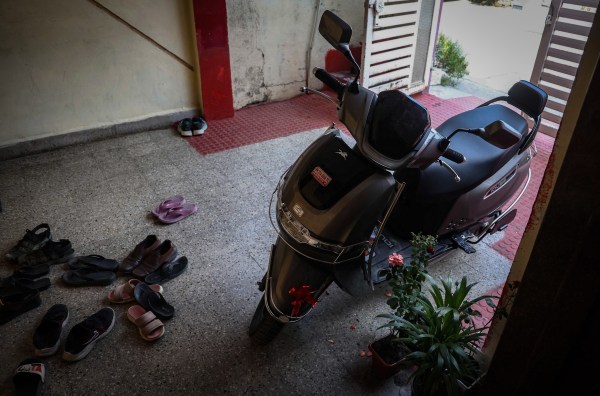
“I went back to the shop four hours later, and they put up a full sport-themed welcome… they handed over the iQube on the condition that Kumkum would get her licence and helmet and ride to the showroom someday,” Anil says.
In two years, it might be Dange’s turn to scramble for the iPhone he has promised. “Happily, but only if she wins an Olympic medal,” he says. It’s a long road ahead, but ‘ho, aamchi porgi’ certainly knows how to beat the Koreans.
KioskNews shows a cleaned-up reading view extracted from the publisher’s page — the original always lives on their site, not ours.