Netanyahu and Eisenkot in dead heat five days before election, final ToI poll shows
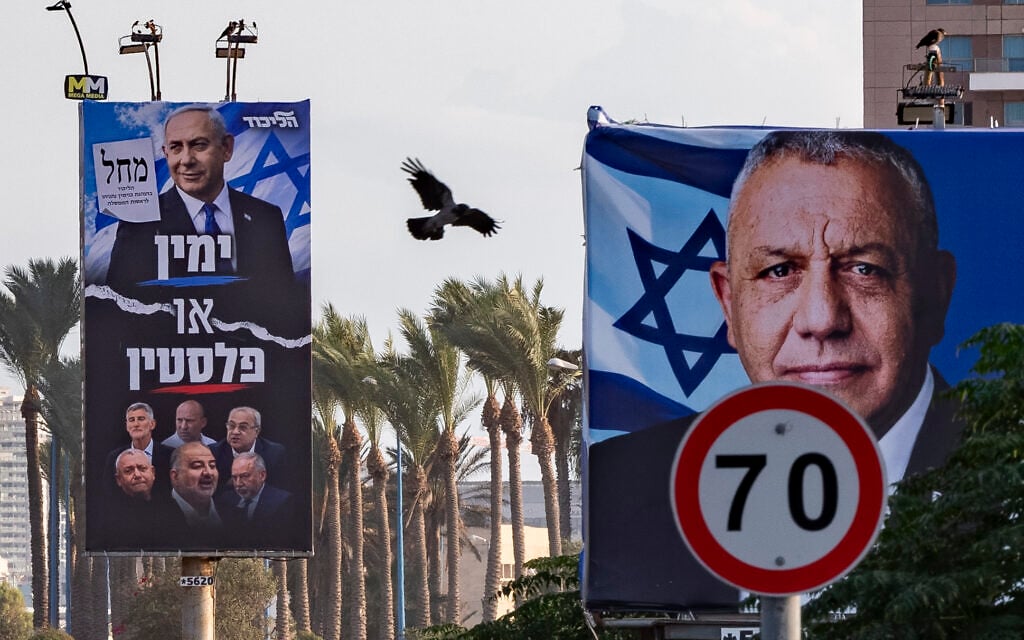
The main blocs of parties supporting and opposing Prime Minister Benjamin Netanyahu are neck-and-neck heading into Tuesday’s election, according to the final poll from Zman Yisrael, The Times of Israel’s sister site.
Thursday’s poll shows each of the two Jewish-led blocs receiving 51 seats, well below the 61 needed for a majority coalition in the 120-seat Knesset. The balance is held by Arab-led parties, which would win 14 seats in total, and the Reservists, a nonaligned party slated to win four seats.
The only way one of the two largest camps could achieve a majority is by reversing campaign pledges not to govern with certain other factions. For weeks, nearly all polls across most networks have shown both sides falling short of a majority.
0:00 / 0:00
Promoted: JPPI, Rabbi Sharon Brous

If neither is able to form a governing coalition, repeat elections will be called, to be held in early 2027, with Netanyahu remaining in charge as a caretaker premier. The Times of Israel poll, however, found that in that scenario most Israelis would not want him to stay on.
Both sides are wooing voters in a bid to avert an inconclusive result. On Thursday, leading opposition candidate Gadi Eisenkot visited the Western Wall, where others at the holy site gave him a mixed reception. On Tuesday, Netanyahu filmed a campaign video with the mayor of Kiryat Shmona, the embattled city on the border with Lebanon, who reportedly agreed to appear under pressure.
Get The Times of Israel's Daily Edition by email and never miss our top stories
By signing up, you agree to the terms
And the Shin Bet said that it had taken down a number of social media accounts that it said were linked to a “foreign influence campaign.”
ToI poll: Most say Netanyahu should resign if he can’t form a government
The Times of Israel’s poll has Eisenkot’s Yashar party winning 23 seats, more than any other party but three less than in last week’s survey.
Netanyahu’s Likud received the second-largest number of seats with 21 — a one-seat increase from last week. That result came days after US President Donald Trump announced his endorsement of Netanyahu.
Next come two opposition parties: Former prime minister Naftali Bennett’s B’Yachad with 11, and the hawkish Yisrael Beytenu with nine. The Arab-led Joint List would also win nine.
Four parties are slated to win eight seats each: The ultra-Orthodox Shas and United Torah Judaism parties, the left-wing The Democrats and the far-right Otzma Yehudit.
The far-right religious Zionism would win six, followed by the historically Islamist Ra’am with five and the Reservists squeaking just past the minimum 3.25 percent electoral threshold to enter the Knesset, and winning four seats.
Ofer Winter’s right-wing People of Israel party, which has pledged to only sit in a Netanyahu-led government but has been repeatedly attacked by the prime minister and other Likud candidates, failed to cross the threshold. Votes for a party that wins less than 3.25% go to waste and do not count.
The poll was conducted on October 14 and 15, with a representative sample of 500 Jewish and Arab respondents participating. The margin of error was 4.4%.
In total, the poll found Netanyahu’s opponents would win 65 seats. But that includes the two Arab-majority parties. Yashar and almost every other Jewish-led opposition party have pledged not to sit in a coalition with either one of them, even though Ra’am has expressed interest in joining a future government and recognizes Israel as a Jewish state.
The opposition parties have likewise pledged not to join a coalition with Netanyahu.
Respondents were asked whether Netanyahu should retire from politics if he fails to form a government. Almost 60% said he should, while nearly 29% said he should remain in politics. The remainder did not know.
Respondents were also asked whether they had made a final decision on who they would be voting for in Tuesday’s election. An overwhelming majority of 87% stated that they had made a final decision. Only 2.4% said they were still undecided between the pro- and anti-Netanyahu blocs.
More than 25% of respondents said they’ve changed their minds over the course of the campaign’s final months, with 19.6% shifting between the blocs and 6% switching between parties within the same bloc. Over 74% said that they have not changed their minds.
Eisenkot cheered and jeered at Western Wall
Eisenkot visited the Western Wall in Jerusalem on Thursday, Judaism’s holiest prayer site, where he received a mixed reception.
The former IDF chief of staff waved to supporters who cheered him on, saying, “The next prime minister” and “Save us,” while opponents shouted “Bibi, king of Israel” in support of Netanyahu, according to the Arutz Sheva news outlet.
In video footage of the visit posted on Eisenkot’s social media, security personnel surrounded him at the site.
עכשיו, בכותל.
בעזרת השם – נעשה ונצליח! pic.twitter.com/kvFTWSGsys— Gadi Eisenkot – גדי איזנקוט (@gadi_eisenkot) October 22, 2026
Netanyahu, meanwhile, attacked Eisenkot in an interview with Arutz Sheva. In a reference to his recent endorsement, he said that the election comes down to “me and Trump or Eisenkot and Abbas,” referring to Ra’am leader Mansour Abbas.
He repeated his frequent claim that an opposition government would include Arab parties, despite Eisenkot and most opposition parties ruling that out.
He said if he loses the election, the next government would be made up of “the left” and Arab parties, “a copy of what is happening in Europe,” an apparent reference to recent riots in France.
“They will give citizenship to hundreds of thousands of Palestinians for demographic change for the next election,” Netanyahu claimed of a potential opposition government.

He also attacked Eisenkot’s credentials, saying he “is incapable of acting on the world stage. He doesn’t have the experience, he doesn’t have the talent.”
Kiryat Shmona mayor pressured to appear in Netanyahu video
On Tuesday, Netanyahu traveled to the Kiryat Shmona area to celebrate the opening of a new university there. During the visit, Kiryat Shmona Mayor Avichai Stern was pressured by Netanyahu’s aides to appear in a campaign video, two sources familiar with the matter told The Times of Israel.
In the clip Netanyahu posted, Stern thanked him and said, “I believe in you,” and that he hopes Israelis will understand “who to vote for.” Netanyahu added: “It’s easy: vote ‘Mahal,'” referring to the Hebrew letters on the ballot for Likud.
The sources said Stern did not want to make the video or appear to endorse Netanyahu, but acquiesced in order to do “what was necessary for Kiryat Shmona” and the new university.
They said there was concern that refusing the Prime Minister’s Office could put the university’s funding at risk, but could not confirm that anyone explicitly threatened to withhold funding if Stern did not participate.
Hebrew media reports following the video’s release said people close to Stern disputed that he had explicitly called on voters to support Likud. Stern has for years been one of Netanyahu’s fiercest critics, accusing the prime minister and his government of abandoning Kiryat Shmona and the north during the fighting with Lebanese terror group Hezbollah, which has devastated parts of the region.
תודה לראש עיריית קריית שמונה, אביחי שטרן, על התמיכה ועל השותפות למען תושבי העיר והגליל כולו.
היום הגשמנו חלום של שנים עם פתיחת האוניברסיטה. יחד נמשיך לבנות , לפתח ולהצמיח.
קריית שמונה לא רק חוזרת, היא פורחת! ???????? pic.twitter.com/c4S79OM6s8
— Benjamin Netanyahu – בנימין נתניהו (@netanyahu) October 20, 2026
The sources also said the Prime Minister’s Office requested a last-minute change to the university’s name. The institution was initially supposed to be called Tel Hai University, but in the days before the inauguration its name was changed to Tel Hai University of Kiryat Shmona in the Galilee, to emphasize its connection to the city, traditionally a Likud stronghold.
Netanyahu had a prolonged falling-out with Stern during the war and made few visits to Kiryat Shmona, despite the city being among those hardest hit by the mass evacuation of the north amid the fire from Hezbollah.
In June 2024, when the city was nearly completely evacuated, Netanyahu visited but did not meet with Stern.
Shin Bet targets ‘foreign influence campaign’ online
In another election-related development, numerous social media profiles used as part of a “foreign influence campaign” were removed from the internet ahead of Tuesday’s vote next week, the Shin Bet security agency said.
The Shin Bet said it worked with the Cyber Department in the State Attorney’s Office and the Central Elections Committee to identify the profiles.
“As part of the joint effort to safeguard the integrity of the elections and thwart attempts at improper foreign influence, these accounts were removed from the internet,” the security agency said.
It did not provide specifics on how many accounts were removed or which countries were behind the alleged influence campaign.
KioskNews shows a cleaned-up reading view extracted from the publisher’s page — the original always lives on their site, not ours.