Energy Ministry says Israel must act now to ensure place in global nuclear fusion race
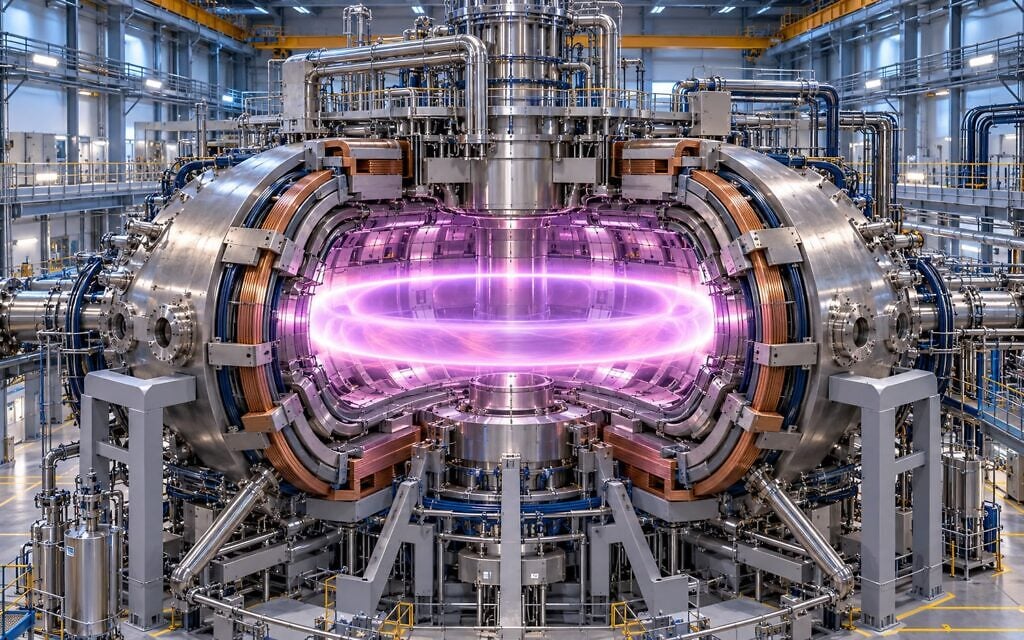
Israel will miss out on a multi-billion-dollar global industry unless it acts immediately to join the international race for nuclear fusion energy, Energy Ministry officials warned in a strategic report issued for public comment on Thursday.
The document, drawn up by the ministry’s policy division and Chief Scientist unit, outlines Israel’s first national framework to position the country as a key player in the emerging global fusion sector.
Today, all nuclear power plants use fission to create electricity, splitting uranium atoms to release energy. Nuclear fusion creates energy by merging hydrogen atoms into helium without generating long-lived radioactive waste or emitting carbon dioxide. This process would theoretically be far safer and more efficient than fission, as it carries no risk of a meltdown and yields far more energy. However, making the process work effectively has long proved elusive, and the issue has long stumped physicists and engineers. But significant strides are being made.
0:00 / 0:00
Promoted: JPPI, Rabbi Sharon Brous

As global electricity demand surges and tech giants push for clean energy for data centers, private investment in fusion has surpassed $14 billion since 2021, with commercial power plants anticipated in the 2030s.
While global commercialization faces major technological hurdles, ministry officials argue Israel has competitive advantages in high-power lasers, radio-frequency systems, electronics, advanced materials, robotics, and artificial intelligence that could make it an important supplier of spare parts.
Get The Times of Israel's Daily Edition by email and never miss our top stories
By signing up, you agree to the terms
“Nuclear fusion has the potential to represent a real breakthrough in meeting global electricity demand,” said Shahar Dolev, a senior policy director at the ministry. “We are standing on the threshold of an extraordinary strategic opportunity to secure a significant position in the sector’s global value chain.”
Israel already has foundational infrastructure, including the Institute for Nuclear Fusion and Hot Plasma, set up by the Energy Ministry to bring together government, academia, and the private tech sector, as well as startups such as nT-Tao, which is developing compact reactors. However, the report highlights major domestic hurdles –a shortage of specialized nuclear physicists, a lack of testing infrastructure, and no specific regulatory framework.
To bridge the gap, the ministry proposed three funding tracks. The baseline option requests NIS 50-100 million ($13-27 million) over five years for research and academic training. A middle track proposes NIS 0.5-1 billion (up to $322 million) to establish a dedicated research center and open national facilities, such as the SARAF particle accelerator at Soreq in south-central Israel, to private industry. The most ambitious plan envisions an NIS 1-2 billion (up to $647 million) national program over a decade to build a complete system, including a potential experimental reactor with international partners.
The report warns that government inaction over the next few years could lock Israeli companies out as global supply chains and technological standards solidify for decades to come.
Help us report truthfully on social media

As a multimedia journalist, my job is to take the quality, fact-based journalism produced by The Times of Israel newsroom and make it accessible across every platform — from Instagram posts to podcasts to short-form videos.
This is how many, especially young people, consume news these days. But misinformation is rampant on social media. Our team at ToI produces accurate, responsible short-form reporting on Israel and the Jewish world.
If you believe in the importance of factual social media journalism, please consider joining our reader support group, The Times of Israel Community. Your financial support is essential to sustain responsible multimedia reporting.
— Gabriella Jacobs, multimedia journalist
Support our work Support our work Already a member? Sign in to stop seeing this
KioskNews shows a cleaned-up reading view extracted from the publisher’s page — the original always lives on their site, not ours.