Spottiswoode residents get $188,000 to turn ground-up ideas into estate upgrades
SINGAPORE – To create a more inviting environment at void decks, Spottiswoode Park resident Roy Fung suggested beautifying the tables and chairs with various themes.
“Void decks tend to be places where people just pass by. I wanted to have a standout feature – such as a seaside or forest theme – that will encourage conversation among residents,” said the 57-year-old, who has been living in the estate for 25 years.
A total of $130,000 was granted to bring his idea to life at seven void decks in the estate, under Singapore’s first participatory budgeting trial. The amount comprises the cost of materials, epoxy coating to seal the designs onto the tables, as well as labour.
The trial gave residents a say in how funds are allocated, from proposing ideas to deciding on neighbourhood improvements.
Another two ideas for a reflexology pebble path and stone seats were granted $48,000 and $10,000 respectively.
Residents were involved from the start – from suggesting the improvements they hoped to see to coming up with a full proposal themselves.
Six proposals were shortlisted from 162 ideas and put to a vote in July. The three winning proposals received a total of $188,000. The three other ideas that did not receive enough votes were for a rock climbing wall, a pickleball court and barbecue pits.
The total budget for this participatory budgeting exercise – a collaboration between Tanjong Pagar Town Council and the Institute of Policy Studies (IPS) – was $200,000 and was drawn from the Future-Ready Society Impact Fund administered by the Tote Board.
Fung, who is also the Residents’ Committee chairman for the estate, said he met his team of six weekly to firm up the details of their proposal – from the concept to the budget and execution.
The resident who suggested the reflexology pebble path, Jagwinder Singh, 55, said he came up with the idea because there are many seniors in the estate.
A pebble path was wellness-focused, feasible and within the budget, said Singh, who also submitted several other ideas such as a garden with a pond.
“This process empowers us. Rather than (agencies) telling us what is best for the estate, we get to play a part,” he added.
The construction of the projects is expected to start in late 2026, after tenders are called for each project.
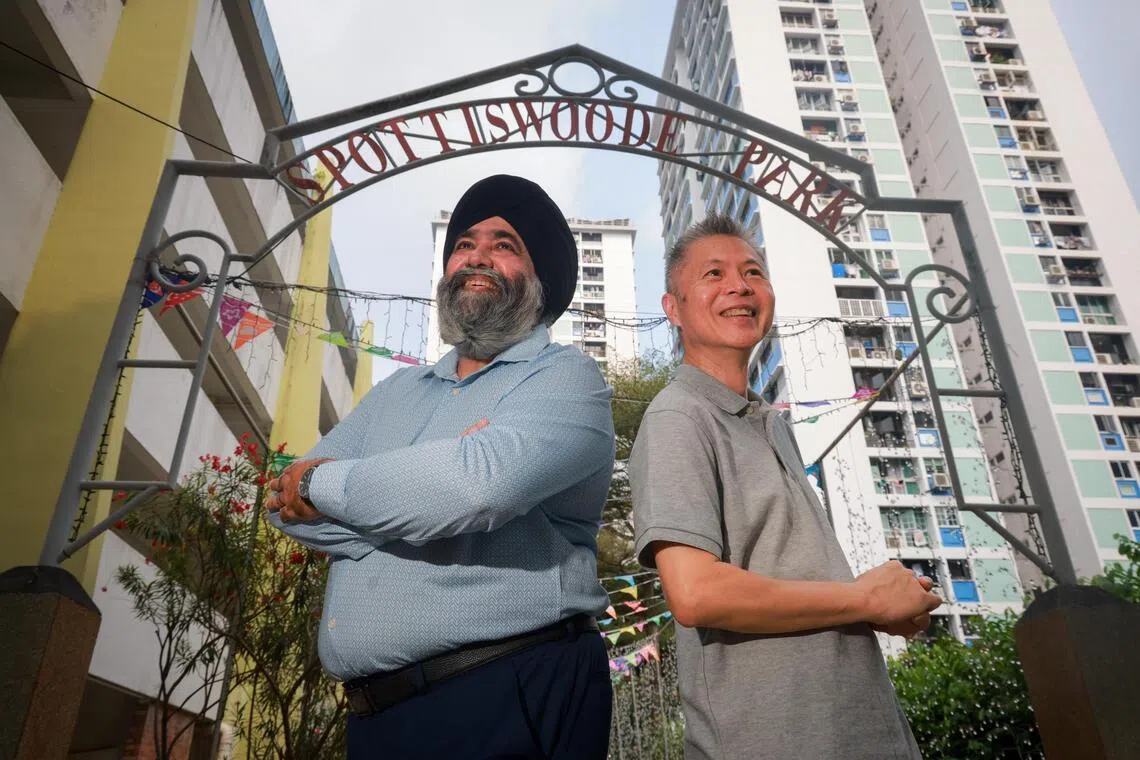
Spottiswoode Park residents Jagwinder Singh (left) and Roy Fung, pictured Sept 4.
ST PHOTO: JASON QUAH
The trial ran alongside the estate’s Neighbourhood Renewal Programme (NRP) but was separately funded, and 26 resident proposals – such as sheltered walkways and barrier-free access ramps – were also incorporated into the NRP’s plans.
National Development Minister Chee Hong Tat said in a written parliamentary reply to Tanjong Pagar GRC MP Foo Cexiang in August that town councils can use their NRP budget to implement estate improvement projects that residents propose and vote on, subject to technical feasibility.
Foo said he asked the question as he saw good outcomes from the trial in Spottiswoode Park – residents felt involved in rejuvenating their estate, and the process also brought them closer to each other.
Chee’s clarification paves the way for participatory budgeting exercises to be expanded, he added.
Unique trial
Justin Lee, senior research fellow and head of the policy lab at IPS, said the trial at Spottiswoode Park was unique because it brought together residents from the public and private parts of the estate.
The nine blocks were built by the Port of Singapore Authority in the 1970s, and five were taken over by the HDB while the other four remained privately owned.
The private blocks were not included in the voting process for the NRP, but they were involved in the participatory budgeting trial, Lee noted.
He added that residents from the private blocks were glad to have a say in the amenities in their neighbourhood.
The pilot is part of IPS Policy Lab’s wider work to test how Singaporeans can take a more direct role in the decisions that shape their everyday environment.
IPS research fellow Nicholas Thomas said he hopes the exercise helped residents think about the collective interest of the community, rather than just their own self-interest.
“The usual expectation is that the Government will come in and do the fixing, but this has inadvertently crowded out the space for decision-making and, over time, the civic muscle starts to atrophy,” he said.
“The exercise lets residents reclaim that space and, equally important, it required the Government to cede it.”
KioskNews shows a cleaned-up reading view extracted from the publisher’s page — the original always lives on their site, not ours.