Netflix’s ‘Stranger Things’ Made Its Biggest Mistake With Its Most Iconic Detail

Julio is a Senior Author for Collider. He studied History and International Relations at university, but found his calling in cultural journalism. When he isn't writing, Julio also teaches English at a nearby school. He has lived in São Paulo most of his life, where he covers CCXP and other big events. Having loved movies, music, and TV from an early age, he prides himself in knowing every minute detail about the things he loves. When he is older, he dreams of owning a movie theater in a small countryside town.
Sign in to your Collider account
Stranger Things built its identity around kids who used Dungeons & Dragons to understand the monsters invading Hawkins. What began as a charming window into their friendship eventually became a storytelling habit the series struggled to outgrow. While the series finale is certainly cathartic and very emotional, the final season is uneven at best, with some of its weakest moments exposing the limits of that approach. The amount of expository dialogue stands out as a particular problem.
Across its eight episodes, characters repeatedly explain threats, devise plans, and spell out their next moves, slowing the action when the stakes should be pulling everyone forward. The D&D references once helped the audience see things from the boys' perspective. By Season 5, the familiar framework too often does the work character development and discovery should.
‘Stranger Things 5’ Storytelling Problems Are Directly Connected to 'Dungeons & Dragons'
Not every expository dialogue is bad, of course, and this trend hasn't started with Stranger Things either. Ever since the early days of television, it has been a necessary narrative device, with viewers jumping into something while swapping channels during a commercial break, for example, and having to know what's going on. We still do this, but, instead of TV channels, it's social media and multiple screens; Netflix even supposedly established a guideline to have characters "announce what they're doing" for this reason. That happens a lot everywhere, but Stranger Things 5 has made this the crux of its writing, which is especially annoying considering the episodes' length.
Collider Exclusive · 8 Questions · 2 Minutes Which Netflix Character Would Be Your Best Friend? Dustin · Emily · Wednesday · Gi-hun
Some friends drag you out of the house. Some sit with you on the worst night of your life. Netflix has written both, plus the one who tells you the truth you have been avoiding all week. Answer eight quick questions about how you actually do friendship, and find out which of them was always going to end up in your corner.
🧢Dustin(Stranger Things)
🗼Emily(Emily in Paris)
🕷️Wednesday(Wednesday)
🟢Gi-hun(Squid Game)
01
How do you usually end up making a new friend? The origin story says a lot about the friendship that follows it.
02
What is a perfect Saturday with your best friend? Friendship is mostly built out of very ordinary hours.
03
You call them at two in the morning. What happens? This is the real test of a friendship, and everybody knows it.
04
What do you want from them when you are clearly wrong? The best friendships are the ones that survive being corrected.
05
What do your friends actually value about you? The friend you attract says something about the friend you are.
06
You have a falling out. How does it go? How a friendship repairs itself matters more than how it breaks.
07
What do you actually need a best friend for? Everybody is missing something. The right friend fills that gap.
08
Ten years from now, what keeps the two of you close? Eight questions in, this is the one that decides who you get.
The Group Chat Has Spoken Your Best Friend Is…
Four Netflix characters, four completely different ways of showing up for somebody. This is the one who fits how you actually do friendship, and what having them in your life would be like.
Dustin Henderson
You do not do friendship at half volume, and neither does he. What you want is somebody who says yes to the plan before you have finished describing the plan.
- Dustin is the friend the entire show runs on: loyal past the point of sense, enthusiastic about everything, and incapable of leaving anybody behind.
- You have the same instinct. Your friendships are loud, specific and slightly ridiculous, and they last for decades because of it.
- He is also the one person who would take your strangest interest completely seriously, which is far rarer than it sounds.
- You would have a group chat. It would never once be quiet.
Emily Cooper
You are the friend who makes things happen, and so is she. Together you would be mildly exhausting to everyone around you and completely delighted with yourselves.
- Emily treats an ordinary Tuesday as something that could be turned into an occasion, which is either the best or the worst quality in a friend depending on your energy levels.
- You share her refusal to sit still. Neither of you has ever accepted a night in when something was happening somewhere else.
- She is far more loyal than people give her credit for. She defends her friends loudly, publicly, and occasionally before checking the facts.
- She would post the photo without asking. You would forgive her, because it is a very good photo.
Wednesday Addams
You have no patience for pleasant lies, and she has no ability to tell them. What looks like coldness from the outside is the most reliable friendship on this list.
- Wednesday never says a kind thing she does not mean, which makes the rare ones count for an enormous amount.
- You would rather be told the truth than be made comfortable. She is constitutionally incapable of offering you anything else.
- Underneath all of it she is ferociously protective. She simply refuses to make a performance out of caring.
- Do not expect a birthday message. Do expect her to ruin anyone who wrongs you.
Seong Gi-hun
You look after whoever is having the worst day. So does he. It is the least strategic way to move through the world and the best possible quality in a friend.
- Gi-hun is not the strongest player in Squid Game, or the cleverest. He is the one who keeps choosing to protect somebody else, over and over, at genuine cost to himself.
- You have the same instinct. You notice who is struggling and you stay with them, long after anybody would blame you for leaving.
- He is a flawed friend, and that is part of why it lands. He lets people down, then comes back and tries again, which is more than most manage.
- He would give you his last chance and never once mention that he had done it.
It started way back in Season 1, when the four main boys were still very young and needed a familiar framework to make sense of everything happening in Hawkins, and D&D offered just that. Their strategizing felt very reminiscent of how players think during a campaign, where exposition is vital since you are explaining your reasoning to the members of your party — plus, it was cute seeing them naming the monster that was after Eleven (Millie Bobby Brown) a Demogorgon, or supporting Will (Noah Schnapp) in Season 2 by calling him "Will the Wise." As the characters grew, however, their reasoning didn't, and by Season 5, even characters who had never played D&D, like Robin (Maya Hawke), Steve (Joe Keery), and even Joyce (Winona Ryder), were coming up with plans in such terms.
Things got to a point where even fans started pondering whether the whole thing was really just one big D&D campaign during the series, since everything about the storytelling relied on how the game is played, and the Duffer Brothers even had to answer questions about it and explain that, no, that was never going to be the case. Still, the reasoning behind every character's actions and their plans remains intrinsically connected to the logic of D&D. Even when the references aren't D&D-related, like when Dustin (Gaten Matarazzo) speaks of a "shield generator" at the Hawkins Lab in the Upside Down, the principle is still the same of thinking like a D&D campaign, even though it's a Star Wars nod.
Constantly Relying on ‘D&D’ as a Framework Makes ‘Stranger Things 5’ Feel Limited
One of the key aspects of creating a D&D campaign is to ensure it has a proper flow for all characters, as well as the story as a whole, hence why being a dungeon master is such an important role. In Stranger Things, it feels like the Duffers have always written the story as if they were dungeon masters instead of actual storytellers, and this created certain patterns that weren't harmful in smaller seasons, when their very structure had to prioritize Netflix's binge model and had to be more dynamic, even with its exposition dumps. Season 5, however, had to be bigger than ever, and its longer episodes made these patterns clear when they endlessly repeated themselves.
In Stranger Things 5, this pattern is: something happens, the characters come up with a plan, they implement that plan, something goes wrong, they somehow overcome it, accomplish their goal, and then regroup. And, every step of the way, it really feels like the Duffers are asking the characters the classic dungeon master question: "So, what are you going to do?" Instead of allowing the plot to flow organically and giving the characters the time to properly develop, this kind of "narrative roundabout" always forces everyone forward without properly dealing with anything, just overcoming one obstacle after another and unnecessarily elongating storylines that should have been much shorter for the sake of the longer episodes.
With so many characters to manage, it really is important to organize everyone, but Stranger Things 5 seems more concerned about giving each character something to do instead of allowing them the room to do some proper growth. This works for D&D campaigns because there’s a huge difference between doing it yourself while playing and watching someone do it in a story, where their decision has to impact their character. You may structure your story like a D&D campaign, but characters aren't like players — and even Dungeons & Dragons: Honor Among Thieves was wise enough to see that. Unfortunately, Stranger Things 5 was more concerned about asking them what they would do instead of telling a proper story.
Constant D&D Analogies and Comparisons Were More Harmful to ‘Stranger Things 5’ Than Beneficial

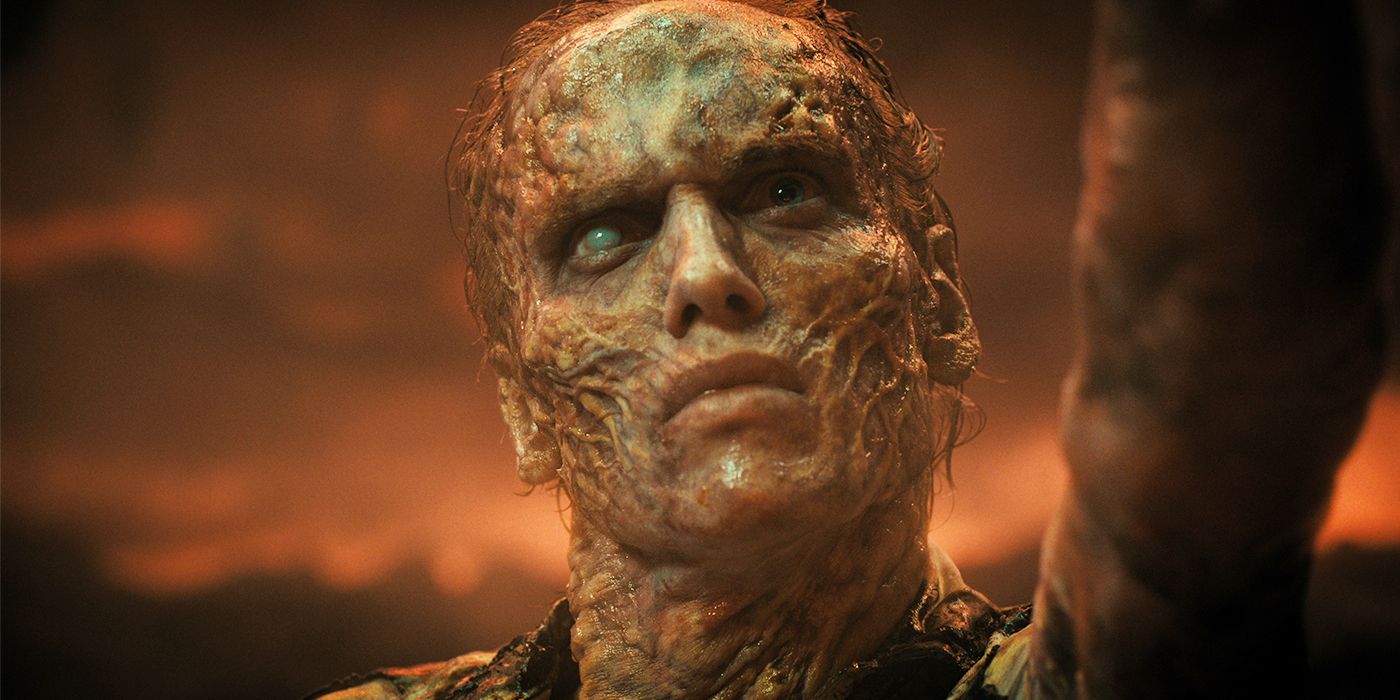
It's not just through its storytelling framework that Stranger Things overuses its D&D influences, though, as there's yet another layer to the series' obsession with the tabletop RPG: the constant analogies and comparisons. Just like the narrative roundabouts, the fact that everything can be explained by D&D takes the place of actual exposition when it comes to world-building. There's Vecna (Jamie Campbell Bower), who's a spellcaster, the Mind Flayer, the Abyss. Apart from Vecna, we never truly learn what any of them really are, as they are already defined by their D&D counterparts. There is no room for them to be used as threats beyond what they represent in a campaign.
This exact same thing happens with characters. In Stranger Things 5, the best example is Holly (Nell Fisher), who is at the center of the whole story. She is targeted by Vecna, finds Max (Sadie Sink), and organizes a rebellion in Camazotz, but none of these incur any development for her as a character, since she is already defined as Holly the Heroic — she is even dressed as the figure Mike (Finn Wolfhard) gives her. Everything she does, then, is based on the D&D character, not the actual character. She is still there to serve as the motivation for the story, more a plot device than a character, but the Holly the Heroic archetype masks all that when she faces challenges and overcomes them exactly as the character would.
The D&D references are actually part of what makes Stranger Things unique, and (as someone who actively plays) it's great to see such a huge cultural phenomenon making use of it. But most of the nods and references end up taking the place of original storytelling, which would make the series far richer and original. As nice as it is to see D&D represented, it would certainly have been better if Stranger Things kept it only as the occasional mention instead of making it its main storytelling framework.
Stranger Things is available to stream on Netflix.
- Release Date
- 2016 - 2025-00-00
- Network
- Netflix
- Showrunner
- Matt Duffer, Ross Duffer
- Directors
- Matt Duffer, Ross Duffer, Andrew Stanton, Frank Darabont, Nimród Antal, Uta Briesewitz
- Writers
- Kate Trefry, Jessie Nickson-Lopez, Jessica Mecklenburg, Alison Tatlock
KioskNews shows a cleaned-up reading view extracted from the publisher’s page — the original always lives on their site, not ours.