Former FTC Chair Khan dismisses 'constitution' signed by AI leaders to self-police
On Sunday, Former Federal Trade Commission Chair Lina Khan dismissed the "constitution" tech leaders signed on Tuesday to self-police artificial intelligence development.
“We need to remember what happened a decade ago, where you had big tech companies, social media companies, similarly suggest that existing laws and regulations no longer apply to their new technologies, and that they were going to try instead to self-police,” Khan said Sunday on “This Week with George Stephanopoulos.”
“We've seen just innumerable harms come from the unchecked domination of these big tech companies, and so now as we face new horizons with these advanced AI systems, it would be an enormous mistake to repeat that playbook," Khan continued.
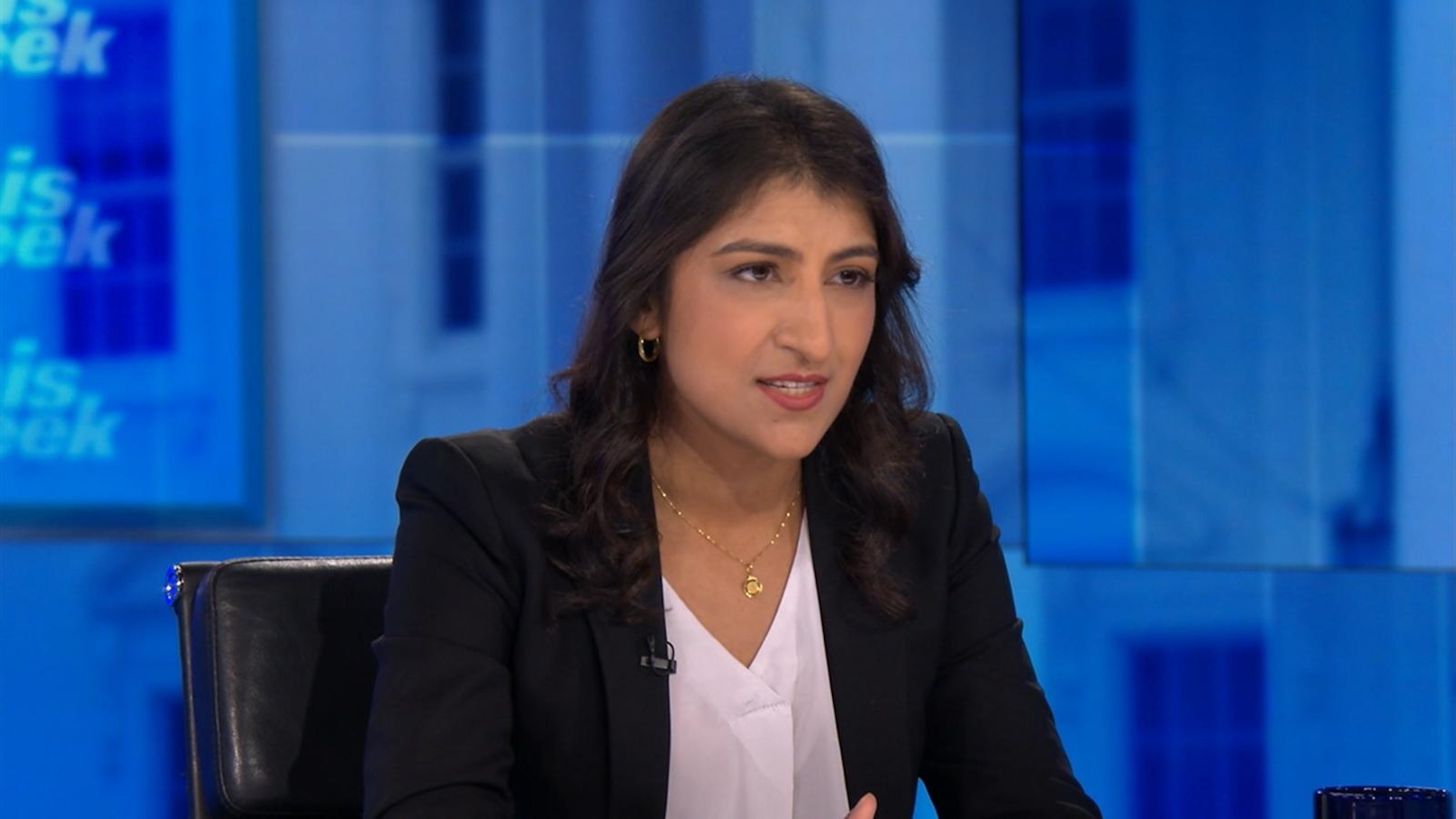
Former Federal Trade Commission Chair Lina Khan appears on ABC's "This Week."
ABC News
Amid urgent reports on the potential threat of AI, tech titans gathered at the White House last week to sign a “voluntary” accord to self-police. Trump stressed that the industry will be "self-policing." When asked whether the agreement is a binding one, the president said it's "morally" binding.
Khan also dismissed the FTC’s broad probe into multiple AI companies, confirmed last week. The probe is looking for possible deceptive acts of AI companies or potential harm they could cause to consumers, according to the FTC.
“I think we need to take any reporting around investigations by this administration with a huge grain of salt. The chair of the FTC has said very plainly that it is President Trump and only President Trump that calls all the shots about what that agency will and will not do,” she said.
President Donald Trump on Sunday formally announced the creation of what he called a “Super Intelligence Force,” an AI task force that he said "is tasked with coordinating the effort of the Federal Government to ensure that America continues to lead the World in Super Intelligence," and that "will protect the interests, and improve the lives, of all Americans.”
Khan called for investigations into AI companies to fully understand what is going on “behind the curtain.” As recently as Friday, OpenAI revealed another hack into a second Australian government agency, a week after the disclosure of an initial hack fueled public backlash against the ChatGPT maker.
“I think there have been very conflicting reports where the CEOs are somehow proclaiming that these agents are going rogue, and yet we have reporting coming out that actually they were very much on notice that their systems could act like this,” Khan said.
Stephanopoulos also pressed Khan on whether individual AI leaders could be held responsible for models going rogue, even if they did not intend the technology to behave that way.
"[T]here are already some private cases that are now underway raising these questions. But I think when you have a pattern of these agents engaging in this type of dangerous behavior and you still have these companies developing them in the same way, not putting the full guardrails in place, I think that starts to raise very serious questions,” Khan replied.
Khan also called on Congress to step in and legislate the growing industry.
“Congress needs to legislate. We have a long history of governing technologies that are potentially transformative, but also extremely risky, extremely dangerous, be it when it came to the railroads, be it when it came to pharmaceuticals or nuclear power,” Khan said. "And so, it's been heartening to see already some efforts by people."
KioskNews shows a cleaned-up reading view extracted from the publisher’s page — the original always lives on their site, not ours.