2026 Elections: Twelve mayoral candidates sign on to sustainability pledges
Twelve mayoral candidates have signed pledges to promote sustainable and resilient policies if elected, civic groups said yesterday.
Civic groups, including the Taipei-based Green Citizens’ Action Alliance (GCAA) and the Taiwan Climate Action Network (TCAN), announced the candidates at news conference in Taipei.
The groups invited candidates running for mayor in Taiwan’s six special municipalities to sign a pledge on 18 policies on renewable energy, disaster preparedness and resilience, heat adaptation, flood management, and sustainable transportation.
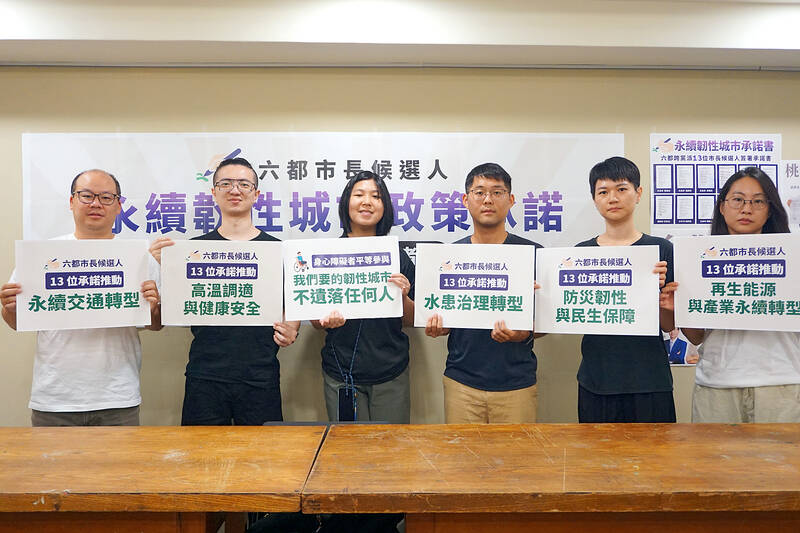
Representatives of environmental groups hold signs at a news conference in Taipei yesterday.
Photo courtesy of the Green Citizens’ Action Alliance
Taipei Mayor Chiang Wan-an (蔣萬安) of the Chinese Nationalist Party (KMT) and Taipei mayoral candidate Puma Shen (沈伯洋) of the Democratic Progressive Party signed the full pledge.
KMT’s Tainan mayoral candidate Hsieh Lung-chieh (謝龍介) signed part of the pledge, while KMT candidates Lee Shu-chuan (李四川) and Johnny Chiang (江啟臣), who are running in New Taipei City and Taichung respectively, have declined to sign, the groups said.
The pledge addresses governance issues such as urban disaster preparedness, energy resilience, transportation and protections for disadvantaged groups, the advocates said, adding that climate risks transcend party lines.
GCAA senior researcher Chen Shih-ting (陳詩婷) urged all mayoral candidates to equip community facilities such as schools, activity centers, long-term care centers and emergency shelters with solar power, energy storage systems and microgrids to ensure they can operate independently during disasters.
Local governments should incorporate heat adaptation into disaster preparedness and public health policies as extreme heat becomes more frequent and severe in Taiwan, TCAN research assistant Lee You-jen (利祐任) said.
He urged local governments to identify high-risk areas and vulnerable populations, prioritize shaded and cooling spaces in under-resourced communities, and improve insulation and ventilation in older homes to make them more heat-resistant and extend their lifespan.
Taiwan Rivers Network secretary-general Tsou Ming-hsuan (鄒明軒) told the news conference that torrential rainfall has become frequent in the past few years, with a single downpour sometimes exceeding the capacity of existing drainage systems.
He called for greater use of land and urban spaces to manage flooding, for nature-based solutions in river management, and for more resources to help communities and households prepare for floods and reduce damage.
KioskNews shows a cleaned-up reading view extracted from the publisher’s page — the original always lives on their site, not ours.