From steel to style: China’s ‘flagship’ AI factories move beyond heavy industry
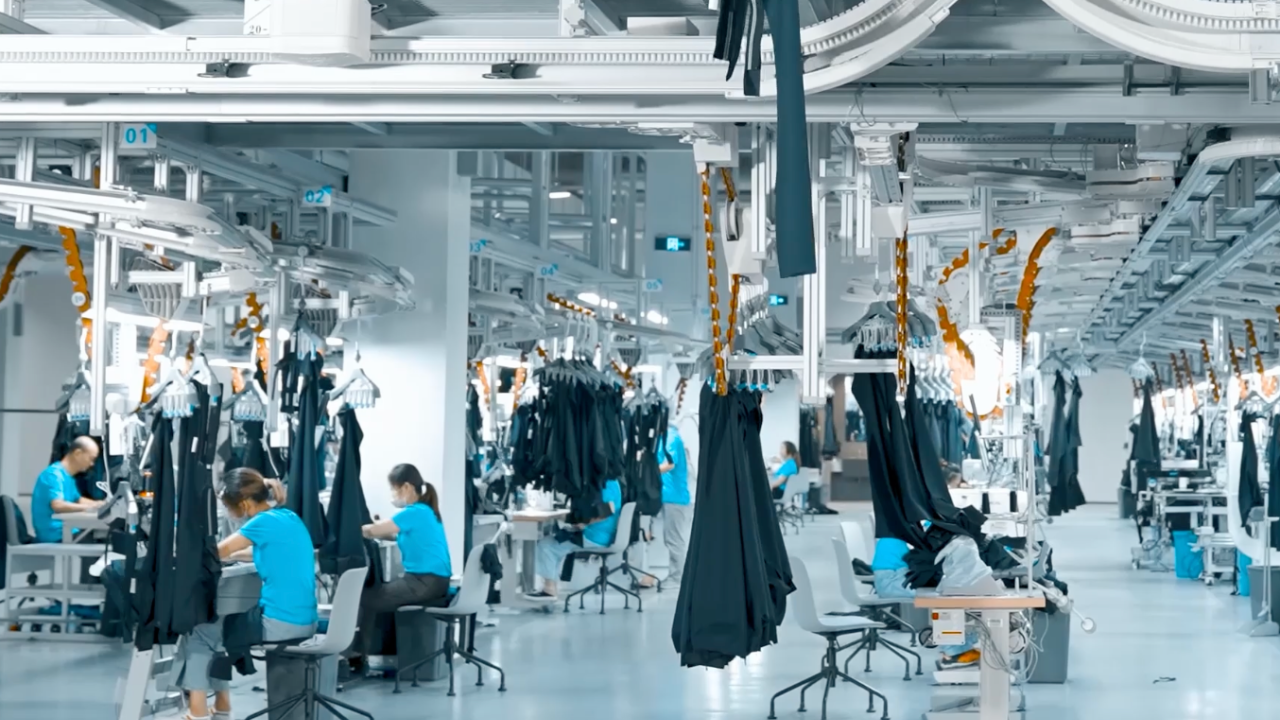
Before a shirt reaches a shop in China, artificial intelligence may have already played a part in making it, from helping manufacturers understand consumer preferences to turning those insights into design ideas.
At a factory run by Jiangsu-based HLA Group, AI-integrated systems work alongside human operators to coordinate production. The approach is gaining ground across China’s manufacturing sector, extending from heavy industry into consumer goods.
On Thursday, the Ministry of Industry and Information Technology (MIIT) named 34 facilities in its latest batch of “flagship” smart factories, including the one run by HLA Group. Launched in 2024, the programme aims to upgrade supply chains and encourage the use of AI and other advanced technologies.
The programme has several tiers, with flagship smart factories at the highest level. To qualify, facilities in this category are required to have an AI application rate of at least 60 per cent.
Traditional industries such as steelmaking and aerospace dominated the first batch of 15 factories, announced in late 2025. Consumer-facing manufacturers were sparse yet included home appliance makers Gree Electric and Haier.
The latest batch, however, reflects AI’s expanding reach across manufacturing. HLA Group is the first apparel maker to join the programme, joining baijiu distiller Luzhou Laojiao, pharmaceutical company Tasly and television maker Hisense. Carmakers Xiaomi, Seres and FAW-Volkswagen were also included.
AI applications accounted for more than 70 per cent of all use cases across these facilities, with more than 1,000 industrial AI agents developed and daily use of tokens exceeding 300 million, according to a Thursday press release from the World Intelligent Manufacturing Conference.
The event, co-hosted by entities including the Jiangsu provincial government and the MIIT, brought together representatives from all 34 factories.
04:51
Inside Shenzhen’s ‘Robot Valley’, where 90% of robot parts are 30 minutes away
“Seeing consumer-facing manufacturers clear high AI thresholds shows that AI is no longer just a back-end automation tool,” said Alfredo Montufar-Helu, China-based managing director at Ankura Consulting.
“Rather, it is actively being used to connect real-time demand insights to flexible production, allowing companies to design and deliver better products at scale and respond faster to shifting consumer preferences.”
The effects are reaching beyond the factories themselves. The 34 facilities had helped nearly 4,000 other companies upgrade their operations by sharing technologies, solutions and experiences, according to the press release.
Montufar-Helu said the shift reflected Beijing’s view of AI as a foundational technology that could boost economic efficiency, strengthen technological self-reliance and improve resource allocation. This had encouraged the government to play a more active role in driving adoption across sectors, he added.
“Rather than simply waiting for market-driven adoption, the government is using top-tier factories to prove out industrial AI use cases, from optimising production and quality control to improving safety and end-to-end traceability,” Montufar-Helu said.
Beijing has repeatedly stressed the importance of applying AI in real-world settings. Speaking at the Apec CEO Summit in Shenzhen last week, President Xi Jinping described China as “a supersized innovation testing ground where frontier technologies are tested, improved and upgraded in real-world scenarios, and are then turned into high-quality growth drivers”.
At a press conference in late October, an MIIT official also highlighted AI’s importance to developing next-generation smart manufacturing, saying it could “enhance the self-perception, decision-making and execution capabilities of equipment and systems, drive changes in production methods and business models and help manufacturers cut costs, improve efficiency and better meet diverse market demand”.
The MIIT was also developing more targeted policy measures to deepen AI integration in manufacturing, the official said.
KioskNews shows a cleaned-up reading view extracted from the publisher’s page — the original always lives on their site, not ours.