Randall Denley: Ontario’s fiscal mess isn’t just bad — it’s getting worse
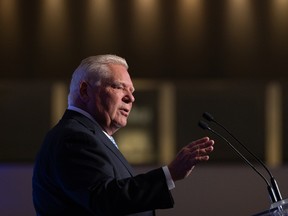
A series of new reports leads to only one logical conclusion: Ontario’s government finances are in a mess and getting worse.
Sign In or Create an Account
The provincial government’s current deficit projections are almost certainly optimistic and so are its numbers for future spending in key ministries, according to analyses by Ontario’s Financial Accountability Office (FAO).
On the deficit, even the Ford government’s own numbers aren’t good. Ontario’s most recent budget projects a deficit of $13.8 billion in 2026-27, $6.1 billion the year after, then a slight surplus in 2028–29.
It’s difficult to give those numbers much credibility. Finance Minister Years ago, Peter Bethlenfalvy said there would be a surplus in 2024–25, but he has now pushed that target back three times.

Columnist Jesse Kline keeps you up to date with what’s happening in Israel and the effects of antisemitism on life here in Canada. Friday mornings.
By signing up you consent to receive the above newsletter from Postmedia Network Inc.
A welcome email is on its way. If you don't see it, please check your junk folder.
The next issue of Channel Israel will soon be in your inbox.
We encountered an issue signing you up. Please try again
The FAO has decidedly different view. Based on its assessment of the economy, current government policies and announced commitments, the accountability office does not foresee a return to balanced budgets even by 2030–31, the last year of its analysis.
If so, those deficits will have a big effect on Ontario’s finances. By 2030–31, the accumulated deficit would increase by 25.3 per cent to $309.6 billion. Net debt, which combines the deficits and borrowing for infrastructure, would jump by $169.1 billion, or 39.6 per cent.
Ontario’s past deficits were incurred despite healthy revenue growth. When Premier Doug Ford took power in 2018, government revenue was $153.7 billion. This year, it’s expected to be $232 billion. And yet, his government still finds ways to spend more than it takes in.
The COVID-19 pandemic did push up government spending, but years later it has never come back down.
The lack of fiscal discipline has real consequences. Debt interest will cost taxpayers $17.2 billion this year and the FAO projects it to rise to $24 billion by 2030–31.
Those are big numbers, but the bottom line is simple. The provincial government has less to spend on important services because it’s paying so much in interest.
That was readily apparent in reports the FAO released Wednesday. The accountability office looked at expected future spending on health care, education, colleges and universities, and social services. In almost every item examined, it found that the future spending identified in the budget would fail to maintain service levels, much less improve them.
That’s particularly dismal news because per capita spending on many Ontario services is less than the national average. The basics are in bad shape.
On health care, the government projects that spending will grow at an average annual rate of 3.2 per cent between now and 2028–29. The FAO estimates that 4.4 per cent annual increases would be necessary to maintain service levels.
The government’s lower planned spending level would mean fewer hospital beds and fewer nurses, although the number of physicians and personal support workers would go up.
There are some gains, but Ontario was already far behind. In 2023, Ontario had the second lowest provincial age-adjusted per capita spending on health.
In the post-secondary sector, the current budget shows an actual decline in planned spending in 2027–28 and the following year, but that’s a bit misleading. A drop in college student numbers, and with it per-student funding, means less overall spending, but a promised $6.4-billion increase for the sector is not fully included. Again, the new funding builds from a low base. In 2023–24, Ontario had the lowest per-student funding for both colleges and universities.
In the education sector, the government plans spending increases of just 0.6 per cent a year for the next three years. That compares to 5.6 per cent a year over the last three years and a long-term average of 3.2 per cent. The FAO estimates that 2.2 per cent would be required to maintain services at current levels. In 2023–24, Ontario’s per-student education spending was somewhat below the national average.
In response to the FAO’s reports, the Ford government cited its “record spending” in a number of areas. Fair enough, but increasing modestly from a low base isn’t much of an accomplishment. The appropriate questions are: How does spending compare to need? And, do annual increases at least maintain service levels?
The government makes a better point when it says future spending projections don’t account for public sector salary increases. Those will certainly push spending up, especially in education. It’s best for the government not to tip its hand before labour negotiations (the province’s biggest teachers unions are currently working without a contract), but also important to realize that higher salaries don’t mean higher service levels.
There is one obvious benefit of underestimating future spending in a budget. That has the happy effect of allowing the government to pretend that future deficits will be smaller than is likely.
Faced with continuous deficits, a government has only two choices: tax more or spend less. The premier has vowed not to increase taxes, but he’s shown little interest in spending less.
Back in 2018, Ford promised to end “reckless” spending and balance the budget. He called it a “moral imperative.” Judged by his own standards, the fiscal results have been a dismal failure.
National Post
randalldenley1@gmail.com
Join the Conversation
This website uses cookies to personalize your content (including ads), and allows us to analyze our traffic. Read more about cookies here. By continuing to use our site, you agree to our Terms of Use and Privacy Policy.
KioskNews shows a cleaned-up reading view extracted from the publisher’s page — the original always lives on their site, not ours.