RSIS can help reduce risk of miscalculation amid geopolitical tensions: Chan Chun Sing
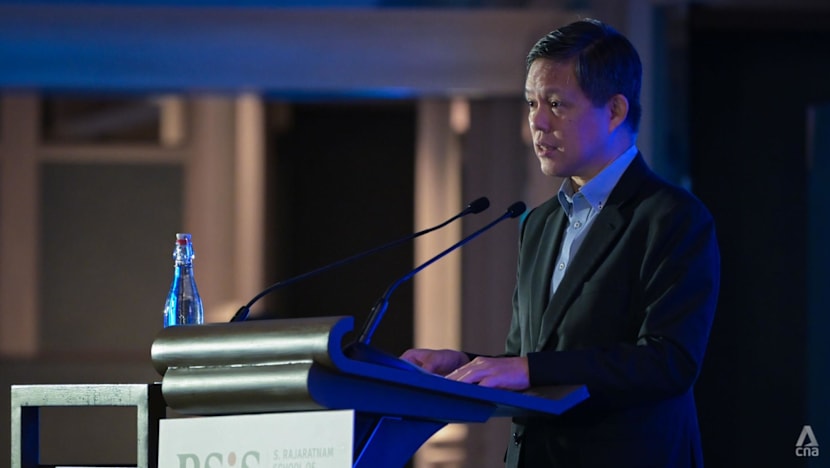
SINGAPORE: Where technology crosses borders, think tanks like the S Rajaratnam School of International Studies (RSIS) can help develop common ground that reduces the risk of miscalculation, Defence Minister Chan Chun Sing said on Tuesday (Sep 22).
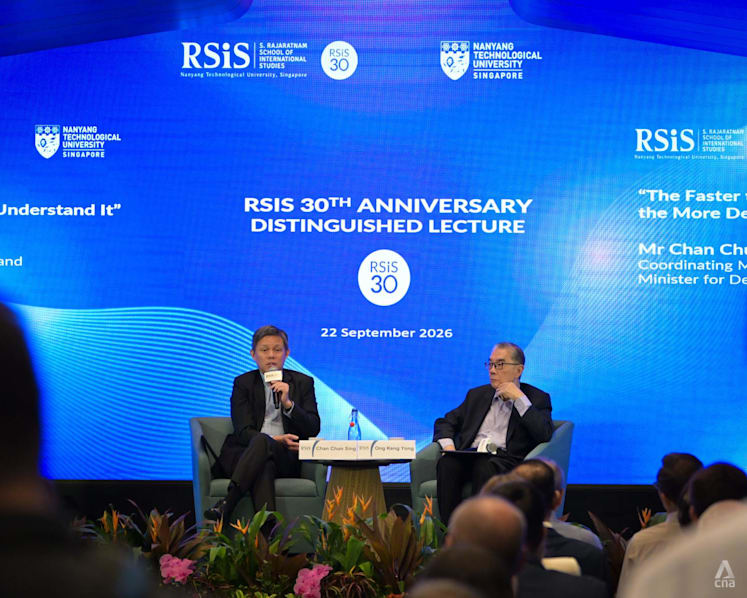
Delivering a lecture to commemorate 30 years of the Singapore-based graduate school that focuses on strategic studies and security affairs, Mr Chan said RSIS must help Singapore think through both the opportunities and the risks as a small state.
He noted how the world has changed over the past 30 years. Rivalry between the United States and China now cuts across trade, technology, supply chains and ideology, while cyberspace has "erased the protection of physical distance", he said.
"In Singapore, we can never wish away our geography, nor can we opt out of geopolitics," said Mr Chan, who is also coordinating minister for public services.
"However, what we can do, and what we must do, is to understand the world more deeply than others would expect a small state to – and more importantly, to use that understanding to stay relevant, to stay connected, and to stay ahead."
REINVENT TO STAY RELEVANT
While RSIS is celebrating its 30th anniversary, the task is "never done" and it cannot do more of the same, said Mr Chan.
"We have to constantly reinvent ourselves ahead of the times to stay relevant. We must always strive to stay one step ahead of all the changes," he said.
"To interpret ongoing change must be a 101 competency for all of us that is necessary, but not sufficient."
He highlighted that RSIS' mission is to help Singapore stay one step ahead, having built up deep connections and understanding of the personalities, institutions and deep forces shaping the world.
It can also help to interpret and project the implications for Singapore ahead of time.
"The shifts we are going through are not just structural; they are also personal. The decisions that will shape our region are being made by specific leaders with specific worldviews, specific insecurities, and specific ambitions," said the defence minister.
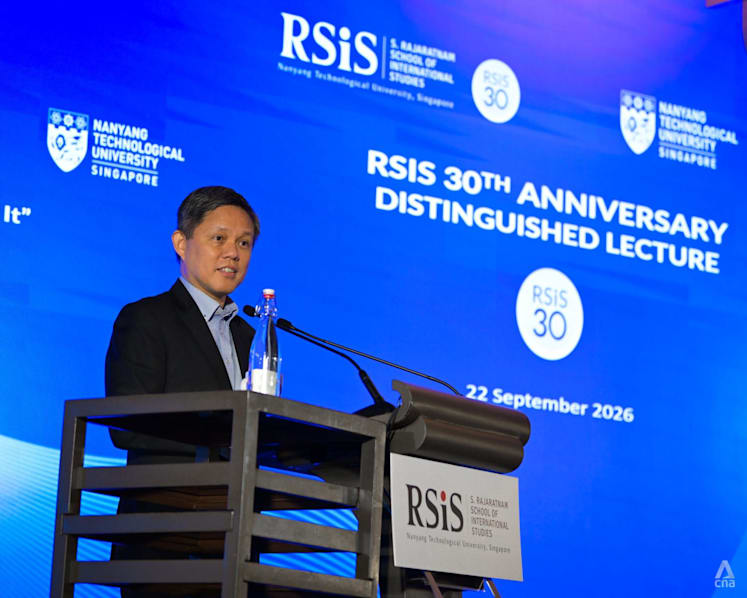
Understanding geopolitics today means understanding the Chinese conception of national rejuvenation and what that means, or how China exercises power in the region and beyond, he said.
It also means understanding the personalities, institutional pressures and domestic politics that shape American foreign and domestic policies, not just under the current administration but across different administrations, Mr Chan said.
It also means understanding what Indonesia is becoming and what that means for the Association of Southeast Asian Nations (ASEAN) and everyone else.
"The Indonesia of the 1990s is a very different Indonesia from that of the 2020s. Over the last 30 years, Indonesia has changed far more than it did in the previous 30 years, by any measure.
"Likewise, the domestic dynamics in Malaysia are also shifting fast. If we look at the last 30 years – from 1996 to 2026 – and compare that to the previous 30 years, from 1966 to 1996, you would see what I mean: the forces shaping and reshaping the societies around us and around the world have changed much more, much faster, and in far more unpredictable ways," he said.
"This is the kind of deep, granular human understanding that cannot be assembled overnight when a crisis hits. It requires persistent research, language skills, long-cultivated relationships, and genuine intellectual immersion in other societies."
In his view, RSIS must always aspire to be the institution that builds and sustains this capability for Singapore, and this will continue to be why the government will support the think tank's growth and development, said Mr Chan.
SINGAPORE'S VALUE
On relationships with the US and China, Singapore's ability to remain relevant to both is never guaranteed, but one that has to be earned continuously, he added.
"Singapore’s value in the room depended entirely on the quality of our understanding and the credibility of our analysis. RSIS, just as Singapore, must keep earning that credibility," he said.
"As the perspectives and needs of the US and China shift, we must constantly challenge ourselves to come up with new propositions that can continue to entrench our relevance. We cannot be the proverbial one-trick pony."
Beyond the two nations, Singapore must also not take its relationships with the closest neighbours, Malaysia and Indonesia, for granted, he said, adding that these were not relationships that can be managed on "autopilot".
They require the same depth of understanding of history, political culture, and the deep forces shaping their societies – from their economic structures to their demographics, to the relationships between their different states and institutions within their own polities, he said.
During a question-and-answer session, Mr Chan was asked how Singapore should decide where it can remain open to both US and China.
To this, the minister said he was "not a fan of binary thinking" and added that it was not correct to say Singapore does not choose sides.
"We always choose Singapore's side. We start everything from our national interest. It's not something profound that I say today. Every country does it. Every country does that every day. Big countries, small countries - we always have to choose our own sides, which is what is in our best interest," said Mr Chan.
Singapore has always been an open platform for collaboration due to trust, and others do not see the country as "threatening anybody", he said.
"It is whether people trust you to be an honest broker. You can do all that you want, but if you have a vested interest and (you) don't bring value to the table, then nobody is going to trust you," he said, adding this was how Singapore organised itself to project its relevance and value.
"I always say this: if you are not successful, you are not relevant, you have to choose sides. Once you choose sides, you will not be relevant as well.
"If Singapore is not a successful country, nobody will very much listen to us, and we don't have to look very far in history ... But to survive, to thrive, you must be successful, you must be trusted. You must be an open platform that seeks to integrate rather than divide."
TECHNOLOGY AND SECURITY
Technology is also redrawing the boundaries of what is possible in security and warfare, said Mr Chan.
Artificial intelligence, autonomous systems and drones are changing the way conflicts are fought and power is projected, he said.
He added that commercial technologies have given smaller states and non-state actors capabilities that once required enormous resources.
"Conflicts today do not begin only when shots are fired; they begin long before – in cyberspace, in the information environment, in the grey zones below the threshold of traditional war," Mr Chan said.
RSIS must help Singapore think through both the opportunities and the risks as a small state, looking at not just what the new technologies can do but also what they mean for how the country operates and makes decisions.
"Where technologies cross borders, RSIS can help develop the common ground and shared expectations of responsible behaviour that reduces the risk of miscalculation.
"Because in the end, this is what it is all about - sound judgement about the capabilities and intentions of others," he said.
Capabilities are easier to see and assess based on information gathered from various sources, but intentions are hard, and this is where RSIS earns its keep, he said.
Poor understanding of the other side and of oneself increases the risk of miscalculation, said Mr Chan, adding that any miscalculation in this part of the world would have "consequences that none of us want to contemplate".
MIDDLE EAST CONFLICT
Mr Chan was posed questions about the ongoing Middle East conflict, including on his forecast on when the war would end.
To this, he said: "We all hope that we can all say after the Middle East conflict. But the last time we checked, for the last 2,000 years, there was no 'after the Middle East conflict'."
An important lesson for this part of the world came down to two fundamental factors: accepting each other's right to exist, and building a common future by working together, he said.
"We pray for peace in the Middle East every day, but I would say that we need very strong political leadership for these two fundamentals to happen - the right for everyone to exist, and therefore we can coexist; the aspiration that we can all have a better future … Otherwise, it's never-ending," said Mr Chan.
He was also asked what Singapore could do in the Middle East conflict.
Reiterating that Singapore will always provide a platform for people who are willing to have a dialogue and has tried behind-the-scenes to encourage parties to come together, he said Singapore "can't bring people who don't want to be together, together".
"It's very difficult to go, and rather it's impossible, to tell people to turn up and dialogue when people do not or have not crossed that fundamental hurdle to say that we want to look forward to something better together," Mr Chan said.
"If any one side does not see that as something that they are prepared to do, then it's quite impossible for Singapore or RSIS to do anything."
KioskNews shows a cleaned-up reading view extracted from the publisher’s page — the original always lives on their site, not ours.