TRC Roulette : Mbeki’s Radio Freedom broadcast on eve of Cradock Four funeral played at Khampepe inquiry
The four UDF activists, we now know, were abducted by members of the security police on 27 June 1985, assaulted, stabbed, strangled with telephone wire and shot before their bodies were burned an mutilated.
In 1993, at the reopened inquest, Judge Neville Zietsman found that security forces were responsible for the deaths of the Cradock Four, although no individual was named. All of the security police members have since died.
The longest thread, however, tracks back to a high-level meeting of the State Security Council (SCC) that took place in March 1984 and was attended by 12 Cabinet ministers, including FW de Klerk, then minister of internal affairs, and Barend du Plessis, then head of education and training.
This meeting was allegedly to discuss strategies to deal with “terrorists” in what was then South West Africa. Also on the agenda was the matter of how to “remove” activists who were becoming a growing threat in Cradock to the apartheid regime. Fifteen months later, the four men were dead.
In March this year Du Plessis testified at the reopened inquest into the Cradock Four and agreed that the order sent to the State Security Council requesting the “permanent removal from society” of the Cradock Four activists implied their murder. However, he claimed the operational order was “misunderstood” or misinterpreted outside his authorisation.

The cover-up
Six security policemen applied for and were denied amnesty for the murders – Nick Janse van Rensburg, Johan van Zyl, Eric Alexander Taylor, Hermanus Barend du Plessis, Harold Snyman and Gerhardus Lotz.
At the reopened 2026 inquest into the murder of the Cradock Four, a haggard former Vlakplaas commander, Eugene De Kock, told the hearing that the murder had been planned independently by the then Port Elizabeth Security Branch and that the activists had not been considered a threat.
De Kock, who served 20 years behind bars for multiple murders, has denied any involvement in the planning and execution of the murder the Cradock Four, and claimed he became “an accessory after the fact” when members of the police Security Branch tried had tried to conceal the gruesome killings.

The charge against Mbeki
It is no secret that Lukhanyo Calata, son of Fort, and the face of the families of victims of apartheid abuses, has accused Mbeki of and former president Jacob Zuma of political interference in post-TRC matters.
In voluminous court papers it is alleged that Mbeki’s government created a “back door” amnesty for human rights abuse perpetrators who had not applied for amnesty. Mbeki and Zuma have denied this.
Perhaps the 84-year-old Mbeki’s decision to include a clip of the Radio Freedom broadcast at this commission could be read as an attempt to assuage the fallen activist’s son who has fought for years for justice for all those whose deaths and disappearances remained unresolved.
Young Mbeki
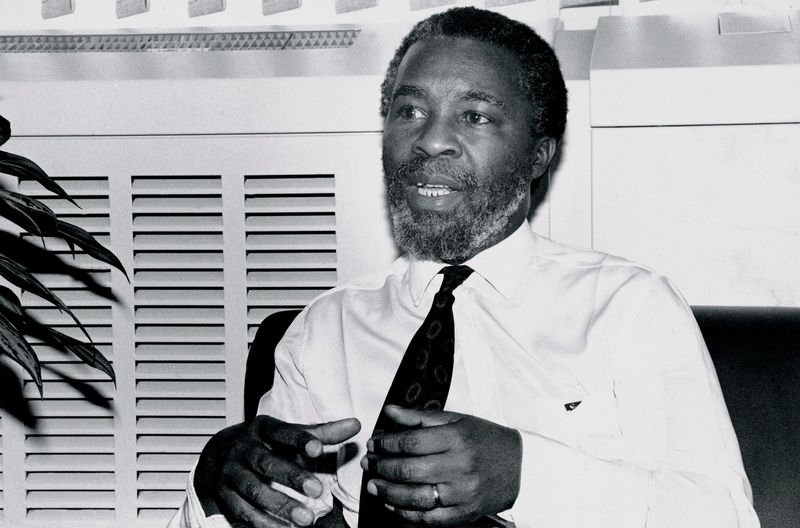
When the then 43-year-old Mbeki broadcast the speech, nothing was known about the ruthless killers. Sentiment in the country had boiled over and it would soon peak in 1986, leading to 1990 when Nelson Mandela was released.
A crowd of 60,000 people who had travelled from across the country to Lingelihle in the Eastern Cape included Allan Boesak, Victoria Mxenge and Beyers Naudé, with a speech written by an exiled Oliver Tambo read out to the crowd.
The day before, Mbeki, who was the director of the ANC’s Department of Information and Publicity, broadcast underground from Lusaka in Zambia.
He began his broadcast: “Compatriots, tomorrow at Cradock in the Eastern Cape we shall be burying our leaders. Today, their names stand at the head of the list of heroic martyrs whom the enemy has murdered in cold blood as part of its continuing war of repression against the people.
“Today, their names are on our lips, their memory in our hearts and minds, the spears they dropped as they fell in our hands. Matthew Goniwe, Fort Calata, Sparrow Mkonto, Sicelo Mhlauli – with raised spears pointed at the heart of the enemy who took your lives, we salute you!”
Mbeki continued that the activists would be laid to rest “without weeping” as “you are warriors of the people’s cause, you who, even in your death, continue the combat for the liberation of our country. We shall say a farewell of war, sound the drums that summon the living to arms, and pin your glorious names on the banners of our combat detachments.”
Dripping in blood
The young Mbeki said the government had embarked on “a new kind of war” in kidnapping and murdering leaders and activists.
“Even as we lay to rest our comrades in Cradock, we cannot forget those who were murdered in Tsakane, Duduza and KwaThema in the East Rand, heroes of the people such as Lucky Mogodi, Samuel Mashiane and Solomon Mashobane.”
He noted that in that year more than 10,000 people had been detained without charge, and that 40 ANC leaders were facing charges of treason in courts in the then Natal and Transvaal.
He singled out then deputy minister of foreign affairs, Louis Nel, who described the murder of the leaders as “tragic and barbaric” and promised to bring the killers to justice. Nel had suggested that the death of the activists was because of factional political battles in Cradock
“We charge Louis Nel and his seniors, PW Botha, Magnus Malan, Pik Botha, [Louis] Le Grange and others of murder. We accuse them of planned and premeditated assassination of our leaders. We say that their hands are dripping with the blood of our people. We reject their offer of assistance.”
Mbeki told clandestine listeners that “An unbridgeable canyon separates truth and the apartheid regime. Between justice and the Pretoria regime, there is no meeting point.”
Thirty years later
The charges that he, alongside Mandela and other ANC leadership had colluded with former apartheid generals to shield them from prosecution when the time came for them to confess, must have stung Mbeki deeply. The playing of the Radio Freedom clip captures the mammoth task that they faces as the ANC leadership once hostilities had ceased. DM
KioskNews shows a cleaned-up reading view extracted from the publisher’s page — the original always lives on their site, not ours.