The many lives of Banarasi weaves
What two exhibitions charting the profusion of Banarsi textiles teach us: there is no singular Banarasi; no one motif, technique, yarn or price

Last week, Bharat Kala Bhavan, a 106-year-old museum (which came to be housed at Banaras Hindu University in 1950), opened a textile exhibition as part of the first edition of the month-long Banaras Biennale. Curator Pramod Kumar KG brought together more than 85 objects for public viewing in Ek Dhaaga, Ek Duniya: Silk, Zari and the Light of Kashi. The exhibition included pieces from the museum’s own textile collection, gathered over a century, as well as contemporary creations from the market — from textiles woven in the city by local makers to pieces that renowned designers have had made here.
There are gold Baroque silks by national award-winning master weaver Hasin Mohammed, heirloom Banarasis, rare meenakari textiles, recreations of temple friezes, creations from textile expert Rahul Jain’s ASHA workshop in Varanasi, Gyaser brocades, carpets, and an installation by zari artisan Shyam Sundar. There are fabrics in metallic yarn and garments stitched almost entirely on the loom by Sanjay Garg for the upmarket label Raw Mango and by designer Payal Khandwala.
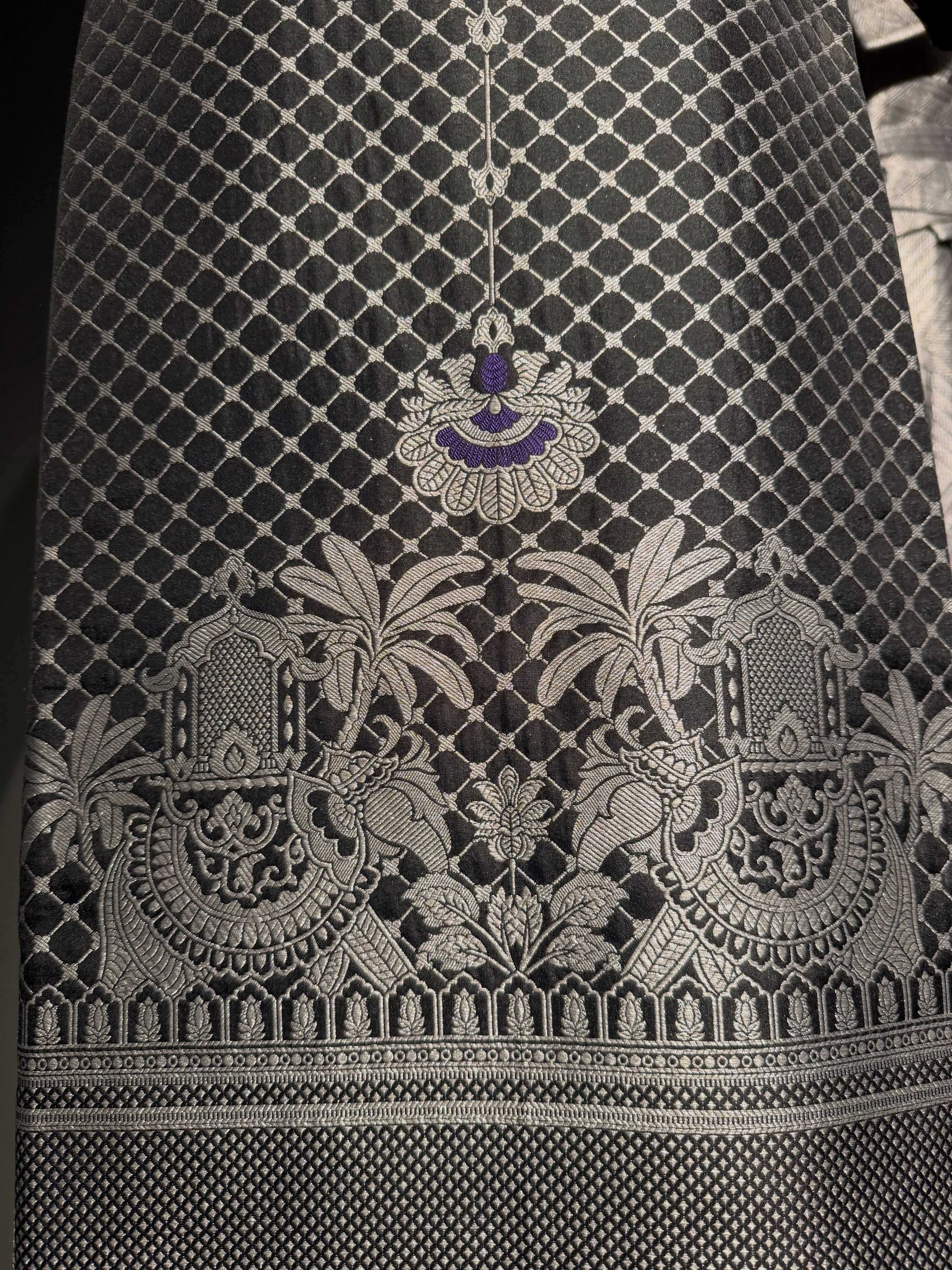
There are innovations on display, too, like a Ladakh-meets-Banaras piece by the Ladakh-based label Namza Couture, which uses woven Ladakh wool, as well as an archival design from Bharat Shah of S&D Silks, the parent company of the label Ekaya Banaras, with Malayalam script woven into it.
In Delhi’s Sarojini Nagar market, a Banarasi sari sells for ₹500. It is woven on a powerloom in polyester, with powder zari or synthetic yarn. In Varanasi, similar saris go for ₹400. At the other end of the market for Banarasis is a rangkat lehenga by the duo Swati and Sunaina, woven by master weaver Saroj Chauhan. “Only two were made, both bespoke,” Swati Agarwal said. The price is on request. Rangkat saris thrive in retail, museums and personal wardrobes, but a lehenga demands a specialised intervention on the loom.
There is no single Banarasi: no one motif, technique, yarn or price. This profusion runs from the cheapest tier of the market to its most inventive work, where the loom is reinvented to make what it never has before.
“There is no such thing as Banarasi style. That’s a fallacy. Anything can be made in Banaras,” said Pramod.
Another show held earlier this month made the same case. Aadyam Handwoven, a handloom label that works with artisan communities to create contemporary textiles, previewed 21 saris for a select audience at the Peshwa Haveli on Bala Ghat, recently restored by INTACH. Hindustani classical singer Vidya Shah sang Begum Akhtar and Noorjehan ghazals while wearing a sindoor-red Banarasi sari. Aadyam Handwoven curator and lead Manish Saksena linked architectural heritage and music to weaving.
“The exhibition links Banaras of the past with the present to reflect continuity and the influence of architectural patterns on textiles,” he said. The saris on display traced Maratha influences alongside the legacy of trade and travel on the Silk Route: Chinese motifs and European florals. There were brocades, tissues and mashrus, and a sari woven in brown cotton with zari. The haveli opens to Biennale visitors on November 29. At both shows, Kashi’s weavers were credited by name and celebrated for their skill.
But the profusion of the Banarasi repertoire is not the same as a healthy weaving ecosystem. The handlooms behind the surge are fewer than this visibility suggests.
Old Looms, New Weaves
A few Aadyam upholstery fabrics are on view at Ek Dhaaga, Ek Duniya. These pieces are made on Gyaser looms, which are narrow, traditionally about 23 inches wide. They once wove heavy brocades for Buddhist monasteries; they are now used to make home fabrics. Then there is an Obeetee woollen carpet, designed by Abraham & Thakore, woven in Varanasi. These pieces remind us that Banaras is a loom economy, not only a sari economy.
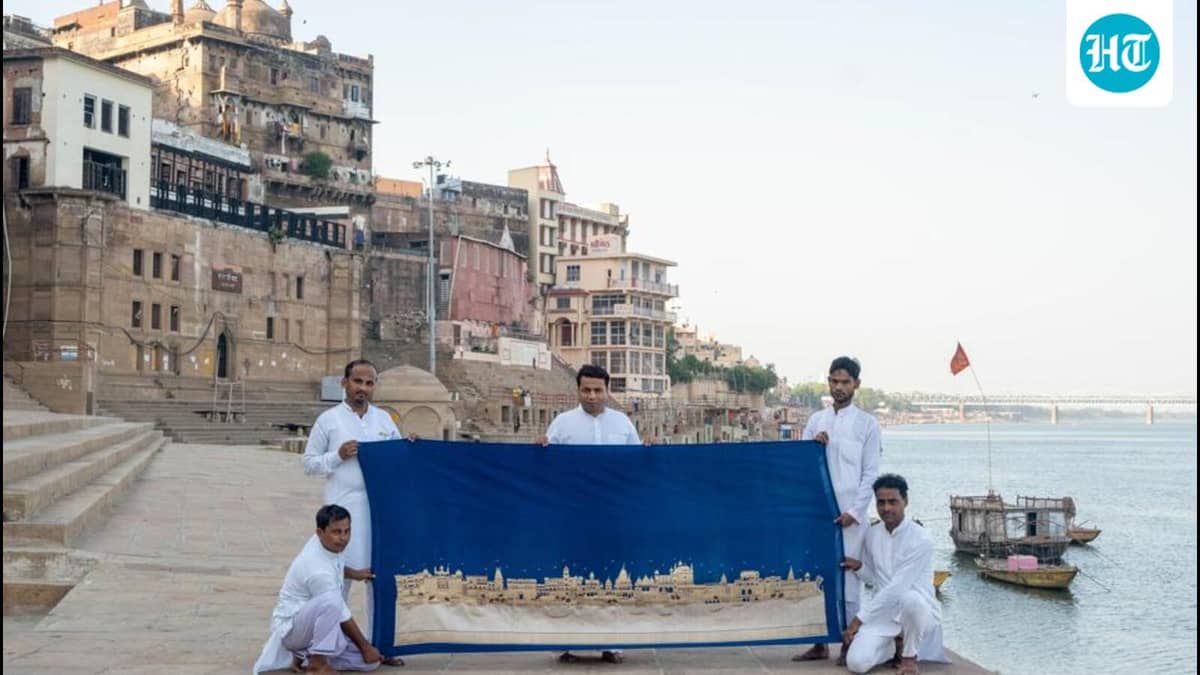
Kashi’s old gaddidars (cloth traders) sell everything: polyesters and synthetics, pure silks from handlooms and powerlooms, and blends. Above them sit premium brands rooted in Banarasi weaving, such as Tilfi Banaras, Shanti Banaras and Ekaya, and retailers such as Swadesh, each making an effort to name its weavers and techniques. Tilfi’s hand-woven panel of a Kashi ghat hangs as an artwork in the new Parliament building and also appears on the brand’s saris. A house signature, it is represented at the BKB exhibition. Meanwhile, Ekaya founder Palak Shah has fashionised the Banarasi through pre-stitched silks and designer collaborations. The latest, with Ashdeen Lilaowala, weaves the Parsi gara’s cheena-cheeni figures into Banarasi silk. The saris sold out on pre-order, says Lilaowala.
Further along the spectrum, each limited-edition Swati & Sunaina sari in real gold or silver zari comes boxed with a certificate. “Every piece is unique and comes with a provenance; the weaver’s name, the quantity of zari, the technique and the days taken to weave it,” said Swati Agarwal.
The Contemporary Banarasi
In Banaras, the contemporary does not always move forward. At ASHA, the workshop that Padma Bhushan awardee and textile engineer Rahul Jain set up in 1993, it moves back two thousand years, about a centimetre a day. Three men work a single draw-loom, indulging in a practice that is two millennia old and whose last vestiges survived in Varanasi and Iran. The cloth is woven upside down, and no one sees it whole for three months. There are now five such looms at ASHA, where Jain is training younger weavers to work them by hand. He calls the results “impressions”, not reproductions, of silks that survive mostly in Mughal murals and miniatures. When ASHA’s work was shown at Delhi’s National Museum in 2019 as Pra-Kashi, also curated by Pramod Kumar KG, Jain said it was “not a craft, a textile, or a product.”
Sanjay Garg of Raw Mango brings the wearer into it. “How can we completely forget the wearer when we use the word contemporary?” he asked. Modernity, he argues, is “a functional dynamic between the maker and the wearer.” In Children of the Night, his 2023 collection, he showed garments welded rather than tailored, all made in Banaras. Saris and blouses came off the loom together, with other garments woven with Lycra, a considered answer to Western pattern-making. Gota became cloth, not trim; sequins were woven in, not sewn on.
Garg has also changed traditional Banarasi patterns. In Sher Bagh (2021), he wove the hunter out of the famous shikargah (a forest hunt) story. He reimagined the power imbalance between human and animal, making wool feel like silk, turning a pangolin’s hide into a pattern, and placing animals in charge of the forest.
Rajesh Pratap Singh, whose fabrics woven with stainless steel and copper form part of the BKB exhibition, talks about his contribution to the Banaras weaving vocabulary rather than to labels like ‘contemporary’ or ‘minimalist’. His menswear jackets keep the brocade and drop the zari, and his William Morris jungles pass through the Banaras loom, more “rock and roll” than shikargah, he said.
“I am not only looking at handwoven creations or pure fabrics,” said Singh. “To me, in experimentation, polyester matters too.”
What the Range Hides
Banarasi textiles now stretch from one end of India’s market to the other, across yarns, looms and prices that have nothing in common. The gap is not just in price. It is the difference between a mill and a pair of hands, between polyester and silk, between skill and scale, between a sari made in hours and one that takes eight months. On Instagram and in retail, the handwoven Banarasi appears to lead the surge. In Varanasi, it does not.
This is where Jain’s caution comes in.
“Thousands of looms in Varanasi have shut down. Many handloom weavers work at the power-loom and my impression is that hand-brocaded textiles are on a decline.” Fashion, he feels, is too capricious to employ artisans sustainably, and only a few commendable places hold the craftsmanship in place. He does not dismiss the powerloom, which keeps the rest of the industry going. But the “glitter value surge of the Banarasi textile must be separated from the compelling qualitative shift in what is being made.”

Get Latest News, breaking headlines, and top India News, and today real-time updates from across the nation. Stay informed on politics, government policies, crime, Today Weather, and major developments on Hindustan Times
KioskNews shows a cleaned-up reading view extracted from the publisher’s page — the original always lives on their site, not ours.