Appeals court upholds conviction for Yoon that could put PPP on hook for 39.7B won in campaign expenses
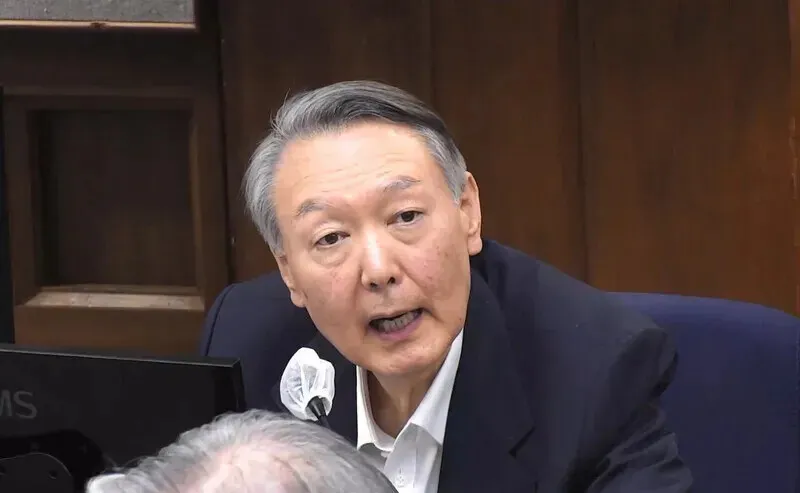
Former President Yoon Suk-yeol. (courtesy Seoul Central District Court)
An appeals court on Wednesday upheld former President Yoon Suk-yeol’s conviction for spreading false information during the 2022 presidential race, keeping in place a sentence that would force the People Power Party to repay 39.7 billion won (US$30 million) in state-reimbursed campaign expenses if it is finalized by the Supreme Court.
At a 2 pm hearing, the Seoul High Court rejected Yoon’s appeal and left intact the lower court’s sentence of 18 months in prison, suspended for three years.
Under the Public Official Election Act, a candidate’s election is invalidated when they receive a finalized sentence of a fine of 1 million won or more for an election crime, and the party that nominated them must return any campaign costs it was reimbursed for. As a suspended prison term exceeds that threshold, the PPP would have to pay back the 39.7 billion won it received from the National Election Commission after the 2022 election if the ruling stands.
Yoon, then the PPP’s presidential nominee, was indicted for claiming in an interview at the launch of a Buddhist leaders forum on Jan. 17, 2022, that he had been introduced to Jeon Seong-bae, a shaman who goes by the name Geonjin, by a party official, and that he had never met Jeon together with his wife, Kim Keon-hee.
Yoon was also accused of spreading false information by saying during a debate in December 2021 hosted by the Kwanhun Club that during his time as a prosecutor, he had never introduced a certain lawyer to the former head of the Yongsan tax office who was under investigation by police. Such an introduction would have violated legal standards of conduct for jurists.
In July, the Seoul Central District Court found Yoon guilty on all charges and handed him an 18-month sentence.
“The crime is very grave, as a candidate spread false information during a presidential election about matters in which voters had an exceptionally high level of interest,” the court said at the time.
The special counsel team led by Min Joung-kie, which brought the charges, had sought a two-year prison term.
On appeal, Yoon again argued for his acquittal, saying the remarks in question could not be considered false.
“The question lasted two seconds, and the answer one or two seconds,” Yoon said in his final statement to the court. “I question whether it is sound judgment to interpret that exchange this way, call it spreading false information and even talk about invalidating an election.” He accused the special counsel of distorting the context and wording of his remarks.
The special counsel team, for its part, asked the appeals court at its final hearing last month to impose the same sentence the lower court had handed down.
“The presidential election at the time was a razor-thin race decided by the narrowest margin in [South Korea’s] constitutional history,” the team said. “Considering the trends in approval ratings, the outcome of the election and the gap in vote share, it is reasonable to conclude that the offense in this case affected the result of the election.”
KioskNews shows a cleaned-up reading view extracted from the publisher’s page — the original always lives on their site, not ours.