Risk of dementia higher for early retirees: research
ADVICE: Retirees should maintain interpersonal relationships, social participation and cognitive activities, said the National Health Research Institutes
By Lo Pi and Esme Yeh / Staff reporter, with staff writer


Early retirement might increase the risks of dementia and alcoholism, research from the National Health Research Institutes showed.
The research — conducted by National Center for Geriatrics and Welfare Research attending physician Wu Chi-shin (吳其炘) in collaboration with a team from the Center for Neuropsychiatric Research — tracked more than 2.4 million Taiwanese aged between 45 and 64 in a long-term study, comparing early retirees and those who continued working.
The risks were higher for private-sector employees and people with lower incomes, while government employees and those with higher incomes did not have significantly high risks, likely because they had better financial security and social resources, the study showed.
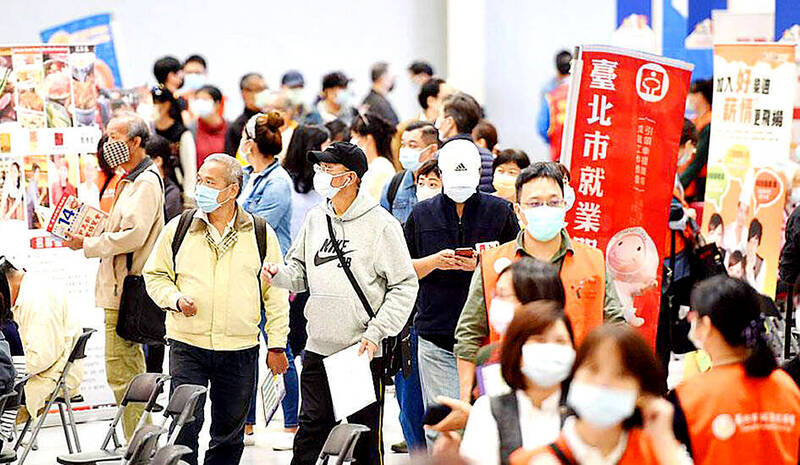
Jobseekers visit an employment fair for middle-aged and elderly people in Taipei in an undated photograph.
Photo: Liu Hsin-de, Taipei Times
Previous studies had different conclusions regarding the impact of retirement on mental or cognitive health, Wu said.
Some showed that retirement would raise the risks of dementia or depression, while others said that workless life helps reduce stress and improve mental health, he said.
The problem lies in the difficulties in identifying the causal links, Wu said.
Some might have retired early due to cognitive or mental issues that had yet to be diagnosed, rather than developing illnesses after their retirement, he said.
The study excluded people who had onset of illnesses within five years after retirement, to prevent misinterpreting “early retirement caused by existing illness” as “early retirement that caused illness,” Wu said.
Results showed that early retirement correlated to dementia and alcohol use disorders, he said.
The former might be related to decreases in cognitive stimuli and social interactions from work, while the latter might result from a change in life roles or priorities, Wu said, adding that increased alcohol intake could be a coping strategy for loneliness and stress.
However, the study only revealed risk correlation, and there is no evidence that early retirement directly caused the illnesses, he said.
There was also no significant correlation between early retirement and illnesses such as depression, anxiety and sleep disorders, the research found.
Retirement is not just a change of lifestyle, and retirees need health management and social support, the foundation said.
Early retirees are advised to maintain interpersonal relationships, social participation and cognitive activities, and avoid using alcohol to cope with loneliness or stress, it said.
KioskNews shows a cleaned-up reading view extracted from the publisher’s page — the original always lives on their site, not ours.